


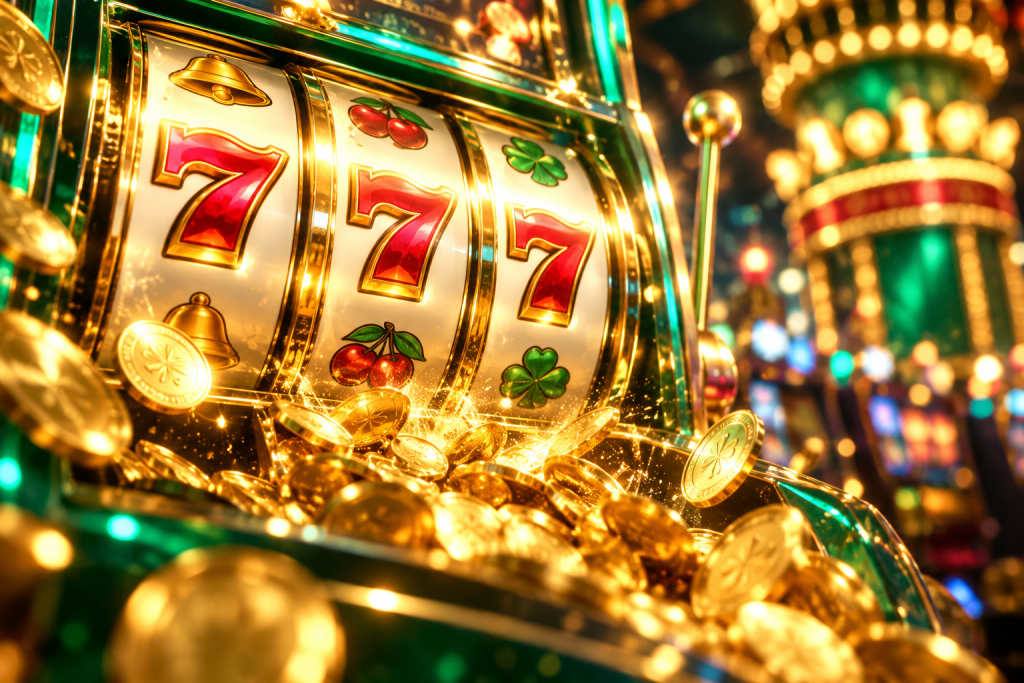
The jackpot is a fixed prize, not a growing pool
When you sit down at a Jackpot Jump style game, the most useful thing to know is that the top prize does not behave like a progressive. The jackpot is a fixed amount printed in the game's paytable. Nothing you or any other player does grows it. It does not get closer to paying because it has not hit recently, and it does not become more likely because someone else just missed it. Each spin is an independent event generated by the game's random number generator, the same as any other slot.
The name describes a mechanic: the jackpot tier is the highest paying combination on the reels, and winning it generally requires a specific symbol arrangement at the stake shown in the paytable. Some versions require a maximum-stake bet to qualify for the top tier. That requirement is not a secret trick; it is stated in the game information panel. If you are playing below the qualifying stake, you are not eligible for the jackpot at all, no matter what lands.
Where the jackpot money comes from
A fixed jackpot is not a separate pool funded by a visible meter. It is simply the largest payout in the game's return structure. The game's theoretical return to player, or RTP, is a statistical average across every possible outcome, including the jackpot. The house edge is the complement of that RTP for the same game under the same rules. If a game's published RTP is a given percentage, the house edge is what remains when you subtract that percentage from one hundred. Both figures are long-run averages, not promises about your session.
In a progressive jackpot, a share of each qualifying wager is diverted into a growing prize, which means the base game return is slightly lower than a comparable fixed-jackpot game. A fixed-jackpot game does not divert a contribution in that way. The jackpot is paid out of the same return structure as every other prize. That does not make the game better or worse; it changes how the top prize accumulates, which is to say it does not accumulate at all.
Why short sessions look nothing like the RTP
RTP is a statement about an enormous number of spins. In a single session of a few hundred spins, your actual return will almost always be far from the published figure, in either direction. Volatility describes how payouts are distributed over time. A high-volatility game pays rarely but can pay large amounts. A low-volatility game pays more often but in smaller amounts. Volatility does not change the RTP. Two games can have the same theoretical return and feel completely different, because one clusters its payouts and the other spreads them out.
What changes your total exposure is how much you wager in total, not whether you win or lose on any individual spin. Total wager is stake multiplied by number of spins. If you play faster, you make more spins per hour. If you raise your stake, each spin costs more. Both decisions increase the amount of money the house edge is applied to. The edge does not get bigger, but the expected loss in absolute terms does, because you are putting more money through the machine.
What a betting pattern can and cannot do
Progression systems are popular because they feel like control. The most common is doubling after a loss, on the theory that a win will eventually recover everything. The arithmetic works in the sense that a win at the doubled stake returns the lost amount plus one unit. What it does not do is change the probability of the next spin. The game does not know you lost. The random number generator does not adjust its output to end a losing streak. Every spin carries the same built-in edge as the one before it.
What a progression does is redistribute your results. It turns many small outcomes into a smaller number of larger outcomes. Most of the time you win back your losses in small increments. Occasionally you hit a losing streak long enough that the required stake exceeds your bankroll or the table maximum, and the system collapses. The average expected loss across all those scenarios is the same as flat betting the same total amount. You have not removed the edge; you have changed the shape of the variance.
| What changes | What stays fixed |
|---|---|
| Your session result in the short run | The game's RTP over a very large number of spins |
| How often you win (volatility) | The house edge on each spin |
| Total wagered, via stake and spin speed | The probability of any single spin |
| Whether you qualify for the jackpot, via stake | The jackpot amount itself |
| The distribution of wins and losses under a progression | The expected loss from the same total wager |
Reading the game information panel before you play
Every slot carries a game information or help screen, and that screen is where the numbers that matter to you live. The paytable shows the jackpot amount, the symbol combination that triggers it, and whether a maximum-stake bet is required. The RTP is usually published there or on the operator's game page. The volatility rating, where shown, is a description of payout frequency, not a promise about your next spin. Read all three together. A game with a high top prize and high volatility will spend long stretches paying little before a rare large win, if one comes at all.
None of this tells you when to stop or how much to wager. Those are decisions only you can make, and they are the only decisions that genuinely change your session outcome in a way you control. Stake, speed, session length, and the point at which you walk away are all yours. The jackpot is not.
FAQ
Does betting maximum increase my chance of hitting the Jackpot Jump jackpot?
It does not change the probability of the symbols landing. What it can change is whether you are eligible for the top prize at all. Some fixed-jackpot games only award the jackpot tier to spins at the qualifying stake, which is stated in the paytable. A maximum bet can also mean a larger payout for the same combination, because prizes are typically expressed as multiples of the stake. But the reels do not behave differently because you wagered more.
Can a slot be due to pay the jackpot after a long dry spell?
No. Each spin is generated independently by the random number generator. The game has no memory of previous spins, and no counter that builds toward a payout. A long losing streak does not make the next spin more likely to win, and a recent jackpot does not make another one less likely. This is the single most important thing to understand about any slot, fixed or progressive.
Is there a strategy that improves my odds on a fixed-jackpot slot?
There is no strategy that changes the house edge on a slot spin. The only choices you control are stake, number of spins, and when you stop. Choosing a game with a lower published house edge reduces your expected loss per unit wagered, but it does not create an advantage. Choosing a stake you can afford and a session length you can walk away from is bankroll management, not a winning method.
If gambling stops being entertainment and starts feeling like a way to recover money, step away and talk to someone. The helpline printed in the footer below is available for exactly that.
Play responsibly
Gambling should be treated as paid entertainment, never as a way to earn income or recover losses. 1-800-MY-RESET (1-800-697-3738)
18+ or 21+ depending on where you are; follow the minimum age that applies to you.
This article is general information about how these mechanics work. It is not legal advice and not a recommendation to gamble or to use any particular operator. Availability and legality differ by jurisdiction — check the rules that apply where you are.