


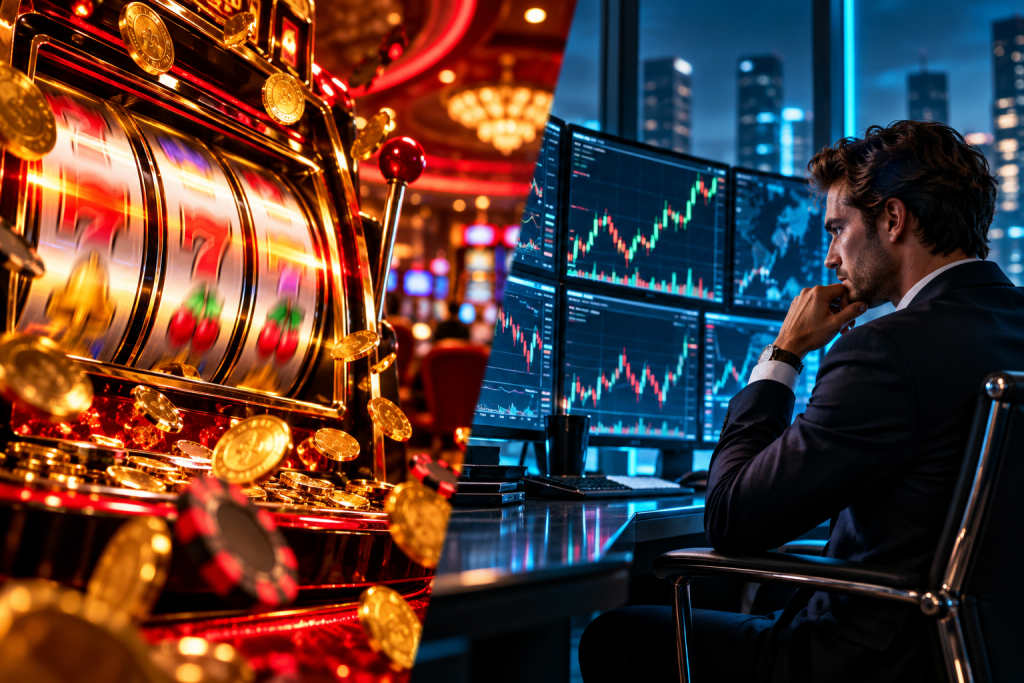
The question usually starts from a shared feeling
Someone sits down at a slot machine, watches reels spin, wins a little, loses a little, and thinks: this feels like watching a stock chart. Both involve money going in, numbers moving around, and outcomes that are not fully under your control. The comparison is common enough that it is worth taking apart carefully, because the two activities are built on different engines even when the surface feels similar.
A slot machine is a game of chance with a fixed mathematical structure. A trade is a transfer of ownership in something that exists outside the trade itself. The confusion comes from the middle part: both produce short-term results that swing around an average, and both can make a person feel that skill or timing is doing more work than it is.
What a slot machine is doing underneath
A slot machine runs on a random number generator. On every spin, the generator selects an outcome from a large set of possibilities, and the machine pays according to a paytable that was fixed before the spin began. Nothing about the previous spin changes the next one. A machine that has paid nothing for an hour is not more likely to pay on the next spin, and a machine that just paid a jackpot is not less likely to pay again.
The long-run behaviour of a slot machine is described by its return to player percentage, or RTP. RTP is a theoretical percentage of total wagered money a game returns to players over a very large number of spins or hands. It is a long-run statistical average, not a per-session guarantee. The house edge is the mathematical advantage the operator holds on a given game, expressed as a percentage of each wager. House edge and RTP are complements: they sum to 100% for the same game.
Volatility describes how payouts are distributed over time. High volatility means rarer but larger payouts; low volatility means more frequent but smaller ones. Volatility does not change a game's RTP. Two machines can have the same RTP and feel completely different, because one pays small amounts often and the other pays large amounts rarely.
What a trade is doing underneath
A trade is a purchase or sale of an asset: a share of a company, a unit of a fund, a commodity, a currency. The asset has a price that changes because other people are buying and selling it, and because the underlying thing has some economic reality. A company earns revenue. A currency responds to interest rates and trade flows. A commodity responds to supply and demand.
This does not mean trading is a reliable way to make money. Prices move for reasons that are hard to predict, and many people lose money trading. But the structure is different from a slot machine. A slot machine has a fixed payout schedule and a built-in edge that stays with the house on every bet. A trade has no fixed payout schedule. The person on the other side of a trade is not a house taking a mathematical cut on a game; it is another market participant with their own view of the asset's value.
The expected value of a trade is not fixed in the way a slot machine's is. A slot machine's RTP is set by its design. A trade's outcome depends on price movement, which no one controls and no one can guarantee. The comparison breaks down at the level of what determines the result.
Where the surface similarities come from
The feeling of similarity is real, and it comes from a few places. Both activities involve repeated decisions with uncertain outcomes. Both produce sequences of wins and losses that can be tracked. Both can trigger the same emotional responses: excitement after a win, frustration after a loss, the urge to keep going after a bad run.
Both also involve variance. Variance is the short-term spread of outcomes around the long-run average. A slot player can be up after a hundred spins even though the machine's RTP is below 100%. A trader can be up after a hundred trades even though their edge, if any, is small. Short-run results and long-run averages diverge in both worlds, and the human brain tends to read the short run as meaningful.
The table below lays out the structural differences that matter.
| Feature | Slot machine | Trading |
|---|---|---|
| What determines the outcome | A random number generator and a fixed paytable | Price movement in a market, driven by many participants |
| Long-run mathematical structure | RTP and house edge are fixed by design | No fixed edge; outcomes depend on price changes |
| Role of skill | None in changing the odds of a spin | Skill may improve decisions, but does not guarantee profit |
| Short-run variance | High or low depending on the game's volatility | Varies with the asset and the position size |
| What the money buys | A chance at a payout from a fixed schedule | Ownership of an asset or a position in a market |
The house edge versus the market
A slot machine is a negative-expectation game for the player. The house edge is built into the paytable, and no betting pattern changes it. A player can choose which machine to play, how much to bet, and when to stop, but the edge stays with the house on every spin. The machine is not trying to beat you; it is simply paying out less than it takes in, on average, over a very large number of spins.
A market is not a game with a house edge in the same sense. There is no single counterparty taking a fixed percentage of every trade. There are transaction costs: commissions, spreads, fees. Those costs are real and they reduce returns, but they are not the same as a slot machine's house edge. A slot machine's edge is a mathematical property of the game. Trading costs are prices for access to a market.
What trading does share with gambling is the possibility of losing money, and the fact that many people lose more than they expect. The difference is not that trading is safe or profitable. The difference is that the source of the loss is different. A slot player loses to a fixed mathematical structure. A trader loses to price movements and to their own decisions, neither of which is fixed in advance.
Why the analogy can be dangerous
The slot machine comparison is sometimes used to dismiss trading as pure gambling, and sometimes used to dress up slot play as a form of investing. Both uses are wrong. Slot play is not investing. It is a game of chance with a known long-run structure. Trading is not a slot machine. It is a market activity with no fixed payout schedule and no guarantee of any return.
The danger comes when someone treats one as the other. A person who thinks of slot play as trading may believe that skill or timing can change the odds, which it cannot. A person who thinks of trading as slot play may believe that the market owes them a payout after a losing streak, which it does not. Both beliefs lead to larger losses than the underlying activity requires.
The honest way to hold the comparison is to recognise that both activities involve risk, variance, and the possibility of losing money, but that the source of the risk is different. A slot machine's risk is designed into the game. A trade's risk comes from the market and from the trader's own choices.
What a player or trader controls
In a slot machine, the player controls the stake, the number of spins, the choice of machine, and the decision to stop. None of those choices changes the RTP of the machine. The player controls how much they expose to the house edge and for how long, but not the edge itself.
In trading, the participant controls the asset, the position size, the entry and exit points, and the decision to stop. Those choices can change the expected outcome, but they do not make the outcome certain. A trader can reduce costs, manage risk, and avoid obvious mistakes, and still lose money because prices moved against them.
The difference in control is real but limited. A slot player cannot turn a negative-expectation game into a positive one. A trader cannot turn an uncertain market into a certain one. In both cases, the sensible question is not how to win, but how to limit the damage when the outcome goes the wrong way.
FAQ
Do slot machines have a strategy like trading does?
No. A slot machine's outcome on any spin is determined by a random number generator and a fixed paytable. The player can choose the stake, the machine, and when to stop, but no decision changes the odds of a spin. Trading involves decisions about what to buy or sell, when, and at what size, which can affect the outcome, though they cannot guarantee a profit.
Can a slot machine's RTP be compared to a trading return?
Not directly. RTP is a theoretical percentage of total wagered money a game returns to players over a very large number of spins. It is fixed by the game's design. A trading return is the result of price changes in a market, which no one controls and no one can predict. The two numbers measure different things and come from different sources.
Why do people say trading is like gambling?
Because both involve risking money on uncertain outcomes, and both produce short-term results that swing around an average. The difference is structural: a slot machine has a fixed house edge built into its paytable, while a trade's outcome depends on market price movements and the trader's own decisions. The analogy captures the risk but misses the mechanism.
If you or someone you know is struggling with gambling, help is available. Contact the National Problem Gambling Helpline at the helpline printed in the footer below for confidential support, or visit the National Council on Problem Gambling website for resources and information.
Play responsibly
Gambling should be treated as paid entertainment, never as a way to earn income or recover losses. 1-800-MY-RESET (1-800-697-3738)
18+ or 21+ depending on where you are; follow the minimum age that applies to you.
This article is general information about how these mechanics work. It is not legal advice and not a recommendation to gamble or to use any particular operator. Availability and legality differ by jurisdiction — check the rules that apply where you are.