


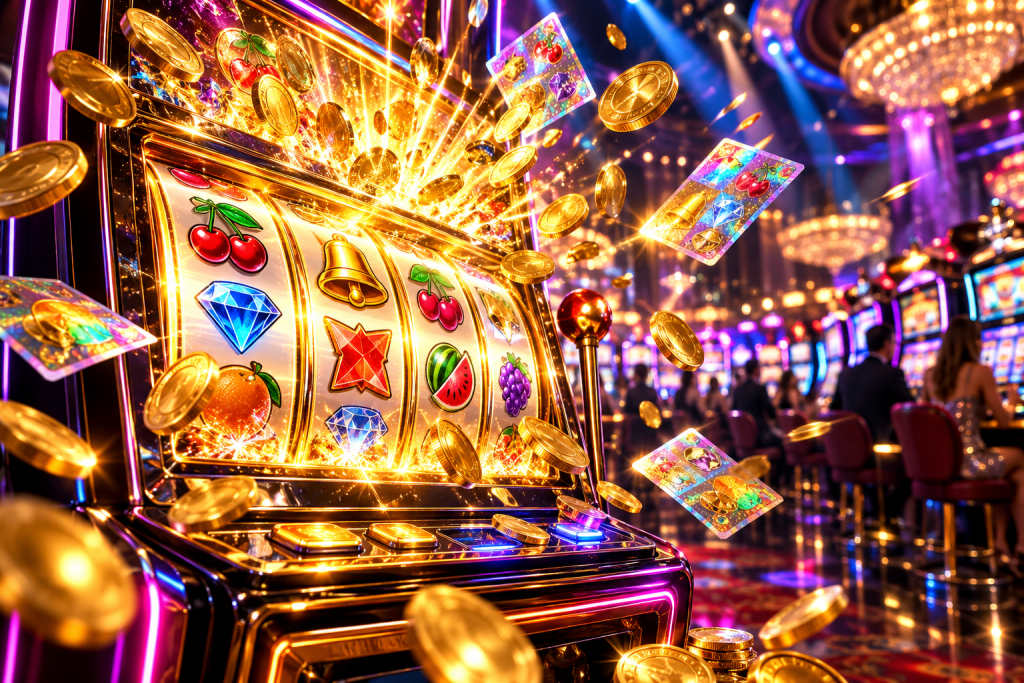
The moment a bonus round appears is not a reward for good timing
When a themed slot drops you into a bonus screen, it can feel like the machine noticed something about your play. It did not. The sequence that put you there was already decided the instant you pressed the spin button, and the only thing the game did afterwards was show it to you with sound and animation. Understanding that one point changes how you read every feature a slot offers, including the scratcher-style bonus the query is asking about.
A slot does not run a separate lottery for its bonus round. The same random number generator that picks your reel symbols also picks whether the spin enters the feature. The RNG produces a number, the game maps that number to a reel position or a feature trigger, and the screen displays the result. A scratcher feature is simply one of the display outcomes the game can map a result to. The game is not hiding a second game behind the reels; it is showing you one outcome in two stages.
What the RNG does between your press and the result
The random number generator is an algorithm that produces a stream of numbers with no pattern a player can use. Each spin is independent. The machine does not remember that you have gone fifty spins without a bonus, and it does not owe you one. That is not a design flaw; it is the definition of independence. A slot that has not paid a bonus in an hour has exactly the same chance of triggering one on the next spin as it did on the first spin of that hour, assuming the same stake and the same game state.
Some games do use a visible meter that fills as you play, and when the meter is full the feature opens. That meter is a presentation choice. The underlying probability of reaching the full state is built into the game's maths, and the meter is a way of showing you where the current spin sits inside that distribution. A meter does not mean the game is closer to paying out in the way a vending machine is closer to dropping a can. It means the game has chosen to display a progress bar.
When a game has a scratcher feature, the same logic applies. The game decides on each spin whether the feature is available. If it is, the feature may present itself as a panel of hidden symbols you reveal one at a time. The reveal is theatre. The prize was already assigned. Scratching slowly, tapping the screen in a pattern, or using a particular finger does not change what is under the panel.
Where the game states how its feature works
The reliable source for any slot feature is the game's own information panel and paytable. Every regulated slot, whether in a venue or in an app, carries a rules screen. You usually open it with a button marked with an "i", a question mark, or the word "info". Inside that screen you will find the feature trigger conditions, the stake multiplier for any bonus prize, and whether the feature can retrigger.
A scratcher feature in a themed slot will be described there in plain terms. The paytable tells you what the feature pays, what symbols or combinations open it, and whether the prize is a fixed amount or a multiple of your stake. If the feature only appears when you bet at a certain level, that condition is written in the rules screen, not hidden in the animation. If the feature has a maximum prize, the cap is stated there. If the feature can appear only during free spins, the rules screen says so.
Read the paytable before you put money through a game you have not played. The information panel is not a legal footnote. It is the only place where the game's actual parameters are stated in a form you can check. The marketing screen, the theme, and the bonus animation are designed to be exciting. The information panel is designed to be accurate.
Paylines and ways-to-win change what a winning combination looks like
Themed slots differ in how they count a win. A fixed-payline game draws specific lines across the reels, and a combination pays only when it lands on one of those lines. A ways-to-win game pays when matching symbols land on adjacent reels, regardless of their exact row. Some games mix both, and some change the number of active ways during a bonus round.
This matters for a scratcher feature because the feature may be tied to a scatter symbol rather than a payline. A scatter typically pays or triggers regardless of where it lands, which is why it is called a scatter. The paytable tells you whether the feature trigger is a scatter, a bonus symbol, a collection mechanic, or a random event that can occur on any spin. Do not assume that a symbol has to line up on a payline to trigger the feature. In many games it does not, and in some games it must appear a set number of times anywhere on the screen.
| Mechanic | How a win or trigger is counted | What to check in the paytable |
|---|---|---|
| Fixed paylines | Matching symbols must land on one of the drawn lines | Number of lines, whether all lines must be active, line patterns |
| Ways-to-win | Matching symbols on adjacent reels pay, usually left to right | Number of ways, whether the count changes in the bonus |
| Scatter trigger | Pays or opens a feature regardless of line position | Number of scatters required, whether they must appear on specific reels |
| Collection or meter | Symbols collected over multiple spins fill a meter | Collection rate, whether the meter resets, stake dependence |
| Random feature | Can trigger on any spin with no visible condition | Stated trigger probability if published, stake conditions |
Volatility decides how often features appear, not whether you win overall
A slot's volatility describes the shape of its payout distribution. A high-volatility game pays less often but in larger chunks when it does pay, and its bonus features tend to be rarer and heavier. A low-volatility game pays more often in smaller amounts, and its features tend to trigger more frequently with smaller average prizes. Neither volatility level is better. They are different experiences with the same underlying arithmetic: the game's return to player percentage stays the same for a given rule set no matter how the payouts are distributed.
This is where most confusion about bonus features starts. A player who wants the scratcher feature to appear often will see it more often in a low-volatility game, all else equal. But the feature will pay less on average when it does appear. A high-volatility game may keep the player waiting far longer, and the feature may then pay a multiple that resets the whole session. The player cannot have both frequent features and large feature prizes from the same stake, because the game's maths balances the two.
Stake size does not change the trigger probability in most games, but it changes what the feature pays. A feature that pays a fixed multiple of stake pays proportionally more at a higher stake. A feature that pays a fixed amount pays the same no matter what you staked to open it. The paytable states which type the game uses. If the scratcher feature pays a fixed amount, then raising your stake to chase it only increases your cost per spin without increasing the prize. If it pays a stake multiple, then a higher stake raises both the prize and the amount you lose on every spin that does not trigger.
| What you change | What it changes | What it does not change |
|---|---|---|
| Stake size | The cash value of a stake-multiple prize; the cash cost per spin | The game's RTP; the probability of triggering the feature in most games |
| Number of spins | Total wager; the number of chances to see the feature | The per-spin probability; the long-run return percentage |
| Game choice | Volatility, feature frequency, prize shape, theme | The fact that the house edge remains on every spin |
| Stopping rule | Session length; whether you keep a win or keep playing | The independence of the next spin's outcome |
Fixed and progressive jackpots sit on top of the base game
Some themed slots carry a jackpot display above the reels. A fixed jackpot pays a set amount when its trigger condition is met. A progressive jackpot grows as a share of qualifying wagers is added to a pooled prize, and it resets after someone wins it. The jackpot is usually separate from the base game's paytable and from the scratcher feature, although some games run the scratcher as the jackpot trigger.
Progressive contributions are taken out of the game's return. That means a slot with a large progressive attached returns slightly less in its base game than a similar slot without one, because part of each qualifying wager is being diverted to the jackpot pool. The game's information panel states whether a progressive is local to one venue or network-wide, what stake qualifies, and what the reset value is. Some progressives require a maximum-stake bet to qualify for the top prize. If you are playing below that stake, you are funding a jackpot you cannot win. The rules screen says so explicitly.
A scratcher feature that awards a jackpot is still just a display. The game decides on the spin whether the jackpot is won, then shows the reveal. No scratching speed or pattern changes the outcome. The only decision that matters is whether you are staking at a level that qualifies for the prize shown on the screen.
How to find the answer for the specific game you are playing
The query names a particular themed slot, but the mechanism behind the scratcher feature is the same across the whole class of games that use one. The specific trigger condition, prize type, and qualifying stake for that exact title are written in the game's own information panel. Open it before you play. Look for the section that describes the feature by name, and read the trigger condition as a rule, not as a hint.
If the information panel inside the game is thin, the operator's game page usually carries a fuller rules document. In a venue, the machine's help screen is the authoritative source, and venue staff can point you to it. In an app, the game menu contains the paytable, and the operator's terms page carries the promotion rules if the scratcher feature is tied to a bonus rather than to the base game. Where the feature is part of a promotional offer, the wagering requirement, game weighting, maximum cashout, and expiry window are all stated in the promotion terms, and those terms decide whether any feature prize can become withdrawable cash.
No play pattern changes the programmed return. Playing longer does not make the feature more likely on any given spin. Raising your stake does not make the RNG kinder. Stopping after a big feature win does not lock in a long-run profit, because the game's edge is applied on every spin you have already made and every spin you make next. What a player controls is which game they play, what they stake, how many spins they make, and when they stop. Those choices change the cost and the shape of the session. They do not change the arithmetic underneath it.
FAQ
Does a slot become more likely to trigger a bonus after a long dry spell?
No. Each spin is independent, and the RNG has no memory of previous outcomes. A game that has not shown its bonus feature for a long time has the same per-spin trigger probability on the next spin as it had on any other spin under the same conditions.
Can I trigger a scratcher feature by stopping the reels manually or scratching in a pattern?
No. The outcome is determined when the spin is initiated, and the stop button or scratch pattern only controls how quickly the result is displayed. The prize and the feature trigger are already fixed by the game's RNG before the reveal begins.
Where do I find out if a slot's jackpot requires a maximum bet?
In the game's information panel or paytable. The qualifying stake for any progressive jackpot is stated there, along with whether the jackpot is fixed or progressive, what its reset value is, and whether it is local or networked. If the game is part of a promotion, the promotion terms on the operator's page carry the same information for any bonus-linked feature.
Play responsibly
Gambling should be treated as paid entertainment, never as a way to earn income or recover losses. 1-800-MY-RESET (1-800-697-3738)
18+ or 21+ depending on where you are; follow the minimum age that applies to you.
This article is general information about how these mechanics work. It is not legal advice and not a recommendation to gamble or to use any particular operator. Availability and legality differ by jurisdiction — check the rules that apply where you are.