


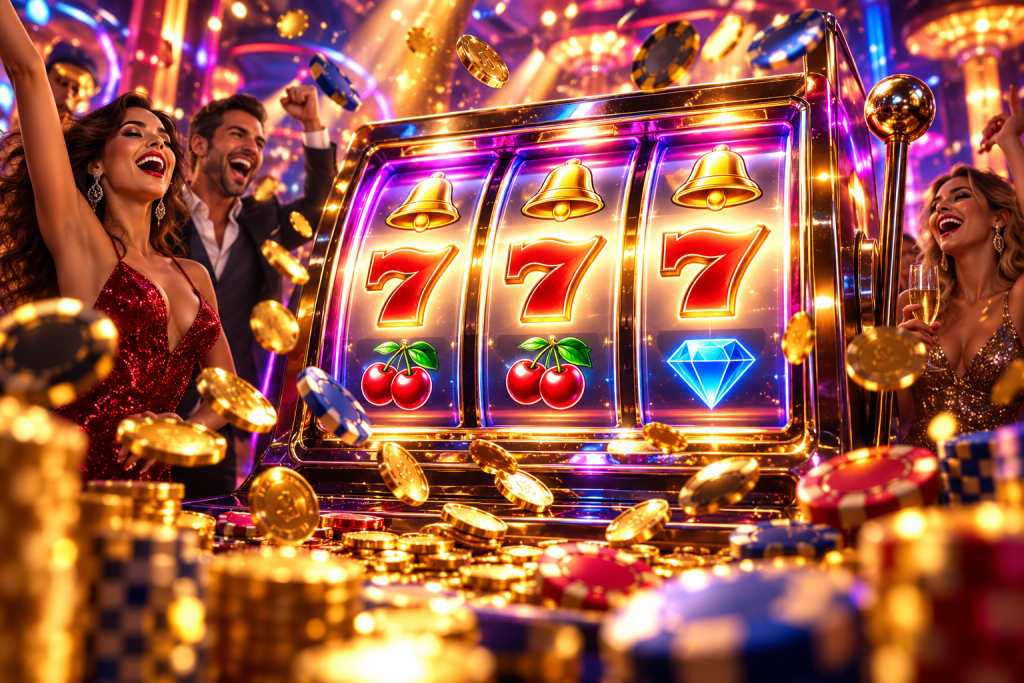
Every symbol on the screen is a position on a virtual reel
When you look at a slot machine, whether it is a physical cabinet or an online game, you see a grid of pictures. A player who reads those pictures as decoration misses the only part of the machine that tells them what a spin is worth. Each picture is a symbol, and each symbol occupies a stop on one or more virtual reels. The machine does not choose a picture to display. It selects a random number, maps that number to a reel position, and the picture at that position lands on the screen.
This matters because the pictures are the language of the paytable. A cherry, a bell, a scatter, a wild, a card rank, a themed character: each has a defined value, and most have a defined behaviour. The pictures are not interchangeable art. They are the output of a mapping process, and the paytable is the dictionary for that output.
How a symbol becomes a result
A slot machine runs on a random number generator, or RNG. The RNG produces a stream of numbers continuously, even when no one is playing. When you press spin, the game takes the current number, or the next number in the sequence, and uses it to determine where each virtual reel stops. A virtual reel is a long list of symbol positions, far longer than the twenty or so stops you can see on a physical reel. The same picture may appear many times on that list, and different pictures appear different numbers of times. That distribution is what sets the probability of any given symbol landing.
The screen then displays the symbols at the chosen positions. The animation of spinning reels is a presentation layer. The outcome was already determined by the RNG and the reel mapping at the moment the spin was initiated. The pictures you see are the result of that selection, not the cause of it.
The paytable is the only reliable description of the pictures
Every slot has a paytable, and the paytable is where the pictures acquire their meaning. It lists each symbol, what a winning combination of that symbol pays, and any special behaviour the symbol has. A player who skips the paytable is betting on pictures they have not read.
The paytable will typically show a grid of symbols with payout values next to them. Those values are usually expressed as multiples of the stake, not as fixed currency amounts. A symbol listed as paying 50 means 50 times the line bet or the total stake, depending on how the game structures its payouts. The paytable also states how many matching symbols are needed for a win, usually three or more, and whether they must land on a payline or in adjacent positions.
Where the reader needs the exact payout for a specific symbol on a specific game, the paytable is the document that carries it. It is normally reachable through an information button, a menu icon, or a help screen inside the game itself.
Standard symbol classes and what they do
Most slot pictures fall into a small number of functional classes. The art style changes from game to game, but the underlying roles are stable.
| Symbol class | What it does | Where its value is stated |
|---|---|---|
| Standard paying symbols | Form the base winning combinations; usually themed pictures or card ranks | Paytable, as a multiple of stake |
| Wild | Substitutes for other paying symbols to complete a combination; may carry its own payout | Paytable, with substitution rules stated |
| Scatter | Pays or triggers a feature regardless of payline position | Paytable and feature rules screen |
| Bonus trigger | Unlocks a bonus round when a stated number land | Feature rules screen |
| Jackpot symbol | Qualifies for a fixed or progressive jackpot under stated conditions | Jackpot rules and information panel |
A wild is the most common special symbol. It acts as a substitute, the way a joker can stand in for another card in some card games. If a wild lands next to two matching symbols, it can complete a three-symbol win. Some wilds also pay on their own when several land. The paytable states both behaviours.
A scatter is different because it does not need to land on a payline. In many games, a stated number of scatters anywhere on the grid pays a multiple of the total stake or triggers a free-spins feature. The scatter is often the picture that unlocks the game's most valuable feature, which is why its trigger conditions are worth reading carefully.
Paylines versus ways-to-win change how pictures connect
Two slot formats dominate modern games, and they read the same grid of pictures differently. A fixed-payline game draws a set of lines across the reels, usually from left to right, and a winning combination must land on one of those lines. The player bets on all lines at once. A ways-to-win game does not use lines. It pays when matching symbols land on adjacent reels, starting from the leftmost reel, in any position on each reel. The number of ways is calculated by multiplying the number of symbol positions on each reel.
The same picture can be worth a different amount in the two formats, because the formats count combinations differently. A payline game might require three matching symbols on a specific line, while a ways-to-win game might pay for any three adjacent matching symbols across the first three reels. The paytable states which format the game uses and how wins are counted.
Volatility is a property of the symbol distribution, not the pictures
Two games can use the same themed pictures and play very differently. The difference is volatility, also called variance. Volatility describes how payouts are distributed over time. A high-volatility game pays rarely but in larger amounts when it does. A low-volatility game pays often but in smaller amounts. The pictures on the reels do not tell you which one you are playing. The symbol distribution on the virtual reels, the payout values in the paytable, and the frequency of the bonus features do.
Volatility does not change a game's RTP, or return to player. RTP is a theoretical percentage of total wagered money a game returns to players over a very large number of spins or hands. It is a long-run statistical average, not a per-session guarantee. A high-volatility game and a low-volatility game can have the same RTP and deliver it in very different patterns. The pictures are the same kind of information either way; the distribution behind them is what differs.
Fixed and progressive jackpots put different pictures to work
Some slot pictures are tied to jackpots. A fixed jackpot pays a set amount, stated in the paytable or on the game's information panel. A progressive jackpot grows from a share of qualifying wagers and resets after a win. The jackpot amount is usually displayed above the reels or on a separate meter, and the qualifying conditions are stated in the game rules.
Progressive contributions are typically taken out of the game's return, and some progressives require a maximum-stake bet to qualify. That means a player who is not betting the qualifying amount may be contributing to a jackpot they cannot win. The jackpot rules screen states the qualifying condition. The jackpot meter shows the current value. Both are part of the game's own information, and neither should be assumed.
Reading the game's own information panel
Every regulated online slot carries an information panel, usually behind an "i" or menu icon. That panel contains the paytable, the game rules, and the RTP figure. It is the single most useful screen in the game, and the one most players skip.
The panel will typically show the symbol values, the payline or ways-to-win structure, the feature trigger conditions, and the theoretical return. Where a game has a progressive jackpot, the panel or a linked rules screen states the qualification conditions and the contribution rate. Where a game has free spins, the panel states the stake at which the spins are granted and whether winnings are credited as cash or as bonus funds subject to wagering requirements.
The pictures on the reels are the visible half of a system whose invisible half is the reel mapping and the RNG. The paytable and information panel are the only places where the two halves meet in plain language. A player who reads them knows what each picture is worth, what it takes for that picture to pay, and what the game is built to return over the long run.
FAQ
Do the pictures on a slot machine affect the odds?
The pictures themselves do not affect the odds; the distribution of those pictures on the virtual reels does. The same picture can appear many times on a virtual reel, and different pictures appear different numbers of times. That distribution, together with the payout values in the paytable, sets the probability and size of wins.
Why do some symbols pay when they are not on a payline?
Those are usually scatter symbols. A scatter pays or triggers a feature based on landing a stated number anywhere on the grid, regardless of payline position. The paytable states the number required and what the scatter awards.
Where do I find what each picture is worth?
Open the game's information panel or paytable, usually behind an "i" or menu icon inside the game. It lists every symbol, its payout as a multiple of stake, and any special behaviour such as wild substitution or scatter triggers.
Play responsibly
Gambling should be treated as paid entertainment, never as a way to earn income or recover losses. 1-800-MY-RESET (1-800-697-3738)
18+ or 21+ depending on where you are; follow the minimum age that applies to you.
This article is general information about how these mechanics work. It is not legal advice and not a recommendation to gamble or to use any particular operator. Availability and legality differ by jurisdiction — check the rules that apply where you are.