


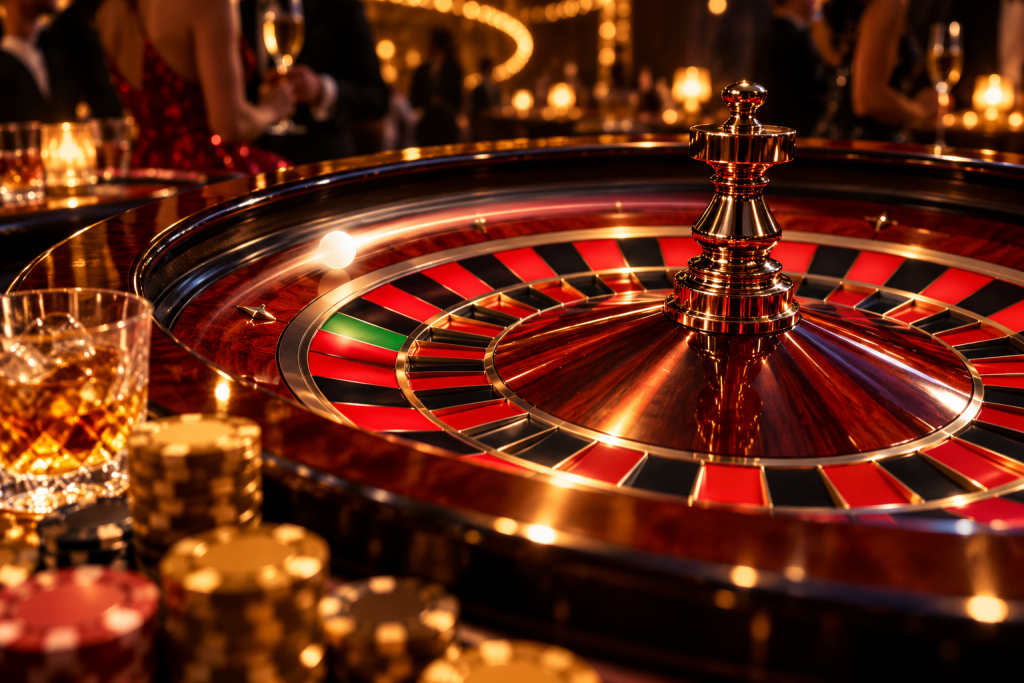
The wheel you are most likely to sit down at
Walk up to a roulette table in the UK and the wheel in front of you almost certainly has 37 pockets. The numbers run from 0 to 36, with the zero pocket coloured green and the rest alternating red and black. If you have seen an American film with a wheel carrying a double zero, you have seen a different layout: that wheel has 38 pockets, and the extra pocket changes the arithmetic of every bet on the table.
The number of pockets is not a piece of trivia. It is the single fact that determines the house edge on every wager you can place, because the payout odds are built around a 36-number wheel while the physical wheel has one extra pocket. That gap is where the operator's advantage lives.
How the 37-pocket layout works
A European-style wheel arranges its 37 numbers in a fixed sequence, not in numerical order. The ordering exists so that red and black, odd and even, and high and low numbers are distributed around the wheel rather than clustered. The sequence is standard across most wheels of this type, which is why a croupier can place the ball and call the result at speed.
The betting layout on the table mirrors the wheel but arranges the numbers in three columns of twelve, with the zero sitting above them. You can bet on a single number, on groups of numbers, or on characteristics such as red or black. Every bet pays as if there were 36 possible outcomes, but the zero is a 37th outcome that belongs to the house on most bets.
Where the house edge comes from
On a 37-pocket wheel, a straight-up bet on one number pays 35 to 1. If the wheel had 36 pockets, a 35-to-1 payout on a 1-in-36 chance would be a fair game. With 37 pockets, the true odds of hitting your number are 1 in 37, but the payout is still 35 to 1. The difference between the true odds and the payout odds is the house edge.
The same principle applies to every bet on the layout. An even-money bet such as red or black pays 1 to 1, but the green zero means the bet is not a true 50-50 proposition. The zero is the reason the operator expects to keep a small percentage of all money wagered over a very large number of spins. It is not a per-session prediction; it is a long-run statistical average.
Main bet types and how they differ
Roulette bets fall into two broad families: inside bets, which sit on the numbered grid, and outside bets, which sit around the edge of the layout. Inside bets cover fewer numbers and pay more when they win; outside bets cover more numbers and pay less. The house edge on a 37-pocket wheel is the same for almost all of them, but the variance you experience changes sharply.
| Bet | Covers | Payout | What it feels like |
|---|---|---|---|
| Straight-up | One number | 35 to 1 | Rare wins, large payouts |
| Split | Two adjacent numbers | 17 to 1 | Still rare, smaller than straight-up |
| Street | Three numbers in a row | 11 to 1 | Moderately rare |
| Corner | Four numbers in a square | 8 to 1 | More frequent than a split |
| Six line | Six numbers in two rows | 5 to 1 | Frequent enough to feel regular |
| Red / black | 18 numbers of one colour | 1 to 1 | Near coin-flip rhythm, zero aside |
| Odd / even | 18 numbers | 1 to 1 | Same rhythm as red / black |
| Dozen | 12 numbers | 2 to 1 | Wins roughly one spin in three |
The table shows why two players at the same wheel can have completely different evenings. One player spreading chips across red, black and dozens will win small amounts often. Another stacking chips on a single number will lose most spins and occasionally collect a payout large enough to change the session. Neither approach changes the long-run edge.
The sequence of a round
A round moves through a fixed sequence, and understanding it keeps you from making procedural errors. First, the croupier closes betting and spins the wheel in one direction while sending the ball around the rim in the other. While the ball is travelling, you place chips on the layout. The croupier announces when no more bets are accepted, usually as the ball begins to slow.
When the ball drops into a pocket, the croupier marks the winning number on the layout with a marker, clears losing bets, and pays winners. You must not touch your chips once the marker is down. The next round begins only after all payouts are settled and the marker is lifted.
Buy-in, chips and table etiquette
At a live table you do not hand cash directly to the croupier. Place your money on the table, and the croupier exchanges it for roulette chips. These chips are typically unmarked with a denomination and carry a colour unique to you at that table, which is how the croupier knows whose winning bet is whose. You cash them back at the table before you leave; they are not valid at other tables.
Two procedural mistakes trip up new players more than any others. The first is reaching for chips after the croupier has called no more bets. The second is placing a bet that straddles two positions and expecting it to count as both. Announce your intention or place the chip clearly on the line the croupier can read. If you are unsure, ask before the ball drops, not after.
What changes if you see a double zero
Some venues outside the UK, and a small number of UK-facing online lobbies, offer an American-style wheel with 38 pockets: the numbers 0 to 36 plus a double zero. The extra pocket increases the house edge on most bets because the payout odds remain built around 36 numbers while the wheel now has two pockets that favour the house on the standard wagers. The comparison is straightforward.
| Wheel | Pockets | Zero pockets | Effect on the player |
|---|---|---|---|
| European-style | 37 | One | Lower house edge, standard UK table |
| American-style | 38 | Two | Higher house edge on the same bets |
If the table layout shows a double zero, you are not playing the 37-pocket game. The difference is visible before you place a single chip, and it is the first thing to check when you sit down.
Why strategy charts do not apply here
Roulette has no decision points after the ball is released. Unlike blackjack, where the player chooses whether to hit, stand, split or double, a roulette bet is placed and then resolved by physics. There is no strategy chart that changes the house edge on a given roulette bet, because no later decision alters the probability once the wager is on the layout.
What you control is which bets you place, how much you stake per spin, how long you stay at the table, and when you stop. Those choices change the shape of your session and the size of your swings. They do not change the built-in edge on any individual wager, and no betting progression removes it.
FAQ
Why does UK roulette have 37 numbers instead of 36?
The 36 numbered pockets match the payout structure, but the single green zero is added as the 37th pocket. That pocket is what gives the operator a mathematical advantage on every spin, because payouts are calculated as if the zero did not exist.
Does the zero count as odd or even on a UK wheel?
No. The zero is neither red nor black, neither odd nor even, and neither high nor low. On a standard layout, an even-money bet on any of those characteristics loses when the ball lands in the zero pocket.
Is the number sequence the same on every UK wheel?
The sequence of numbers around a 37-pocket wheel is standardised across most European-style wheels, which is why croupiers can work quickly. The physical arrangement is different from the numerical order on the betting layout, so do not expect adjacent numbers on the table to sit next to each other on the wheel.
Please play responsibly. If you or someone you know needs support, contact local responsible gambling services.
Play responsibly
Gambling should be treated as paid entertainment, never as a way to earn income or recover losses. 1-800-MY-RESET (1-800-697-3738)
18+ or 21+ depending on where you are; follow the minimum age that applies to you.
This article is general information about how these mechanics work. It is not legal advice and not a recommendation to gamble or to use any particular operator. Availability and legality differ by jurisdiction — check the rules that apply where you are.