


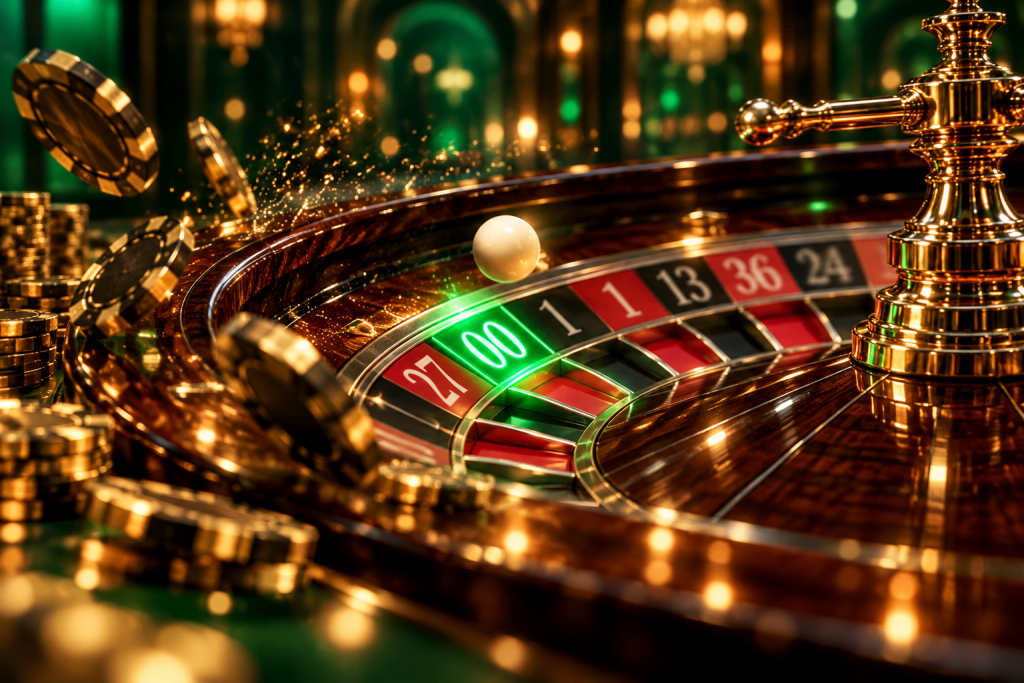
The payout on 00 is a fixed multiple, but the wheel has changed underneath it
A bet on 00 pays at the same advertised rate as a bet on any other single number on the same layout. On an American wheel, the operator posts that rate on the table felt, and it is usually stated as a payout of 35 to 1. That number is not a secret and it does not change from spin to spin. What changes is the wheel itself: the American layout carries both a 0 and a 00, so there are 38 pockets where a European wheel has 37.
That extra pocket is the entire story. The paid odds stay the same, but the chance of the ball landing in your pocket gets smaller, and the gap between what the bet pays and what the bet is worth opens wider.
Paid odds and true odds are two different measurements
Paid odds are what the operator hands you when you win. True odds are what a fair bet on that outcome would pay if the payout matched the probability exactly. On a single-number bet, the two never match, and they are not supposed to. The difference is where the operator's mathematical advantage sits.
On an American wheel, a single number has one winning pocket out of 38. The true odds against hitting it are therefore 37 to 1. The bet pays 35 to 1. The two-unit gap between those figures is the house edge expressed in payout terms.
| Wheel type | Pockets | Single-number paid odds | True odds against a single number | What the extra pocket does |
|---|---|---|---|---|
| European | 37 | 35 to 1 | 36 to 1 | No 00 pocket; the gap between paid and true odds is smaller |
| American | 38 | 35 to 1 | 37 to 1 | The 00 pocket widens the gap, so the same bet carries a larger built-in advantage for the house |
The 00 pocket does not change what a winning bet pays. It changes how often the bet wins, and that is the part that costs money over time.
Where the house edge on 00 comes from
House edge and RTP are complements: for the same bet under the same rule set, they sum to 100%. The edge is the share of each wager the operator keeps as a long-run average; RTP is the share returned to players over a very large number of spins. Neither figure predicts a single session.
You can build the edge for a 00 bet from the payout and the wheel count. Suppose a player wagers one unit on 00. Over 38 spins that each cost one unit, the player risks 38 units in total. On average, the ball lands in the 00 pocket once, and that one win pays 35 units plus the original unit back, so the player receives 36 units. The player has put in 38 and received 36, leaving a shortfall of 2 units for every 38 wagered, on average. That shortfall is the house edge expressed as a share of total coin-in.
The same arithmetic works for any single-number bet on the same wheel, because 00 is not special in its payout. It is special only in that it exists, and its existence makes every other number on the wheel slightly less likely to appear.
Short sessions look nothing like the long-run average
A player who walks up, puts a chip on 00, and wins once has not beaten the edge. They have experienced variance. A single-number bet pays a large multiple of the stake, so one win can cover many previous losses, and the session can end ahead even though the bet carries one of the larger built-in advantages on the table.
Volatility is the distribution of those outcomes over time. A single-number bet is high-volatility: wins are rare relative to losses, but when one lands, it pays a large multiple. That does not change the RTP or the house edge. It changes what a short session feels like.
The long-run average only asserts itself across enough spins that the gap between paid odds and true odds has room to operate. In a short session, the sample is too small for the average to dominate, and either side of the table can be ahead. That is not a flaw in the maths; it is what variance means.
Decisions per hour multiply total exposure, not the edge
The house edge is a rate, and a rate only costs money when it is applied to something. In roulette, what it is applied to is the total amount wagered, which is the product of the stake and the number of spins.
Suppose a player bets one unit on 00 per spin. If the table runs at a given number of spins per hour, the player's total hourly exposure is the stake multiplied by that spin count. The edge is applied to that exposure as a long-run average, not to the player's starting bankroll. A player who bets the same amount per spin but plays twice as many spins has doubled the amount of money the edge is working against, without changing the edge itself.
Game speed therefore matters more than most players assume. The payout on 00 is fixed, the wheel count is fixed, and the edge is fixed. What the player controls is how many times the bet is placed.
Why progression systems do not remove the edge on 00
A progression system changes the size of the next bet based on the previous result. The most common form doubles the stake after a loss, on the logic that a single win will recover the accumulated losses and return a small profit.
The problem is not that the logic fails in the short run. It often works for a while, because a single-number win pays a large multiple and can cover several prior losses. The problem is that the bet still loses more often than it wins, and the edge is applied to every unit wagered, including the larger ones.
Suppose a player starts with one unit on 00 and doubles after every loss. After a run of losses, the next stake is a large multiple of the first. The wheel does not know the stake size, and the probability of the 00 pocket appearing has not changed. The player has simply arranged to wager a large amount on a bet that still carries the same built-in disadvantage. The progression redistributes outcomes: it turns many small losses into occasional large wins and occasional very large losses. It does not change the expected loss per unit wagered.
Table limits also cap how far a doubling sequence can run. When the sequence hits the maximum stake the table allows, the player can no longer place a bet large enough to recover the accumulated losses under the same scheme. That cap is posted on the table, and it is the practical end of any progression.
What the player can choose
The paid odds on 00 are fixed by the table. The wheel count is fixed by the layout. The house edge is fixed by the relationship between the two. What varies under the player's control is the choice of bet, the stake, the number of spins, and the stopping rule.
Different bets on the same American wheel carry materially different edges, because the same 38-pocket wheel sits under all of them. A bet that covers more numbers pays less per win but wins more often; a bet that covers one number pays more per win but wins less often. The edge on each bet is built from the same wheel, but it is not identical across bet types.
The information panel on the game, or the table felt itself, states the paid odds for each bet. The wheel type is visible on the layout. From those two pieces, a player can see the gap between paid and true odds for any bet on the table, including 00.
FAQ
Does 00 pay more than 0 in roulette?
No. On an American layout, 0 and 00 are both single-number bets, and both pay at the same advertised rate, usually 35 to 1. The two pockets are identical in payout; they differ only in that the wheel contains both of them, which changes the probability for every number on the layout.
Is betting on 00 worse than betting on red or black?
It carries a different volatility profile. A 00 bet wins rarely and pays a large multiple when it does. A red or black bet wins more often and pays even money. The house edge is built from the same wheel count, but the two bet types do not carry the same expected loss per unit wagered, and the short-run experience is very different.
Can I check the paid odds before I bet?
Yes. The paid odds for every bet on the layout are printed on the table felt or shown in the game's information panel. The wheel type is also visible on the layout. From those two pieces, you can see the payout and count the pockets to work out the true odds against any bet, including 00.
Gambling involves risk. Please only gamble with funds you can afford to lose. If you or someone you know needs support, contact the helpline printed in the footer below.
Play responsibly
Gambling should be treated as paid entertainment, never as a way to earn income or recover losses. 1-800-MY-RESET (1-800-697-3738)
18+ or 21+ depending on where you are; follow the minimum age that applies to you.
This article is general information about how these mechanics work. It is not legal advice and not a recommendation to gamble or to use any particular operator. Availability and legality differ by jurisdiction — check the rules that apply where you are.