


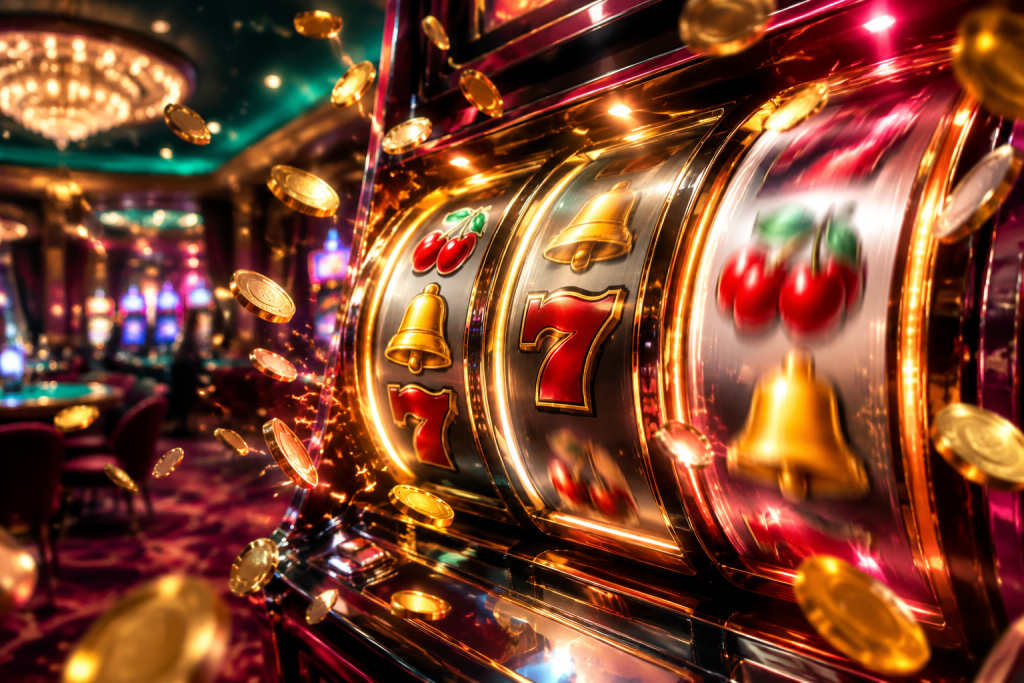
The Reels Stop, But the Outcome Was Already Decided
When you press spin on a three-wheel slot machine, the reels appear to spin and land on a combination. What you are watching is a short animation. The machine's internal random number generator has already selected the outcome. The spinning reels are a presentation layer. Understanding this one mechanism changes how you read everything else about a slot machine: the odds, the paytable, and what the house edge really means.
A three-wheel slot is the classic format. Three reels, each showing a column of symbols, with a payline running across the middle. The machine uses a random number generator to pick a stopping position for each reel. The symbols that line up on the payline determine whether the spin pays, and how much. The reels do not have memory, and a spin does not influence the next one.
What the Random Number Generator Does on Every Spin
The random number generator is the algorithm that decides game outcomes. On a modern slot machine, it runs continuously, generating numbers even when no one is playing. When you press spin, the machine takes the current number and maps it to a reel position. That mapping is what determines which symbols land on the payline.
Independent testing laboratories commonly certify that the random number generator behaves as intended. That certification covers game mechanics, not an operator's financial conduct. In practice, it means the outcome of each spin is independent of the previous spin. A machine that has not paid out in an hour is not due. A machine that just paid a jackpot is not cold. The random number generator does not track history.
Each reel position has a fixed probability of being selected. If a reel has 22 stops, each stop has a one-in-22 chance of being chosen on that spin, assuming the stops are weighted equally. The machine's paytable and symbol distribution determine how often a paying combination appears. The spinning animation does not change those probabilities.
How the Paytable Sets the Price of Every Spin
The paytable is the document that tells you what each combination pays. On a three-wheel machine, a typical paytable lists the winning combinations and their payouts. A single cherry might pay a small amount. Three bars might pay more. Three sevens might pay the top fixed jackpot. The paytable is where the machine's return is built.
Return to Player (RTP) is a theoretical percentage of total wagered money a game returns to players over a very large number of spins. It is a long-run statistical average, not a per-session guarantee. The house edge is the mathematical advantage the operator holds on a given game, expressed as a percentage of each wager. House edge and RTP are complements: they sum to 100% for the same game.
Suppose a three-wheel slot has an RTP of 92%. That means, over an enormous number of spins, the machine is designed to return 92 units for every 100 units wagered. The house edge is 8%. This is a hypothetical example. The actual RTP for a specific machine is stated in its game information panel or help screen. The number is not a promise for your session. In a short session, you might win more than you wagered, or lose far more than a small fraction of it.
Why a Short Session Looks Nothing Like the Long-Run Average
RTP is a long-run statistical average. A long run for a slot machine can mean millions of spins. Your session might be a few hundred spins. In that window, almost anything can happen. You could hit a jackpot on your first spin. You could go fifty spins without a paying combination. Neither outcome tells you anything about the machine's true RTP.
Volatility describes how payouts are distributed over time. High volatility means rarer but larger payouts. Low volatility means more frequent but smaller ones. Volatility does not change a game's RTP. A high-volatility three-wheel slot might have the same RTP as a low-volatility one, but the high-volatility machine will have longer dry spells and bigger occasional wins. The low-volatility machine will pay small amounts more often. Your choice between them is a choice about how your session feels, not about whether you will win.
Three-wheel slots tend toward a specific feel because they have fewer reels and fewer symbols than five-reel video slots. The paytable is usually simpler. Jackpots are often fixed rather than progressive. Fixed jackpots pay a set amount. Progressive jackpots grow from a share of qualifying wagers and reset after a win. A three-wheel machine with a fixed top prize will not grow that prize over time.
Paylines and Ways to Win on a Three-Reel Layout
A payline is the pattern across reels that produces a paying combination. Fixed-payline games require betting all lines. Ways-to-win formats pay on adjacent-symbol combinations instead of fixed lines. A classic three-wheel slot usually has a single horizontal payline across the middle row. Some three-wheel machines add diagonal lines or a second horizontal line, but the format is simpler than a five-reel video slot with hundreds of ways to win.
The number of paylines matters because it changes how much you wager per spin. If a machine has one payline and you bet one unit, your total wager is one unit. If a machine has three paylines and you bet one unit per line, your total wager is three units. The paytable payout is usually expressed as a multiple of the line bet, not the total wager. Read the machine's rules to see how it handles this.
| Feature | Three-wheel slot | Five-reel video slot |
|---|---|---|
| Reels | 3 | 5 or more |
| Typical paylines | 1 to a few | Many, often 20 to hundreds |
| Symbol set | Smaller, classic symbols | Larger, themed symbols |
| Jackpot style | Often fixed | Often progressive or bonus-driven |
| Volatility feel | Varies, but simpler paytables | Varies widely |
What Decisions Per Hour Do to Your Total Exposure
Slot machines are fast. A player can complete hundreds of spins in an hour. Each spin is a separate wager. The house edge applies to each wager. The more spins you make, the more total money you put through the machine, and the more the long-run average has room to express itself.
Suppose you bet one unit per spin and complete 300 spins in an hour. Your total coin-in for that hour is 300 units. If the machine has a hypothetical house edge of 8%, the expected loss for that hour is 24 units. This is an example using a hypothetical edge. The actual edge for a specific machine is in its game information panel. The point is not the exact number. The point is that speed multiplies exposure. A slower player making 100 spins in an hour has one-third the coin-in and one-third the expected loss, all else equal.
You control the speed of play, the size of your wager, and the length of your session. You do not control the house edge. That is built into the game. Choosing a machine with a lower house edge, or a lower volatility profile, changes the expected rate of loss. It does not create a way to win.
Why Progression Systems Redistribute Outcomes Instead of Removing the Edge
A progression system is a betting pattern that changes your wager based on previous outcomes. The most famous is doubling after a loss. The idea is that when you eventually win, you recover your previous losses and gain a small profit. The arithmetic works on paper, but it does not change the house edge.
The problem is that the house edge applies to every wager, regardless of its size. Doubling after a loss increases the size of your wagers. A larger wager carries a larger expected loss. The progression redistributes outcomes: many small wins, punctuated by rare large losses. It does not remove the built-in edge of a negative-expectation game.
Suppose you start with a one-unit bet and double after each loss. After four losses, your next bet is 16 units. If the machine has a table limit, you may hit it before you can place the bet the progression requires. If you do not hit the limit, a long losing streak can exhaust your bankroll. The progression does not make the next spin more likely to win. The random number generator does not know you are due.
No betting pattern changes the built-in edge of a negative-expectation game. Progression systems and similar methods change the shape of your results, not the expected value. The only variables under your control are bet size, game choice, speed of play, and session length. Those variables change how much you wager and how long you play. They do not change the house edge.
What the Spin Costs You
Every spin on a three-wheel slot machine is a wager with a built-in house edge. The random number generator selects the outcome. The paytable sets the payouts. The RTP and house edge sum to 100% for the same game under the same rule set. A machine with a higher RTP has a lower house edge, and vice versa. But RTP is a long-run average. Your session is a small sample.
The spinning wheels are the part you see. The random number generator, the paytable, and the house edge are the parts that determine what happens. Before you play, open the game information panel or help screen. It states the RTP, the paytable, and the rules for the specific machine you are playing. That is where your numbers are. The spinning reels will not tell you.
FAQ
Do the three wheels on a slot machine spin independently?
Each reel stops at a position selected by the random number generator. The reels do not influence each other. The machine selects a stopping position for each reel, and the combination on the payline determines the outcome.
Can you tell when a three-wheel slot is about to pay out?
No. The random number generator selects each outcome independently. Previous spins do not change the probability of the next spin. A machine that has not paid out recently is not due, and a machine that just paid a jackpot is not less likely to pay again.
Is a three-wheel slot better than a five-reel slot?
Neither format is inherently better. A three-wheel slot usually has a simpler paytable and fewer paylines. A five-reel slot often has more paylines and bonus features. The relevant numbers are the RTP and volatility for the specific game, which are stated in its information panel.
Play responsibly
Gambling should be treated as paid entertainment, never as a way to earn income or recover losses. 1-800-MY-RESET (1-800-697-3738)
18+ or 21+ depending on where you are; follow the minimum age that applies to you.
This article is general information about how these mechanics work. It is not legal advice and not a recommendation to gamble or to use any particular operator. Availability and legality differ by jurisdiction — check the rules that apply where you are.