


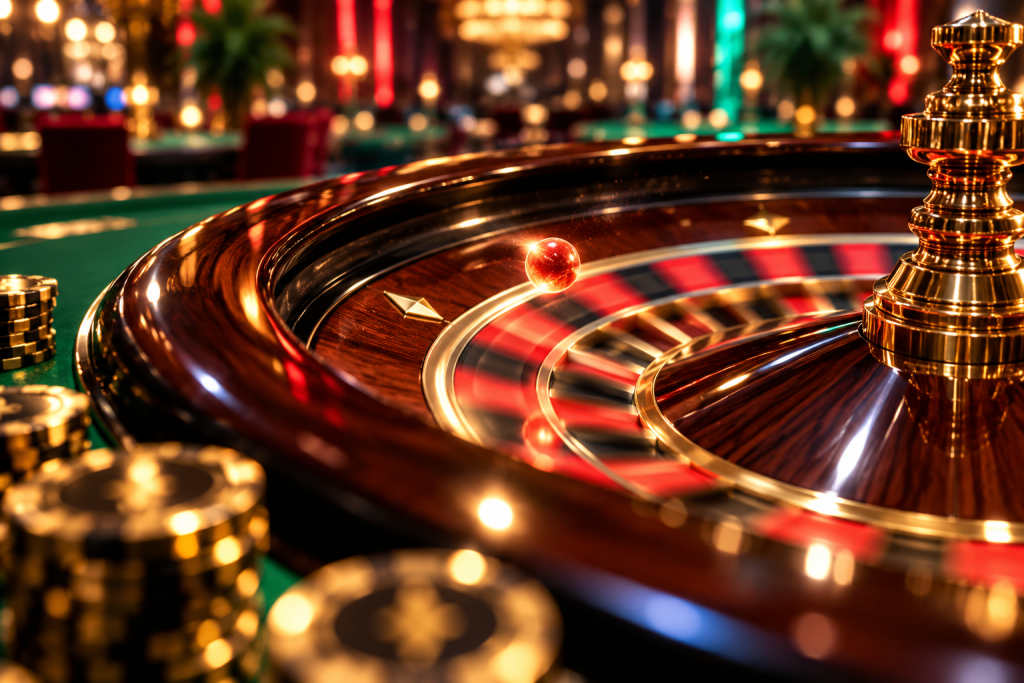
The wheel has no memory, and no number is owed a win
A player walks up to a roulette table and sees a screen showing the last fifteen results. 17 has hit three times. The player bets 17, convinced it is 'hot'. Another player bets 23 because it has not appeared in forty spins and 'must be due'. Both are acting on the same underlying belief: that the wheel somehow cares about its own history. It does not. Every spin on a properly functioning wheel is an independent event, and the odds of any single number landing are identical on every spin, no matter what happened before.
So when people ask about lucky numbers in roulette, the honest answer has two layers. The first is cultural and personal: some numbers carry meaning for individual players, and that meaning is real to them. The second is mathematical: no number on the wheel is luckier than any other. The wheel is a physical randomising device, and its design is what determines where the money goes over time.
What the wheel is
Roulette comes in two main layouts, and the difference matters more than any lucky number ever could. A European wheel has 37 pockets, numbered 0 through 36, with a single zero. An American wheel has 38 pockets, adding a double zero alongside the single zero. The extra pocket is not a neutral addition; it changes the arithmetic of every bet on the table.
When you bet on a single number on a European wheel, you are paid 35 to 1. But the true odds against that number landing are 36 to 1, because there are 37 pockets and only one of them wins for you. The gap between the payout and the true odds is where the house edge lives. On an American wheel, that gap widens because there are now 38 losing pockets against the same 35-to-1 payout.
| Wheel type | Pockets | True odds against a single number | Payout for a single number | What the extra pocket does |
|---|---|---|---|---|
| European | 37 (single zero) | 36 to 1 | 35 to 1 | Creates the house edge |
| American | 38 (single and double zero) | 37 to 1 | 35 to 1 | Widens the house edge further |
The zero is not a lucky number or an unlucky one. It is the mechanism through which the house keeps a percentage of every wager over the long run. When the ball lands in zero on a European wheel, every bet on red, black, odd, even, high or low loses outright. That single pocket is the entire reason the game is profitable for the operator.
RTP and house edge: two names for the same arithmetic
Return to Player (RTP) and house edge are complements. For the same bet under the same rule set, they sum to 100%. If a game has a house edge of 2.70%, its RTP is 97.30%. Neither figure promises anything about your next spin or your next hundred spins. They describe what happens across an enormous number of wagers, the kind of volume a busy table sees over months or years, not over one evening.
Here is the arithmetic, using a hypothetical example. Suppose you bet 1 unit on a single number on a European wheel, and you do this 37 times, once on each pocket. As an example, if each spin were independent and you covered every number exactly once, you would expect to win once and collect 35 units in profit on that winning spin, while losing 36 units on the other 36 spins. Your net result across those 37 bets would be a loss of 1 unit. That 1 unit, divided by the 37 units wagered, is the house edge expressed as a percentage. The same logic applies to every bet on the layout, though the edge differs by bet type.
What this means for lucky numbers is simple: no number returns more than any other. The payout for a winning single-number bet is fixed at 35 to 1, and the probability of any given number landing is fixed by the wheel's design. A number that has hit five times in a row has exactly the same chance of hitting on the next spin as a number that has not appeared in two hundred spins.
Why short sessions look nothing like the long-run average
RTP and house edge are statistical averages, and averages are almost invisible in a short session. If you play twenty spins and hit your number twice, you are ahead. If you play twenty spins and hit nothing, you are down twenty units. Both outcomes are ordinary. Neither tells you anything about the wheel's long-run behaviour, and neither changes the edge on the next spin.
Volatility, also called variance, is what creates this gap between the short run and the long run. A single-number bet is high volatility: most spins lose, but the rare win pays 35 to 1. A bet on red or black is lower volatility: you win close to half the time, but the payout is only even money. Volatility does not change RTP. It changes the shape of your session, how often you win, how large the wins are, and how long a given bankroll tends to last.
| Bet type | Payout | How often it tends to win | Volatility | What stays the same |
|---|---|---|---|---|
| Single number | 35 to 1 | Rarely | High | House edge on that bet |
| Red or black | Even money | Close to half the time | Lower | House edge on that bet |
| Dozen or column | 2 to 1 | Roughly a third of the time | Moderate | House edge on that bet |
Choosing a lower-volatility bet does not make you more likely to finish ahead. It changes the rhythm of wins and losses. The house edge is built into the payout structure, and it applies to every bet on the table, just at different rates.
Decisions per hour and total exposure
One of the least discussed variables in roulette is speed. The wheel does not care how fast you play, but your total exposure does. Every spin is a fresh wager with the same edge attached. The more spins you play in an hour, the more total money you put at risk, and the more the long-run average has room to express itself.
Suppose, as an example, you bet 1 unit per spin on an even-money bet. If the table runs at 40 spins per hour, you wager 40 units in that hour. If it runs at 80 spins per hour, you wager 80 units. The house edge is applied to every unit wagered, so the expected loss over the session grows in proportion to the total amount you put on the felt, not in proportion to how long you sit there. This is why two players at the same table with the same bankroll can have very different nights: one is making twice as many decisions per hour as the other.
This is also why 'lucky number' thinking is expensive. A player who believes a number is due will often chase it with repeated bets, increasing decisions per hour and total exposure. The wheel does not become more likely to hit that number because the player has now bet it thirty times. The probability on the thirty-first spin is the same as on the first.
Progression systems redistribute outcomes; they do not remove the edge
Many roulette players use progression systems, most famously the Martingale, where you double your bet after every loss so that a single win recovers all previous losses plus one unit. The logic feels sound, and in a world with infinite bankrolls and no table limits it would appear to work. Real tables have neither.
What a progression system does is change the distribution of outcomes. Most of the time, the system produces a small win. Occasionally, it produces a catastrophic loss, the long losing streak that either exhausts the bankroll or hits the table maximum. The small wins and the rare disaster average out to the same house edge that was there before the system existed. The system does not change the edge; it rearranges when the losses arrive.
Here is a hypothetical example. Suppose you bet 1 unit on red and lose. You bet 2 units and lose. You bet 4 units and lose. You bet 8 units and lose. You bet 16 units and lose. You are now down 31 units, and the next bet in the sequence would be 32 units. If the table maximum is 25 units, you cannot make that bet. The system has failed at the exact moment it was designed to work, and the failure is built into the arithmetic. No betting pattern changes the fact that the wheel has 37 or 38 pockets and pays 35 to 1 on a single number.
What a player can control
The honest version of this article is that almost nothing about roulette is under the player's control. The wheel is a physical randomising device. The payouts are fixed. The house edge is built into the gap between the payout and the true odds. What the player does control is smaller, but it is real.
You control which wheel you play. A European wheel with 37 pockets has a lower house edge on most bets than an American wheel with 38. You control which bets you make. Different bets on the same table carry different edges, and a player who wants to minimise expected loss can choose the bets with the lower edge. You control decisions per hour. You control session length. You control the size of your wager relative to your bankroll. None of these choices makes a number lucky, and none of them makes you likely to win. But they determine how much you expose to the edge, and how long that exposure lasts.
If a number feels lucky to you, there is no mathematical harm in betting it, provided you understand that the feeling is yours, not the wheel's. The wheel does not know which number you picked, and it does not adjust its behaviour to reward or punish your choice. Every number on the layout faces the same arithmetic.
FAQ
Is there a number that hits more often than others in roulette?
No. On a properly maintained and balanced wheel, every pocket has the same probability of landing on any given spin. Short-run streaks are normal and expected, but they do not indicate that a number is more likely to appear in the future.
Do casinos track hot and cold numbers to help players?
Many casinos display recent results on a screen, and some players use those screens to look for patterns. The display is a record of what has already happened, not a prediction of what will happen next. Past spins have no influence on future spins.
Can a betting system make a lucky number more profitable?
No betting system changes the payout or the probability of any number. Progression systems change the timing and size of wins and losses, but the expected loss over time remains tied to the house edge on each wager. The only things a system reliably changes are session volatility and the speed at which a bankroll can be depleted.
Gambling involves risk. Please only gamble with funds that you can comfortably afford to lose. While we do our best to provide good advice, we cannot be held responsible for any loss that may occur as a result of gambling. We do our best to make sure all the information that we provide on this site is correct. However, from time to time, mistakes or changes may occur. We do not take responsibility for these. Some services cited in this article may not be available where you are. Please check with your local regulator or licensing authority. Everyone referred to in this article, no matter whether a professional, a compulsive or a responsible gambler, is 18+. If you need support, contact the National Gambling Helpline on 0808 8020 133.
Play responsibly
Gambling should be treated as paid entertainment, never as a way to earn income or recover losses. 1-800-MY-RESET (1-800-697-3738)
18+ or 21+ depending on where you are; follow the minimum age that applies to you.
This article is general information about how these mechanics work. It is not legal advice and not a recommendation to gamble or to use any particular operator. Availability and legality differ by jurisdiction — check the rules that apply where you are.