


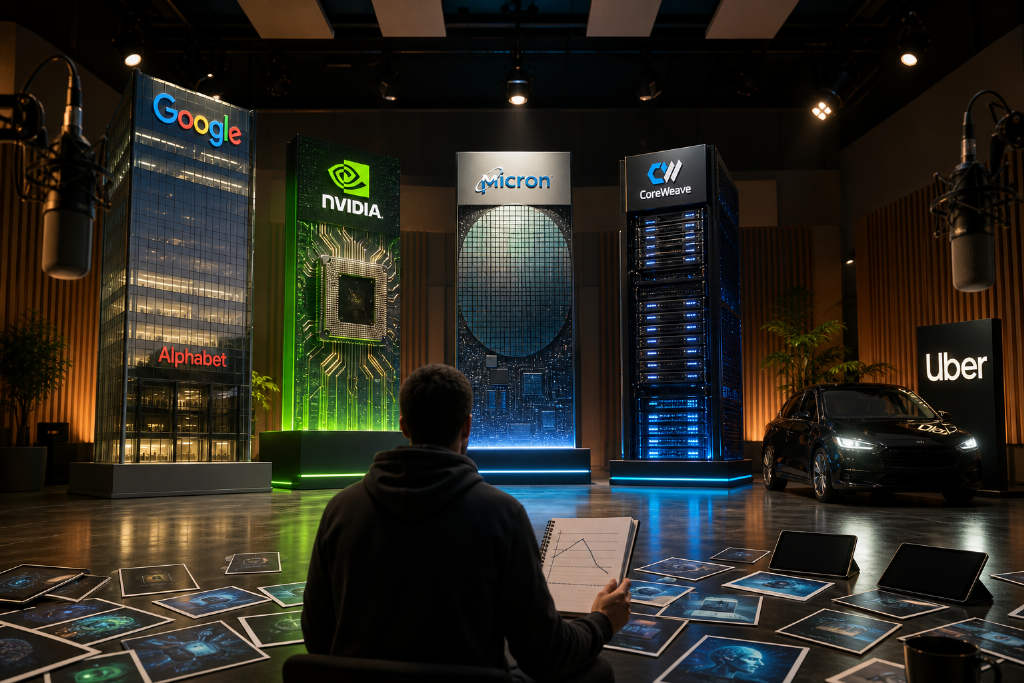
Brian Ferraro, who runs the Business With Brian channel, said a review of 21 YouTube investing channels and 141 stock videos left only five companies being mentioned again and again: Alphabet, Nvidia, Micron, CoreWeave, and Uber.

The episode was titled "21 YouTubers Agree on 5 Stocks. My Entry Points." It ran 25:19, was published on Aug. 25, 2026, and had recorded 127,000 views. The source material identified Ferraro as an independent investor and said the BWB channel had 429,000 subscribers.
Ferraro disclosed his own positions at the start. He said he owns Nvidia, which makes up more than 12% of his portfolio and has already hit his self-imposed limit. He also owns Alphabet, Micron, which he said he is still buying according to plan, and Uber. He does not own CoreWeave. The episode also carried paid sponsorship from Galaxy Premium Yield, a cash-management tools provider. Ferraro added that every price level cited in the show came from his personal model and was not investment advice.
Only five stocks kept showing up across 141 videos
Ferraro said one creator spent 11 days going through 141 stock videos from 21 YouTube investing channels, watching only the stock-discussion portions of each episode and logging every name into a spreadsheet. When that work was done, only five companies kept resurfacing: Alphabet, Nvidia, Micron, CoreWeave, and Uber. More than 100 other companies were mostly mentioned once and then disappeared from later discussion.
He did not present that list as something to copy blindly. Ferraro said Steve Eisman, the investor known as the real-life inspiration for the main character in The Big Short, also watched this type of podcast content and reacted by selling Google. Eisman’s line, as cited in the episode, was simple: these AI stocks are really the same trade, and they either win together or lose together.
Ferraro then broke down the 141 videos by topic. He said 76 of them were about chips, cloud infrastructure, and AI models, a little more than half the sample. On that basis, four of the five repeatedly favored stocks — Alphabet, Nvidia, Micron, and CoreWeave — amount to the same AI bet under different names. Uber, in his view, was the only one that stood apart.

Alphabet: $362 at the time, but only a half position
Why people like it
Ferraro said Alphabet looks among the cheapest it has been in a decade if measured against profits already earned. He put the stock at $362, about 14% below its May all-time high. Valuation-focused creators he cited generally placed fair value somewhere between $350 and $450.
He also pointed to a news item involving Berkshire Hathaway. According to the episode, Warren Buffett’s conglomerate had recently increased its Google position sharply, nearly doubling it, and Google had moved into Berkshire’s top three holdings.
What worries people
Using a different yardstick flips the answer. Measured against revenue, Ferraro said Google sits in the most expensive 3% of its own 10-year history. His point was that the same company can look cheap or expensive on the same day depending on which line of the financial statements an investor chooses to emphasize.
He also recalled an experiment from another creator’s livestream. That host first asked viewers at what price they would sell Google, and everyone wrote down a number. After the Berkshire accumulation news was revealed, the host asked again. Everyone changed their answer. Ferraro used that example to show how quickly retail discipline can break when fresh headlines arrive.
Ferraro’s position
At $362, he said he would only take half of his normal position size and buy through monthly dollar-cost averaging rather than going heavy. Cheap and expensive can both be argued, so his answer was to buy less and buy slowly.
Nvidia: $221, model value above that, but his allocation is already full
Why people like it
Ferraro said one creator built an Excel model using Nvidia’s assets, liabilities, and share count and came up with an intrinsic value of about $300 per share. Against a market price of $221, that implied the stock was roughly one-quarter to one-third below model value.

Ferraro’s own model produced a fair value of $290, while the broad sell-side expectation cited in the episode was $330. He said those figures all pointed in the same direction: undervaluation.
What worries people
The fear he highlighted was outside the standard valuation debate. Ferraro said Nvidia’s customers had borrowed about $500 billion to buy chips, nearly twice Nvidia’s annual revenue, with repayment periods stretching as long as five years. He added that those debts ultimately sit on pension balance sheets.
He also said the cost of buying default insurance on debt linked to Nvidia had doubled since late May. In his framing, equity investors may be talking bullishly, but the insurance market is signaling discomfort with the structure underneath.
Ferraro’s position
Even though his model says $290, Ferraro said Nvidia already accounts for 12% of his portfolio, which is the maximum he allows, so he is not adding.
He also set a hard line lower down. Below $148, he said he would not buy at all. If the debt-funded chip-buying chain really breaks, that level would not mean a bargain to him; it would mean the company story had changed.
Micron: biggest upside in his model, but still only a planned buy
Why people like it
Ferraro said his model assigns Micron a fair value of about $1,450, the largest upside among the five names in his table. He also said the company’s production capacity is effectively sold out through 2027, with orders already locking in output.

What worries people
Micron’s valuation argument depends on which profit number is used. Ferraro said the stock trades at 22 times realized earnings, which is not cheap, while the common "cheap" argument refers to about six times next year’s expected earnings.
Those two numbers can coexist only if the market is assuming Micron’s profit will triple. In his telling, buying Micron is really a bet on whether that threefold increase arrives.
He also stressed that Micron is a cyclical stock. At the top of a cycle, cyclical names often look cheap, and Ferraro said memory companies have fallen 70% from peak levels more than once in the past.
Ferraro’s position
Ferraro said his own model is internally conflicted on Micron: one side says the stock is cheap, while a comparison with Micron’s own history says it is expensive. He chose to listen to the more cautious signal and keep the position small.
- The 50-day moving average at $961 is his master switch. Because the stock has already fallen below it, he will continue buying according to the original plan but will not add an extra dollar.
- He would only increase the position after the stock moves back above $961.
- $434 is his "the company is broken" line. If the price reaches that level, he said the whole story has changed and his earlier analysis no longer applies.
Ferraro also contrasted his method with another creator’s approach: buy at $135, add at $275, then add again at $500, each step coming after a fresh breakout to new highs. That is a momentum trader’s framework. Ferraro’s is the opposite, waiting for lower prices before buying. His point was not that one is right and the other is wrong, but that the fit depends on the investor.

CoreWeave: $104 on the tape, no position from Ferraro
Why people like it
Ferraro said CoreWeave has $130 billion in contracted orders. One creator he cited put fair value at $113, compared with a market price of $104.
What worries people
He framed the risk through an older market analogy. In 1999, Ferraro said, the U.S. had a star stock called Lucent. Lucent lent money to customers, those customers used the money to buy Lucent equipment, and Lucent counted the transactions as revenue. The numbers looked strong until one customer came back for another $90 million, was refused, and went bankrupt a few weeks later. Only then did investors realize that some of the demand may have been financed into existence by the seller itself.
Ferraro then linked that story to CoreWeave. He said Nvidia disclosed in an SEC filing that it agreed to lease back all compute capacity that CoreWeave could not rent out through 2032. In plain terms, he said, part of the demand appearing on CoreWeave’s statements may involve the seller backstopping its own customer base.
That is why he argued the structure looks very similar to the old Lucent example.
Ferraro’s position
His answer was simple: zero position, keep watching. CoreWeave has been public for only 17 months, he said, which is not enough history for him to map out his usual entry ladder.
He made a point of separating observation from ownership. Standing aside, he said, should not be confused with secretly buying after saying you are cautious.

Uber: the only relatively separate name, and his strongest buy tier
Why people like it
Ferraro said Uber is the only stock in the group that is not fundamentally part of the core AI trade. The company generates about $10 billion in free cash flow a year, has a market capitalization of about $150 billion, and sits in the cheapest third of its own 10-year range, according to the episode.
Uber was mentioned by only one creator across the 141 videos, yet Ferraro ranked it as the deepest buy on his whole list.
He also highlighted a valuation cross-check. That other creator independently arrived at a fair value of $120 for Uber, while Ferraro’s own estimate was $109. They had not seen each other’s work, but the two results were separated by only about $10, or roughly 5%. He said the stock was at $67 on the recording day, after a 7% decline.
What worries people
The central discount factor is autonomous driving. Ferraro said either Waymo and similar services take riders away from Uber, or Uber is forced to own fleets itself and turns into a very different, asset-heavy business.
Ferraro’s position
Uber sits in his deepest buy tier, and he said he buys it at full size. His anchor is free cash flow rather than accounting profit, because one-time items can distort profit while cash flow, in his view, is cleaner.
He said the market is pricing Uber as if future profit will weaken, while he values it on the durability of cash flow. The gap between those two frames is where he sees upside.

The four questions Ferraro says to ask before buying any stock
Ferraro closed with a four-question checklist behind his entry framework:
- Is the stock expensive or cheap relative to its own history?
- What is the current price already assuming?
- Are you mixing up a good company with a good price?
- What would make you change your mind?
He added one practical note. Writing down an exit price before entering a position and searching for an exit after losing money are, he said, two completely different mental states. The first is discipline. The second is damage control.
Five stock names may still amount to one AI bet
Ferraro ended by returning to the theme split in the 141-video sample. More than half of the videos — 76 out of 141 — were talking about the same underlying subject: chips, cloud infrastructure, and AI models.
Even Uber, the only relatively separate pick in the group, still carries autonomous-driving risk that runs through Nvidia’s chips. That is why Eisman’s warning mattered to Ferraro. If a watchlist is assembled from this type of content, it may look diversified across five companies while really being the same AI trade expressed through five different names.
Ferraro acknowledged that point directly at the end of the show, saying his own list had been built in much the same way.