

Software stocks are being repriced, but not evenly
Andreessen Horowitz said the pain across publicly traded software companies is still real, though it does not look like an indiscriminate wipeout. In the firm’s latest note, the selloff is framed less as a judgment on current or near-term operating results and more as a market-level debate over whether these businesses can sustain their performance over time.
The report says valuation multiples on next-twelve-month free cash flow for software companies now sit at or below 2014 levels. In its reading, investors are assigning one of the lowest premiums in more than a decade to the cash-generation capacity of software businesses. a16z added that even if the evidence for the claim that “SaaS is dead” remains thin today, investors are being paid to form a view on the future, and right now that future is being discounted more harshly.
Still, the firm said the market is no longer treating software as one homogeneous group. Looking at the IGV index, it noted that over the last 30 trading days both the top quartile and the median stock outperformed the ETF as a whole, while the bottom quartile weighed on aggregate returns. That weaker bucket included some of the larger names in the group.
Over a one-year lookback, the pattern was different at first, with the median name tracking the broader ETF more closely. Around the start of the year, that changed. The report says the spread between the top and bottom quartiles has widened to roughly 50 percentage points.
a16z also argued that recent price action has not mapped cleanly to simple growth metrics. On revenue growth alone, it said there is little visible correlation with short-term performance. Many software companies sit in a roughly 10% to 20% revenue-growth band, yet their stock performance is scattered widely. Some of the fastest growers, including some of the largest companies in the ETF, are in the bottom performance quartile.
What the market appears to care about more, the note said, is perceived long-run durability. When grouped by sector, the strongest and second-strongest quartiles were dominated by two clusters: cybersecurity and observability on one hand, and vertical SaaS on the other. The lower two quartiles, by contrast, were more heavily made up of horizontal SaaS, cloud and infrastructure, and a broader “other” bucket that included marketplaces, ad tech, point solutions and hard-to-classify names such as MicroStrategy.
That distinction matters because, in a16z’s view, investors are now drawing a fairly explicit line between software companies that seem to have some AI defense or AI tailwind and those that do not. In cybersecurity and observability, AI is expected to raise buyer urgency, while incumbent vendors may retain a trust premium that newer challengers cannot easily break. In vertical SaaS, specialized information embedded in workflows, data and customer relationships is being treated as a barrier to entry for AI-native challengers.
For many others, the note was blunt: software by itself is not a moat. Years of sticky and compounding ARR, broad feature sets and widespread adoption are not earning the same benefit of the doubt from the market. a16z said a few quarters of stable or improving growth could change that view, but at this stage investors remain unconvinced.
Cheaper intelligence is driving broader AI demand
The report then turned to AI usage economics and a shift it described as moving from “token-maxxing” to “token-optimizing.” The idea is straightforward. Frontier model training costs keep rising, but the marginal benefit from each new jump in frontier performance may not always be enough to justify the extra cost for customers. Instead of maximizing use of the newest and most powerful tokens, customers may downgrade where possible to cheaper and weaker models, including open-weight alternatives.
Some critics see that shift as a challenge to the sustainability of frontier model development: if users will not fund the cost of the strongest models, what happens to the labs building them? a16z did not try to settle that broader dispute. Its narrower observation was that intelligence costs are falling quickly, and that seems to be stimulating demand rather than suppressing it. The firm framed this as a Jevons-style dynamic: the cheaper AI gets, the more people and companies want to use it for more tasks.
To illustrate the point, the note compares AI adoption economics with an earlier technology wave that also began as centralized and expensive before becoming far more distributed and affordable: the personal computer. According to the report, PCs took nearly two decades to achieve the affordability gains that AI has reached in about three years. That pace, a16z wrote, is extraordinary, and as happened with computing, falling costs appear to be helping push the demand curve up and to the right.
On the consumer side, the note cited PNC Bank data showing that the share of households paying for AI remains small but is rising. Average monthly spending by those households is also moving higher, and the spending line is steeper, up about 25% since the start of the year. For perspective, the piece says only about 45% of adults aged 35 to 54 reported owning a PC in 1997, decades after computers had already been commercialized mainly in enterprise settings. Today, household computer ownership is around 90%, and close to 97% if smartphones are included. The point, a16z said, is that mass-market adoption takes time and expands with usefulness and cost declines.
The note also cited YipitData analysis of OpenRouter data, which covers a subset of total token consumption. It said frontier-token usage is still rising while open-weight tokens continue to gain share quickly. “Asian providers,” used in the report as a proxy for open-weight substitutes, now account for about 60% of total tokens, triple the level seen at the beginning of the year. a16z acknowledged that OpenRouter’s sample may skew at least somewhat toward open-weight users, but said the pattern is still consistent with a pricing-tier story and with the broader Jevons-style demand thesis.
Using another OpenRouter readout, the report said both token use per user and spending per user are climbing quickly, but token consumption per user has risen much faster than spending since the start of the year. That, in a16z’s framing, points to a market where falling intelligence costs are broadening demand rather than capping it. Cheaper tokens from sub-frontier models are taking share, but the net effect is still a sharp increase in total spending. The report said that is difficult to read as a bearish signal.
The note did not dismiss concerns that open-weight models may pressure frontier players. Its argument was narrower: a scenario in which efficiency gains have no clear effect on demand, or one in which they actually pull total spending down, would look much more negative. What the current data shows instead, according to a16z, is closer to what bullish observers would want to see.
Entry-level hiring data does not support an AI jobs-collapse narrative
a16z then shifted to labor. It argued that while AI is often described in contradictory terms — too weak to generate meaningful ROI but somehow strong enough to wipe out broad categories of work — the data so far does not show meaningful job destruction. The firm focused in particular on entry-level hiring, an area that has often been treated as vulnerable.
Using Revelio data, the report said tracked summer internship activity for 2026 is running well above prior years. Internships are not the same thing as full-time jobs, the piece noted, but they still function as a demand signal for younger workers. On that measure, the 2026 cycle is running ahead of 2025 and 2024, though not as high as 2023.
ADP data, according to the note, tells a similar story from a wage angle. Pay growth for younger workers aged 16 to 24 has rebounded from its 2025 low. Wage growth is treated in the report as a demand signal, so a pickup there is consistent with improving entry-level employment conditions.
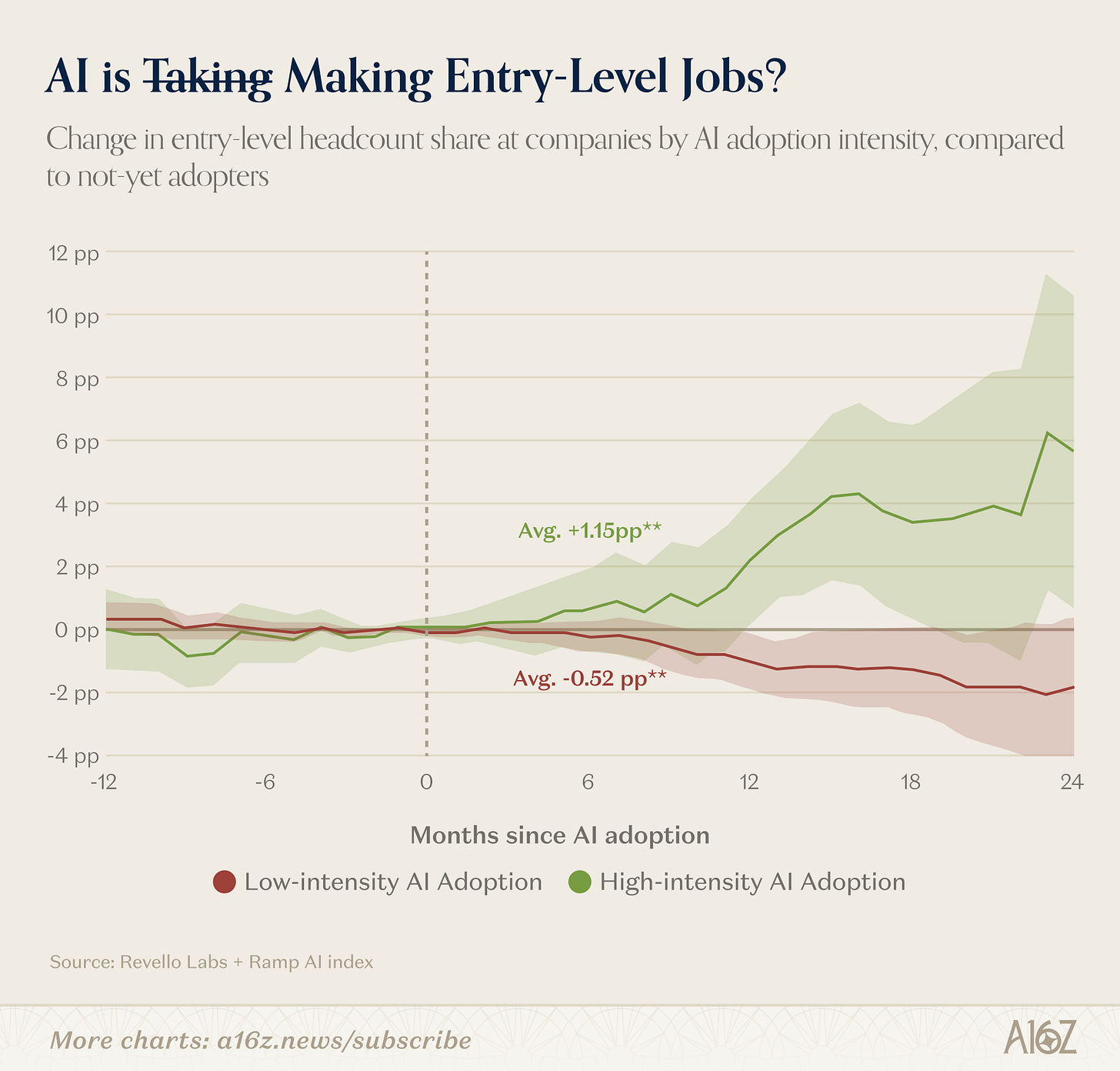
The most direct AI-linked claim in the labor section came from an analysis of Revelio job data and Ramp spending data. a16z said “high-intensity AI adoption” corresponds to about a 6 percentage point increase in the number of entry-level employees two years after adoption, while “low-intensity” AI adoption corresponds to about a 0.5 percentage point decline.
A chart included in the piece presented a related version of that result: among high-intensity AI adopters, the share of entry-level employees rises by an average of 1.15 percentage points two years later, while low-intensity adopters see a 0.52 percentage point decline. The report laid out several ways to interpret that outcome. One is that AI is helping create entry-level hiring. Another is that AI adopters are simply growth companies and growth companies hire more people anyway. A third is that Ramp’s data may not represent the broader economy well enough to justify a firm conclusion.
But a16z said one interpretation is hard to defend with the available evidence: that AI is currently destroying entry-level work. That might happen at some point, it wrote, though it also suggested there are good reasons to think it may not. For now, the evidence does not support that call.
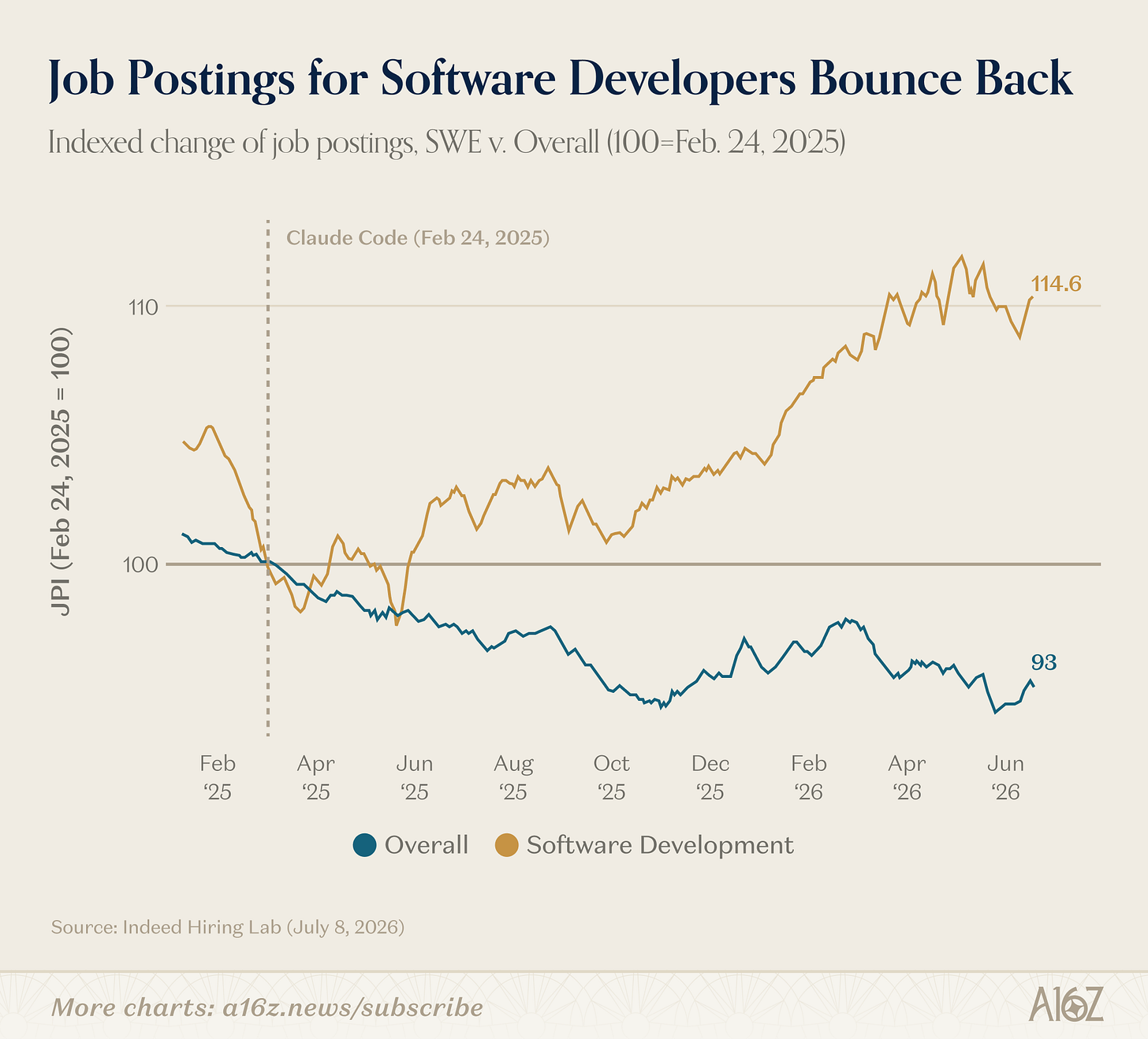
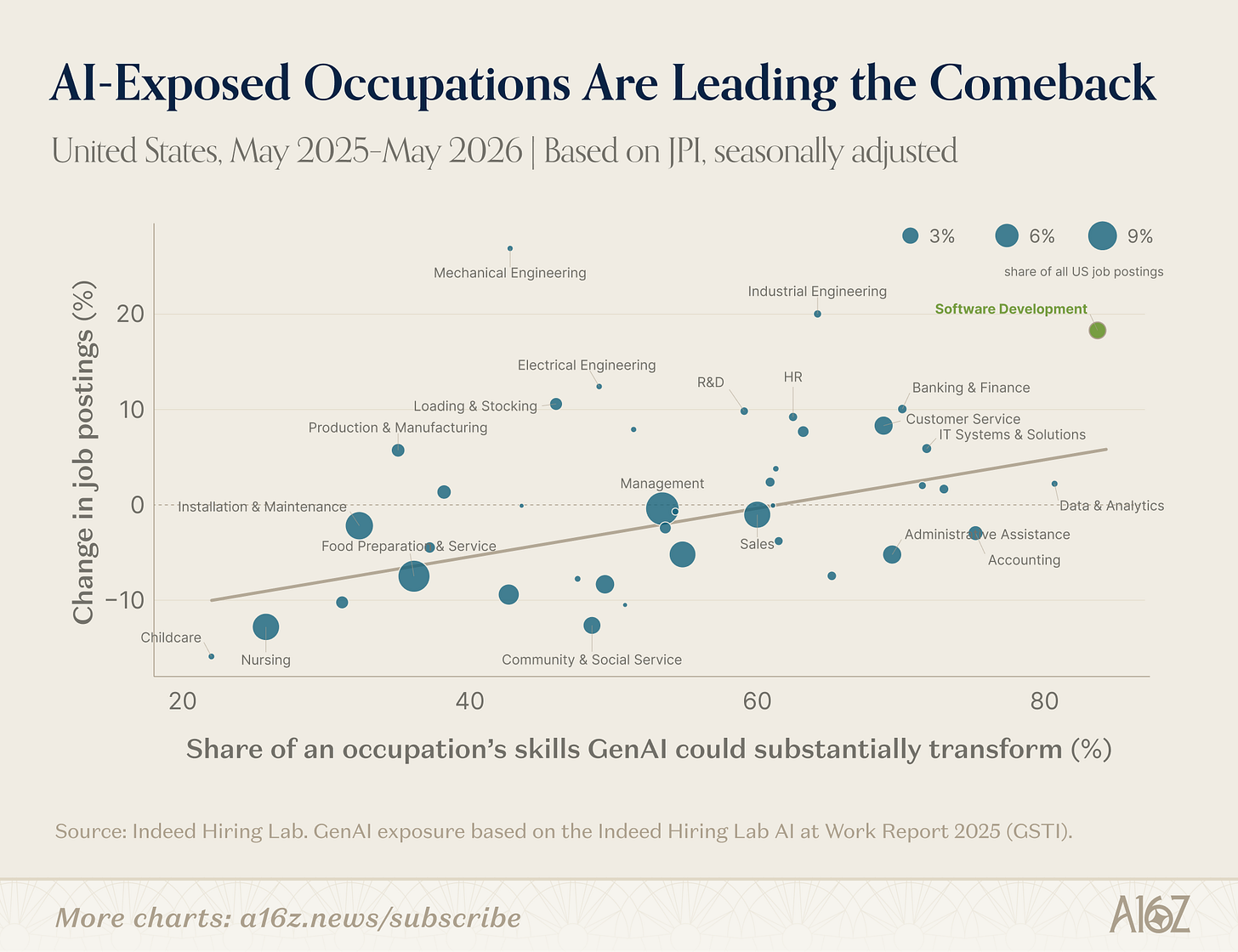
At a broader level, the note cited Indeed Hiring Lab data showing that, since May 2025, job categories with greater AI exposure have seen stronger recoveries in openings. Software engineers stand out the most. Since the launch of Claude Code, software job postings are up about 15%, while the broader market is down about 7%. Earlier in the piece, a chart was described as showing software-development postings rebounding to 114.6 while the overall market slipped to 93.
a16z said that makes it premature to argue that AI is rendering human workers obsolete. If anything, the current data points in the other direction, with AI exposure appearing to correlate positively with employment growth rather than negatively.
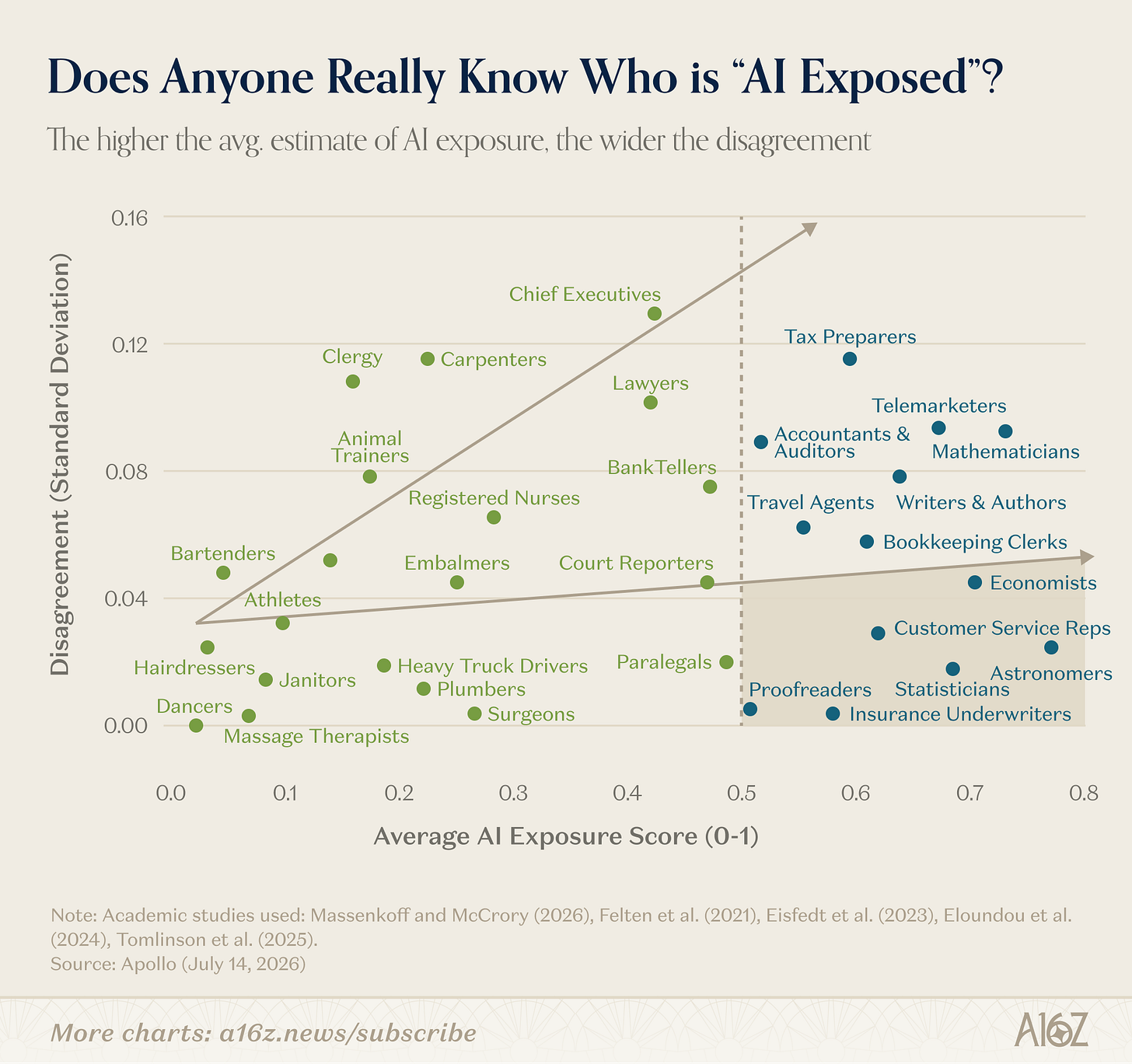
The firm did add an important caveat. “AI exposure” remains a disputed category, and there is little consensus on who is exposed to AI, or by how much. The note says that the higher the average AI-exposure score assigned to a given occupation, the larger the disagreement across researchers about the size of that exposure.
There are some exceptions where views seem more aligned. The report said proofreaders, insurance underwriters, statisticians and, notably, economists are all widely seen as highly exposed to AI.
Data centers and electricity prices move in a less intuitive way
The energy section of the note focused on a policy move announced earlier in the week by New York Governor Kathy Hochul: a one-year pause on data-center development. One stated goal of the pause, as quoted in the report, is to “protect utility ratepayers” because data-center development threatens to push up electricity bills. The note added that Hochul discussed her reasoning in more detail on the Odd Lots podcast.
a16z said that claim is difficult to square with the evidence it reviewed. While data centers do increase electricity demand, the firm argued that they may actually help lower user costs.
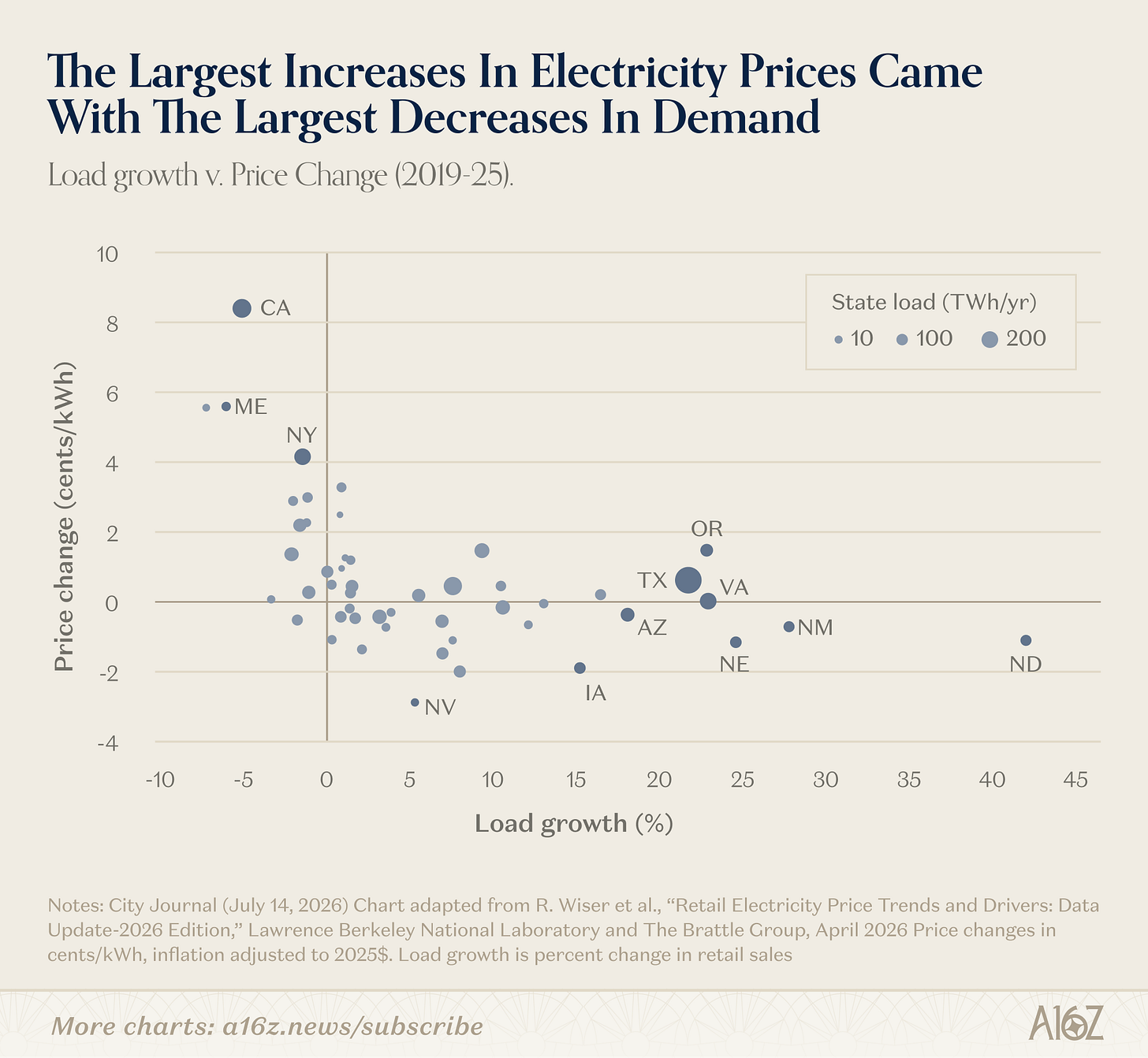
Citing work from Lawrence Berkeley National Laboratory and The Brattle Group, the note said that at the state level in the US, electricity price increases are negatively correlated with demand growth. In other words, places consuming more have in many cases paid less. Over the last six years, states with some of the fastest load growth and the most data-center development, including Texas and Virginia, have seen little price inflation. By contrast, states with the largest price increases and relatively little new data-center buildout, including California and New York, have seen weaker load growth. The report says California’s electricity demand fell about 5%, yet its power-price increase was larger than in any other state, about 33% above the second-highest state.
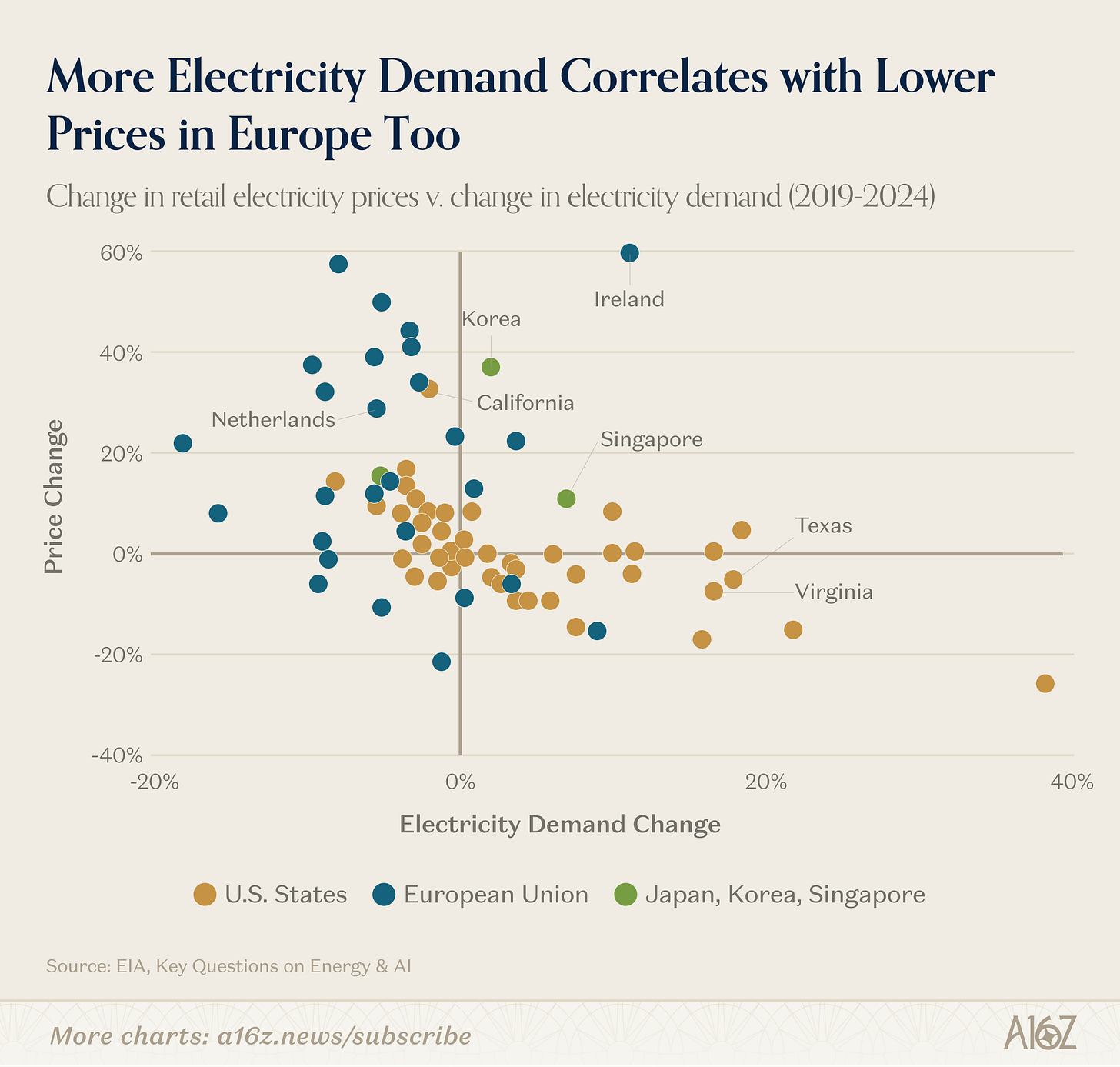
The note then extended the same comparison to Europe. Using EIA data, it said that, with Ireland as an exception, the European Union countries with the biggest power-price increases were also the ones with the largest declines in electricity demand.
The explanation offered in the report is that electricity grids often benefit from economies of scale. The more demand there is, the more fixed infrastructure costs can be spread out, potentially lowering the all-in price paid by users. On that basis, a16z argued that New York’s data-center pause may fail to protect ratepayers and could even produce the opposite result if it leaves fewer customers sharing fixed grid costs. The firm also noted that this relationship may not hold forever, but said it is what the data has shown so far.
AI-related infrastructure remains one of the few growth engines
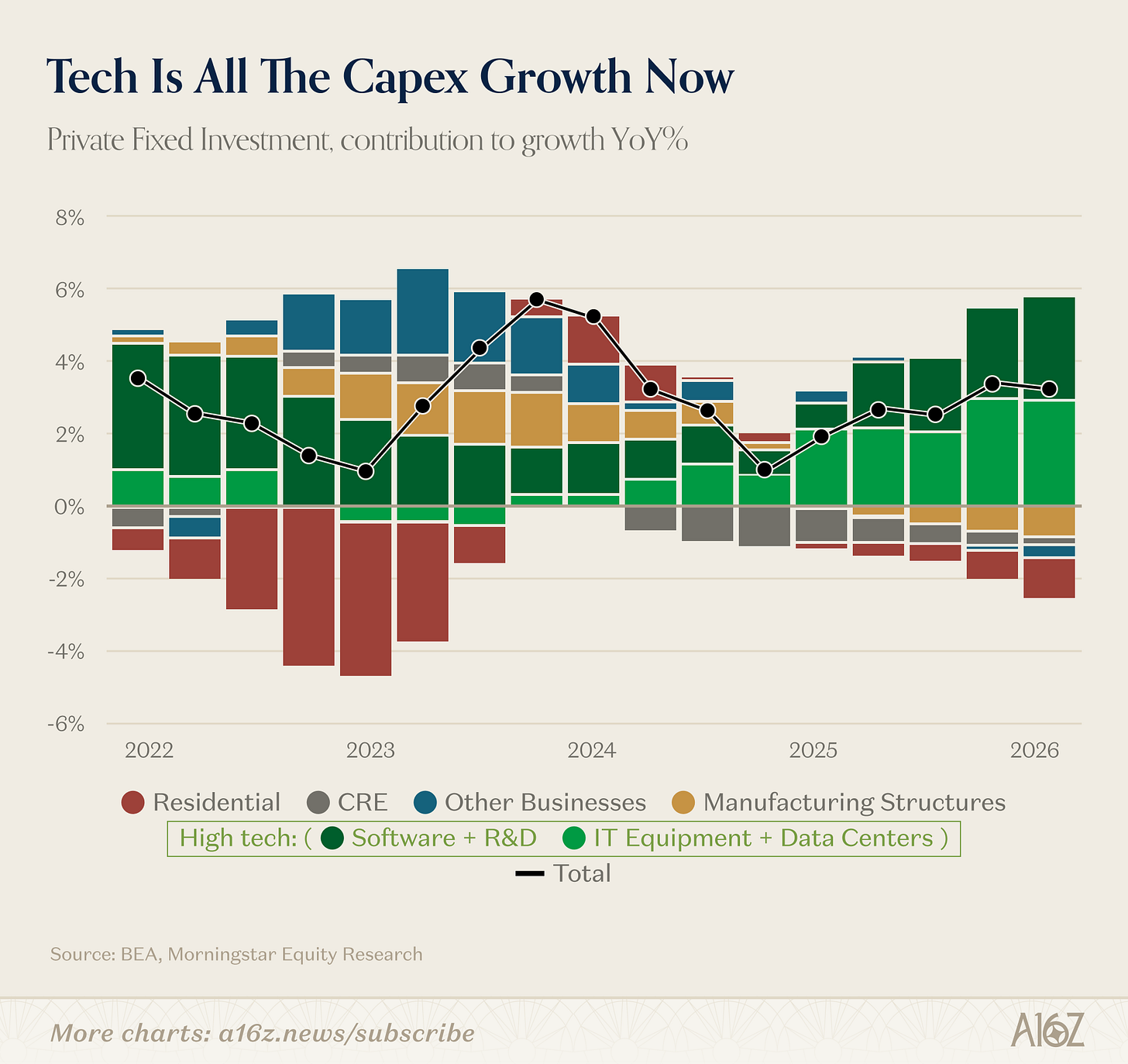
Beyond electricity prices, the report tied the data-center debate to a broader investment picture. Without AI-related infrastructure spending, it said, there is very little visible investment growth in the current environment. Technology-related investment, including software, R&D, IT equipment and data centers, is described in the note as the only category still contributing positively to private fixed-investment growth.
That is why a16z views a halt to data-center development as a direct hit to one of the strongest remaining tailwinds in the economy. The note ends by saying the governor may have her reasons, but a policy that could both raise electricity prices and weaken what it calls New York’s most important investment tailwind is hard to understand.