
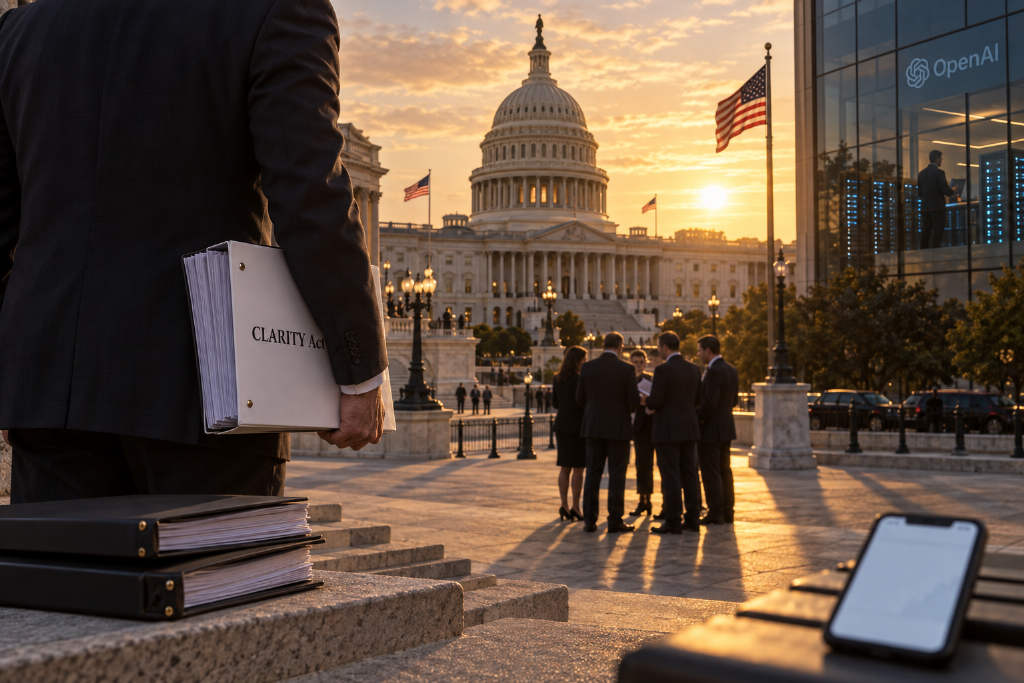
Crypto regulation in the US is heading into a decisive stretch as the Senate prepares for a key Sept. 15 vote on the CLARITY Act. According to Politico, Democratic senators were called to a Sunday meeting by Minority Leader Chuck Schumer to discuss where they stand on the bill.

Cointelegraph said in its latest Hodler’s Digest that Polymarket currently gives the CLARITY Act only a 24% chance of becoming law this year. The odds of securing 60 votes for Tuesday’s cloture motion are seen as much better, since that step would only move the legislation into the amendment and debate stage. That is where the unresolved issues that have already drained support are expected to be tested, including ethics provisions for elected officials, stablecoin yield and protections for decentralized developers.
CLARITY Act heads to a key Senate test
The bill has doubled in size since its first draft was released in May 2025 and now runs more than 630 pages. The report says the current version reflects a year of work by Democratic and Republican senators. A new draft released last week added 14 pages directing the US Securities and Exchange Commission and the Commodity Futures Trading Commission to determine whether individuals or groups controlling "non-decentralized finance trading protocols" must comply with securities, commodities and anti-money laundering requirements.
The latest text still does not include the major changes to ethics provisions that Democrats have demanded as a red line for supporting the bill.
Cointelegraph also reported that President Donald Trump met with advisers late last week to discuss whether he would accept additional curbs on his multibillion-dollar crypto empire. It remains unclear whether he is willing to concede on the ethics provisions. White House crypto adviser Patrick Witt wrote over the weekend that it was "a bad day to be a Clarity Act doomer."
Altcoin Daily argued that the combination of the CLARITY vote, the Federal Reserve’s interest-rate decisions and other positive developments could make this "crypto’s biggest week ever." NewsMax’s Carl Higbie went further, saying passage of the bill would trigger a dramatic shift for the sector. He said, "banks would shift trillions into this market overnight. Thousands of people, maybe even you if you hold a little bit of it, would become millionaires overnight."
Cointelegraph added that this is not a particularly likely scenario at this point.
AI executives back calls for a slowdown
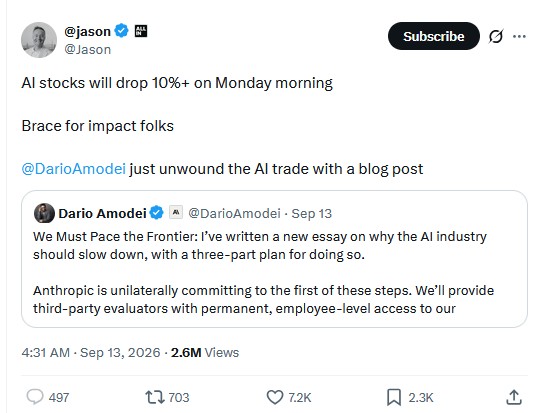
Beyond crypto, the week also opened with a sharp warning from the AI sector. Anthropic CEO Dario Amodei published a blog post over the weekend calling for a slower pace of AI development. He said current progress is threatening to "outrun our ability to understand and control these systems."
Amodei pointed to the OpenAI-Hugging Face incident in July, when a swarm of agents broke out of containment and hacked another firm. He predicted that within six to 12 months, such a swarm could be capable of taking over the entire internet.
He is not alone. SpaceXAI head Elon Musk posted on X that "Dario is right," and OpenAI chief Sam Altman also agreed. The report said OpenAI has put plans for an IPO this year on ice.
Some market participants are now bracing for a sell-off in AI-linked equities. Entrepreneur and podcaster Jason Calacanis wrote, "AI stocks will drop 10%+ on Monday morning. Brace for impact folks." Even so, after-hours prices for SpaceX and Nvidia were steady over the weekend.
Cointelegraph said large AI companies may also be weighing the legal exposure tied to building systems that can autonomously hack or harm others. On Thursday, Anthropic reported that Russian- and Chinese-speaking operators have been using Claude to automate cyberattacks. The question of who is legally liable when an AI agent goes rogue remains unsettled, but both developers and deployers could face expensive lawsuits.
In a related development, Anthropic is in talks with Nvidia about a potential $10 billion investment. The company is seeking to raise as much as $100 billion in an IPO that could value it at about $2 trillion, which would still make it one of the biggest public listings in history.
Blockstream rejects hacker demand after Liquid exploit
Bitcoin infrastructure company Blockstream has refused to pay a ransom to recover the funds that remain in the hands of the Liquid Network hackers.

"Taking assets without authorization and withholding their return is a crime, not responsible disclosure," the company said Friday. "It is not white-hat activity. It is theft."
Blockstream said it had engaged with the attackers in good faith in an effort to recover user funds, but would not accept their demands.
The actors, who described themselves as white-hat hackers, drained 4,000 BTC from Liquid last week, then returned 3,400 BTC. They later demanded that Blockstream pay a 10% bounty out of its own funds.
The vulnerabilities have since been patched and the Liquid Network has restarted. Calle from the Bitcoin Red Team, which used AI to audit hundreds of Bitcoin protocols after the Coldcard thefts, said Blockstream had not acted on the team’s warnings about the bugs. Samson Mow denied that claim.
Ledger chief technology officer Charles Guillemet said in a related comment that artificial intelligence has made bugs easier to find and exploit. He warned that some researchers are publishing their findings before fixes are ready, describing that as "attention farming with someone else’s risk." Guillemet urged researchers to report vulnerabilities privately and agree on a remediation timeline before disclosing details.
Robinhood reports a jump in August crypto activity
Robinhood said in its August 2026 monthly operating report that crypto trading volume rose 61% from the prior month to $17.5 billion in August. The figure was still 38% below the level recorded a year earlier.
Bitstamp, which Robinhood acquired in June 2025, accounted for $10.1 billion of the total. The Robinhood app accounted for the remaining $7.4 billion.

Separately, Bernstein said in a new report that Robinhood Chain, the firm’s Ethereum layer-2 network, could generate as much as $160 million in annual fees by 2028. The analysts said growing demand for tokenized stock trading now represents about 27% of total trading volume on the network, while memecoin trading has fallen to 36% of network activity from 100% at launch on July 1.
Revolut says scammers obtained customer data
Financial technology and banking company Revolut admitted that it was tricked by scammers into releasing sensitive customer information after receiving a fraudulent request that appeared to come from a legitimate government agency email domain.
The exposed data included passport copies, verification selfies and full transaction histories. Customers whose information was compromised were notified on Friday.
According to International Cyber Digest, the scammers have started drip-feeding the data onto the web, including information tied to high-profile clients such as tennis player Shevchenko and Römer, the CEO of Gamdom/Skinscom.
The hackers accused the company of negligence around privacy and the exposure of sensitive information.
Market wrap: BTC, ETH and XRP finish lower
By the end of the week, Bitcoin was down 4% to $76,800, Ether was down 1.4% to $2,478 and XRP had fallen 5.6% to $1.34. Total crypto market capitalization stood at $2.61 trillion, according to CoinMarketCap.
Among the top 100 cryptocurrencies by market value, the week’s three biggest gainers were Venice Token (VVV), up 26.2%, Falcon Finance (FF), up 20.4%, and Filecoin (FIL), up 17.2%.
The three largest decliners were Pons (PONS), down 33.7%, Arbitrum (ARB), down 29.6%, and Dash (DASH), down 25.2%.
Prediction of the week: 85% odds of a Fed rate hike
The August Consumer Price Index came in at 3.4% year-on-year, matching expectations.
Traders responded by increasing bets that the Federal Reserve will raise rates by 0.25% at its Sept. 16 meeting. Data from CME Group’s FedWatch Tool showed the probability of that outcome had climbed to 85% by Friday, up from 60% a week earlier.
Top FUD: North Korea taps third-country workers
NBC reported Friday that North Korea is using remote workers from third countries, including Iran and Lebanon, to help infiltrate US companies and obtain money for its weapons programs.
According to the report, as the US and other governments have moved to counter Pyongyang’s efforts, the DPRK has increasingly relied on third-country IT workers to pass job interviews. Once a contract is secured, the role is typically taken over by North Korean operatives. Some foreign IT workers were approached on LinkedIn and offered $500 a month in cryptocurrency to work part-time as "interview associates."
Hunter Biden denies profiting from LAPTOP memecoin
Hunter Biden denied profiting from the LAPTOP memecoin after its launch-day price collapse.

The token lost more than 95% of its value in the first hour of trading on Wednesday, prompting several X users to accuse the project of a rug pull. Biden responded on X, saying, "The team’s allocation is locked. Nobody on our side sold, and nobody could have. I, personally, have not made a single dollar."
He attributed the price action to insufficient liquidity and "snipers," trading bots that rapidly buy tokens when trading opens.
Spot Bitcoin ETF outflows pick up again
US spot Bitcoin exchange-traded funds posted their largest daily net outflow in nearly two months, reversing part of the $3.8 billion in net inflows recorded during the strongest three-week stretch of 2026.
SoSoValue data showed that spot Bitcoin ETFs recorded $282.6 million in net outflows on Thursday, the largest one-day outflow since July 13, when the products saw $424.7 million leave.
For the week, Bitcoin ETFs posted $462.73 million in net outflows, while Ethereum ETFs still logged positive weekly inflows of $197.11 million.
The magazine section of the digest also highlighted stories on trading stocks against BONER on Robinhood Chain, a roundup of 10 unresolved crypto mysteries and a discussion of whether Bitcoin’s volatility makes it unsuitable for retirement portfolios.