
A paper posted to arXiv by two high school students and a UCLA postdoctoral scholar is drawing attention in math circles after a report said it advances an open problem connected to June Huh’s work on Lorentzian polynomials.

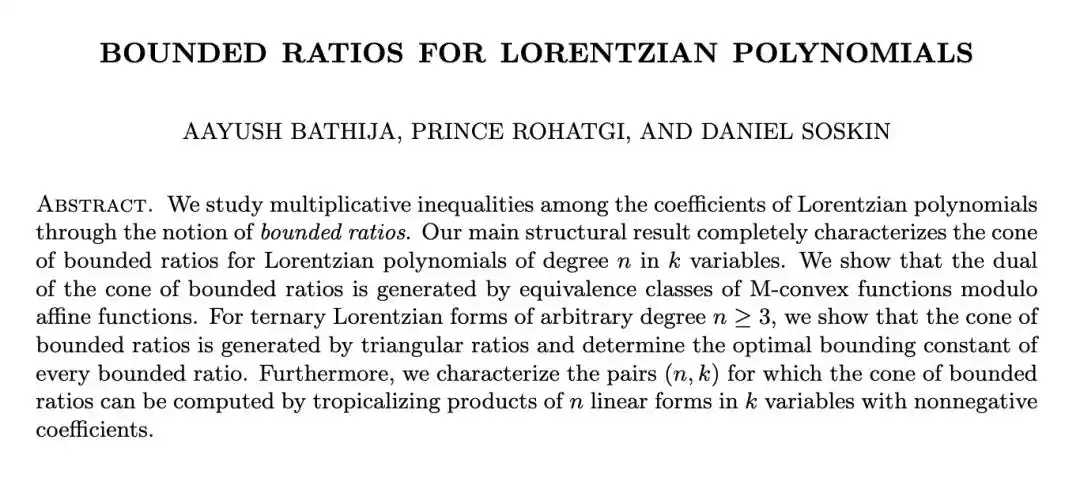
The paper, titled Bounded Ratios for Lorentzian Polynomials, runs 75 pages. Its authors are Aayush Bathija, Prince Rohatgi, and UCLA postdoc Daniel Soskin. The report describes the result as work on a problem Huh had not solved in this direction.
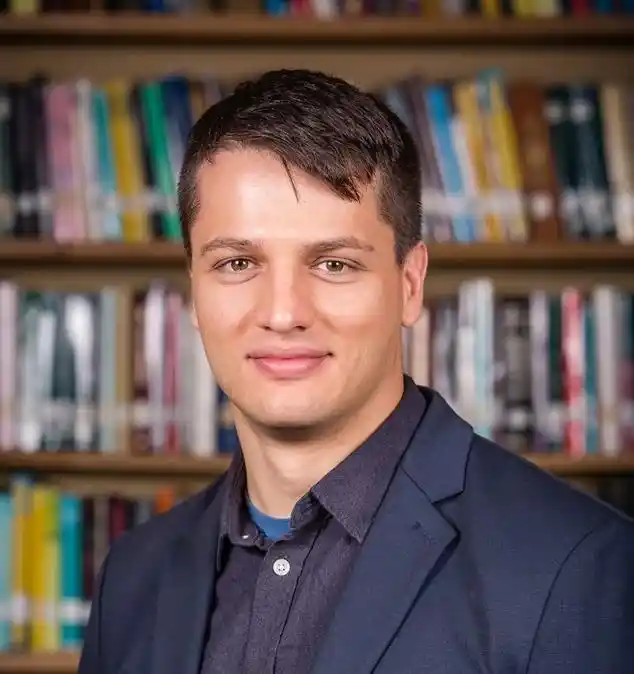
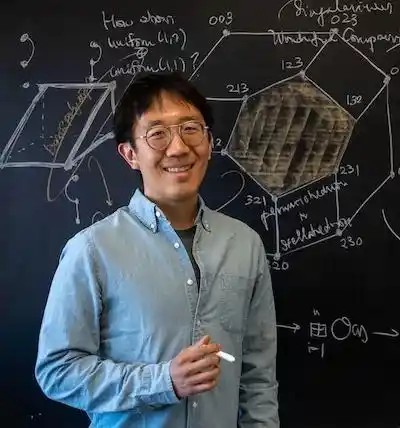
Huh, a Korean mathematician, won the Fields Medal in 2022. One of the major foundations behind this story is the theory of Lorentzian polynomials, developed by Huh and collaborators in 2020.
What problem the paper addresses
At the center of the paper is a question about how tightly the coefficients of Lorentzian polynomials constrain one another. In this theory, coefficients cannot be assigned freely. The structure links problems in combinatorics with geometry and inequalities among coefficients.
The paper asks which ratios built by multiplying some coefficients and dividing by others always stay under a universal ceiling, which ratios can blow up without bound, and, when a ceiling exists, how low the optimal upper bound can be.

According to the report, Huh and collaborators had already characterized bounded ratios in quadratic Lorentzian polynomials and obtained sharp upper bounds in the three-variable case. What had not been settled was how far those patterns survive in degree three, degree four, and then in arbitrary degree, where the relations among coefficients become much more complicated.
The new paper is presented as pushing that line of work to higher degree. Its main structural theorem, as summarized in the report, extends the earlier quadratic picture to arbitrary degree and gives a complete criterion for deciding whether a coefficient ratio admits a uniform upper bound, using a set of discrete convexity conditions.
A simple example of a bounded ratio
The report explains the idea through a low-degree example. Take a polynomial with positive coefficients a, b, and c, with the middle term written as 2b for convenience. In the simplest setting, being Lorentzian forces an inequality among those coefficients. Intuitively, if the coefficients on the two ends are large, the middle coefficient cannot be too small.
One example given is a=4 and c=9, which forces b>=6. That captures the basic idea that the coefficients sit inside a constrained family rather than moving independently.
In higher degree and with more variables, the constraints become much richer. The formal definition involves a matrix tied to curvature, and in the strict case that matrix has a signature with one positive eigenvalue and the rest negative. That sign pattern is where the term “Lorentzian” comes from.
In the simple quadratic case, one transformed ratio stays bounded by 1 across all allowed choices of coefficients. Reverse the ratio, and the situation changes. Fix a=c=1 and let b grow: the Lorentzian condition still holds, but the reversed ratio can become arbitrarily large. The broader question is which coefficient combinations behave like the first case and which behave like the second.
The students and the UCLA program behind the work
Bathija and Rohatgi both attend Oak Park High School in California and are members of the UCLA Olga Radko Math Circle, or ORMC.
Bathija is a high school junior and an AIME qualifier. Rohatgi is a senior, also an AIME participant, and the report says he serves as a lead instructor for AMC 10/12 competition classes in the math circle.
The story frames that as part of what makes the result striking. In the conventional path, getting to the edge of Fields Medal-level mathematics would usually take years of undergraduate and doctoral training. Here, under Soskin’s guidance, two high school students entered an active research problem directly.
How the proof strategy is described
The report says the key idea is to test whether a ratio can lose control by examining what happens in extreme regimes first.
One way to do that is to rewrite complicated numerical behavior in terms of exponents. Let t approach 0 and assign three coefficients in a suitable way. Then a ratio may behave like a power of t. Flip the ratio, and it can become t raised to a negative power, which tends to infinity.
That move turns multiplication and division into addition and subtraction of exponents. Once written that way, the sign of the exponent reveals whether the ratio shrinks or explodes.
The report connects this to the paper’s use of tropicalization. Existing Lorentzian polynomial theory says admissible exponent patterns are controlled by a discrete convexity rule called M-convexity. In rough terms, it governs which rates of change can appear together.
A central step in the paper, according to the report, is proving that if a ratio can become arbitrarily large, then there is a path with the right exponent pattern that exposes that blow-up. Checking such paths can then be upgraded into a complete criterion. The proof is said to use tools including curve selection from semialgebraic geometry.
Claude and GPT were credited for proof ideas
Another reason the paper has drawn notice is the role assigned to AI. The report says the acknowledgments explicitly name Claude Opus 5 and GPT-5.6 Sol as core tools used in the project.
The models were used for computation, proof ideas, and editorial assistance. The mention of proof ideas stands out because it places AI inside the exploratory phase of research rather than limiting it to polishing text or checking routine steps.
The authors also made the limits clear. Some AI suggestions were helpful, they wrote, while others were misleading. They said all computations were independently verified and that the authors take responsibility for the paper’s contents.
That distinction matters. A model can offer a line of attack, but the researchers still have to test assumptions, fill in missing conditions, and make sure edge cases do not break the argument. A clean-looking answer is not the same thing as a valid proof.
The report also points to the importance of Soskin’s supervision and the ORMC research setting. That framework gave the students access to a genuine open problem and a professional environment in which AI became one component of the workflow.
The timing sharpened the debate
The report places the paper against a dramatic backdrop. One day before this work was publicized, a public letter signed by 25 Fields Medalists warned that AI was damaging mathematics itself. Huh was among the signatories.

Then came a result produced by two high school students using AI assistance in Huh’s own research area.
That juxtaposition is what gives the story much of its force. The concern from leading mathematicians, as described in the report, is that AI may erode rigor and the norms that define pure mathematical work. The Bathija-Rohatgi paper points to a different possibility: once research barriers fall, the change may not show up only as faster problem-solving, but also as wider access to the frontiers of the field.
The report stops short of making a final judgment. It does, however, suggest that AI has moved beyond a peripheral support role and into the stage where ideas are generated and tested, while formal verification remains the condition that decides whether a result stands.
References cited in the report
- Paper: Bounded Ratios for Lorentzian Polynomials
- arXiv link: https://arxiv.org/pdf/2609.05341
- Original attribution in the source report: WeChat account “新智元” (ID: AI_era), by Taozi and Mako