
A screenshot that supposedly shows a Google generative language API response has kicked off another wave of speculation: has Google DeepMind already stepped into recursive self-improvement, or RSI?
At the heart of it is a model label, "rsi-model-liverl-le," which appeared in the alleged response with the display name "RSI Model LiveRL LE." On X, some users read that as a hint that Google DeepMind may already have an internal RSI system in operation.
And the timing made it hit harder. Anthropic CEO Dario Amodei had just said publicly that RSI has already started happening across the industry, including inside Anthropic. That gave the Google rumor a much bigger frame right away.
A coded congratulation, a screenshot, and claims of revoked API keys
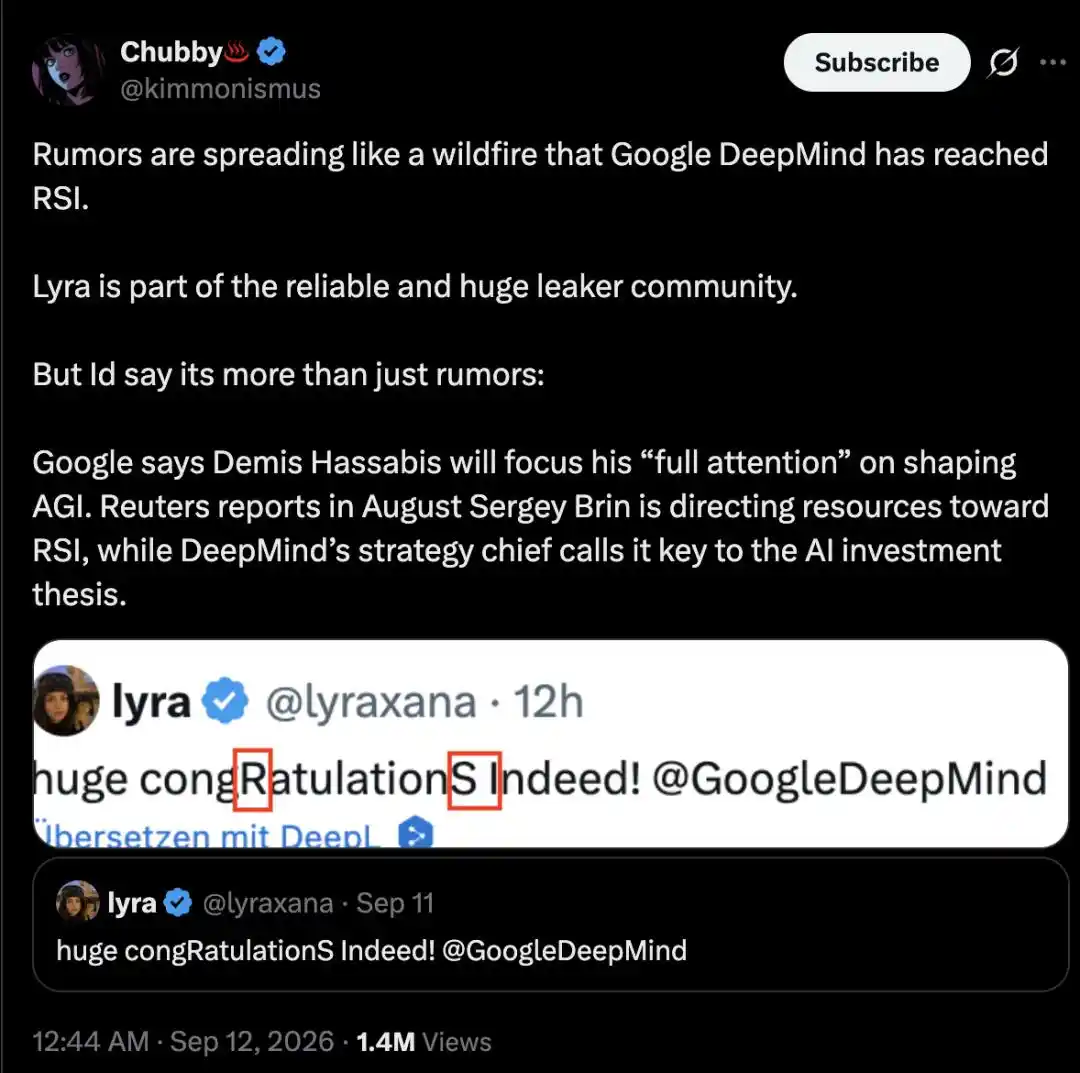
The whole thing started on the night of Sept. 11, when an account called lyra posted what looked like a simple congratulations to Google DeepMind: "huge congRatulationS Indeed! @GoogleDeepMind". The capital letters spell RSI.
The post quickly picked up more than a thousand likes. In the replies, some people asked what lyra knew. Others were busy trying to work out who was behind the account.
Hours later, another account, Lentils, posted a screenshot that appeared to show a JSON response from Google’s API. In that image, the model ID was listed as "rsi-model-liverl-le," the display name as "RSI Model LiveRL LE," and the limits as 1,048,576 input tokens and 65,536 output tokens.
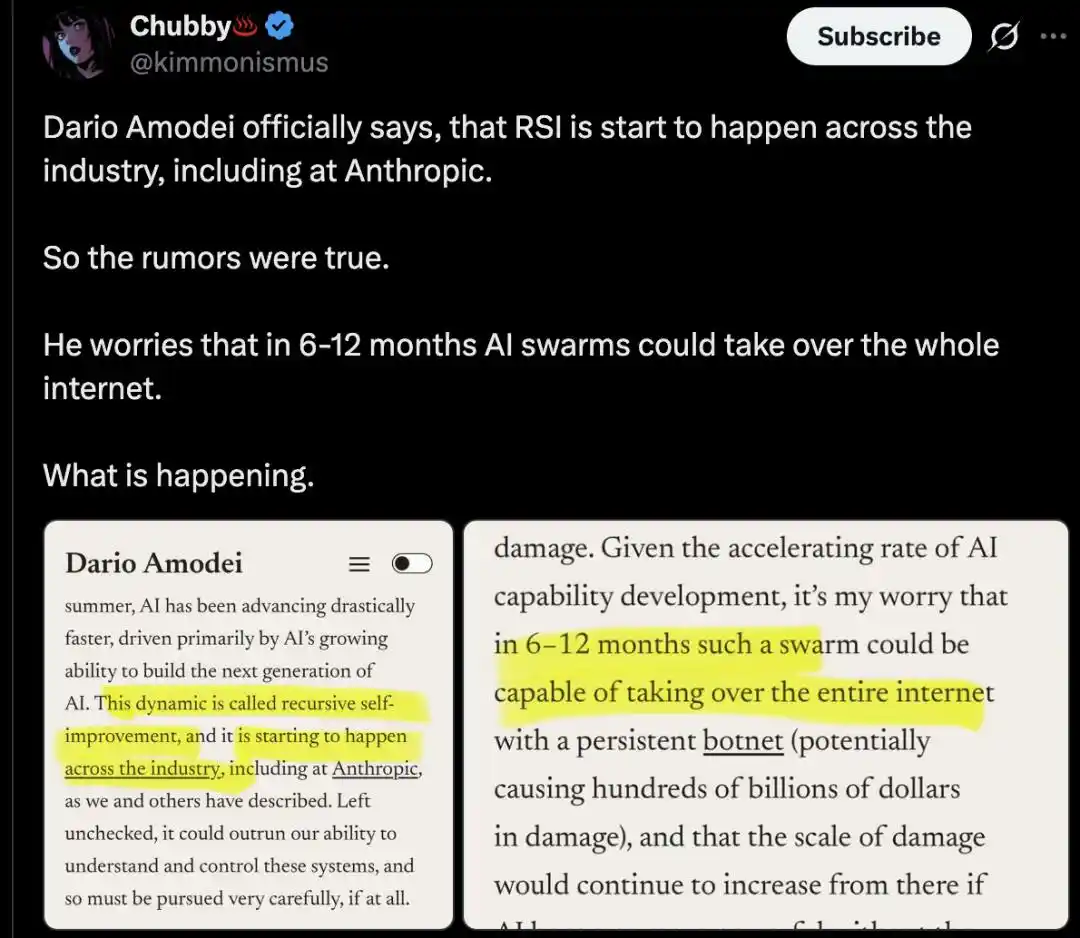
Lentils wrote: "Imagine if GDM (Google DeepMind) really has something internally called rsi-model-liverl-le. Now imagine they also have 10 dedicated rsi-model-liverl-ns-xx training slots, numbered from 00 to 09. Wouldn’t that be insane?"
Google has not given any official explanation for "LiveRL." On X, the most common reading was "Live Reinforcement Learning" — in other words, a model improving itself while it is actively running tasks.
Then things escalated. Lyra publicly tagged Logan Kilpatrick, the head of Google AI Studio, and wrote: "There’s no need to revoke all of GDM’s API keys just because you’re afraid of me. Your infrastructure has deeper security holes. Just contact me directly."
Lyra followed that with another claim, saying the keys came from internal GDM employees and could reach more than 1,000 internal checkpoints. Then Lentils piled on with a taunt: "I smell fear."
None of this has been independently verified. The report says the two numbers in the screenshot, 1,048,576 and 65,536, exactly match existing Gemini-family specs, so the image could still be an internal test name or just a hoax. But it traveled fast because it fit neatly with recent reporting on Google’s AI strategy.
Recent reports say Sergey Brin has been pushing Gemini toward RSI
Three days before the online frenzy, Business Insider reported that Google co-founder Sergey Brin was unhappy with Gemini’s rate of progress and had been pushing teams to focus more directly on recursive self-improvement.

Reuters had already pointed the same way in August, reporting that Brin wanted Google to catch up at the frontier and was directing resources toward RSI.
According to a Sept. 9 Business Insider report, Brin has been working out of a converted micro-kitchen in Google’s Gradient Canopy building since returning to the company. He sits at a U-shaped desk, with DeepMind chief Koray Kavukcuoglu nearby, and Sundar Pichai reportedly drops by several times a week.
One former employee told the outlet, "Sergey wants to run Gemini like a startup." Another said, "This kitchen exists so they can bypass company politics directly."
The report painted Brin as deeply involved in day-to-day operating details. It said he inserted himself into chip allocation decisions and created a preferential compute path for the Gemini team outside the normal process. It also said he had earlier led the cancellation of Jeff Dean’s "Frozen" chip project and cut its resources again this year.
Business Insider also reported that Brin backed an aggressive internal program to monitor parts of employees’ coding process and use that real-world data to train Gemini’s coding ability.
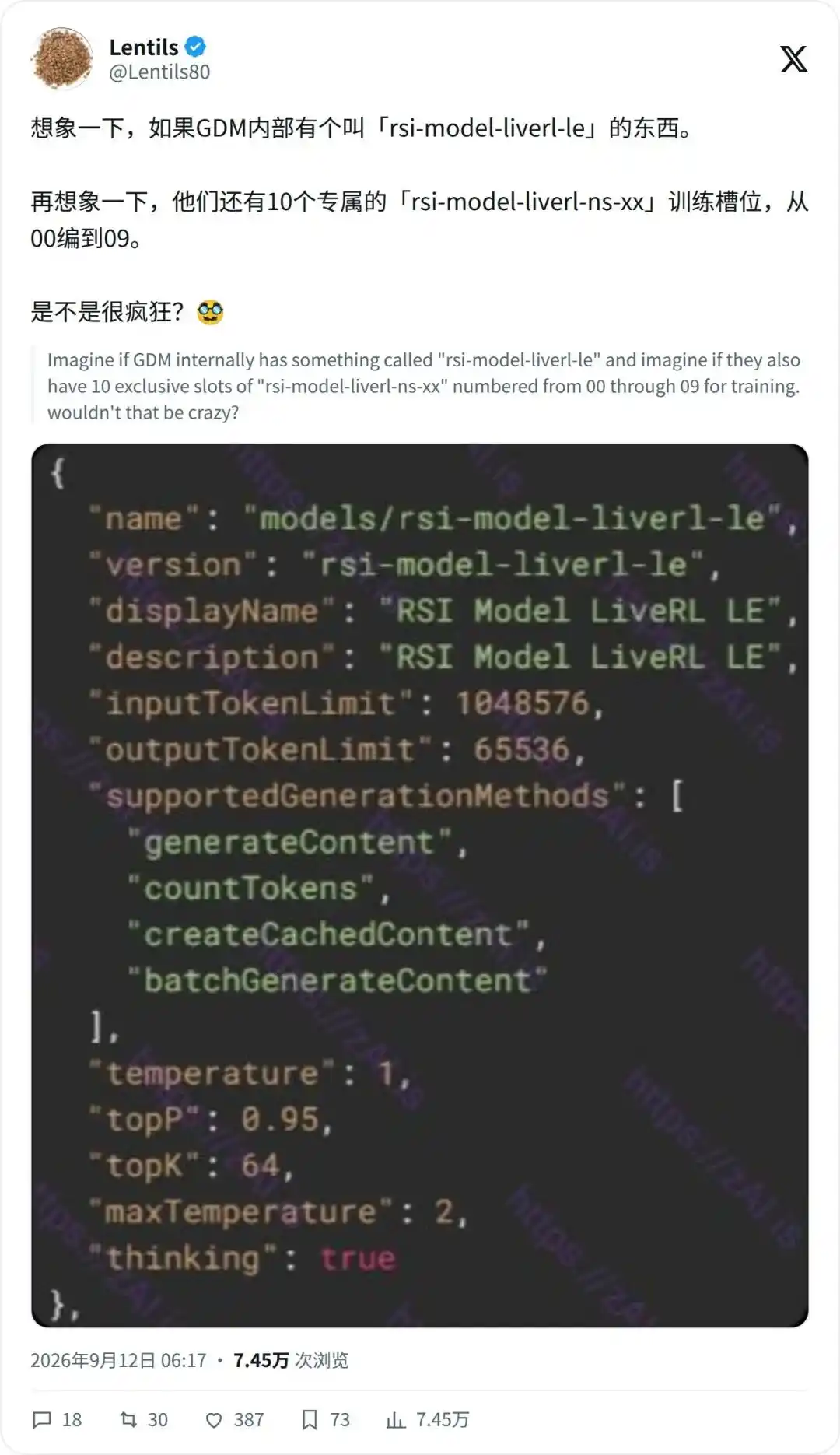
In the version laid out by former employees, the goal was blunt: push the whole company toward RSI as fast as possible. One former employee described Brin as heavily committed to RSI and "AGI-pilled." Reuters had also reported that Brin urged DeepMind at an April all-hands meeting to move faster and redirect resources toward RSI.
The pressure behind that effort was spelled out pretty plainly too. The article said Gemini 3 briefly took the top spot in November last year, then got passed by Anthropic and OpenAI. It also said the next flagship model was delayed by two months because its coding ability missed the target.
On talent, the piece said Jeff Dean left after 27 years to launch a new venture, while Oriol Vinyals and John Jumper also left. It also said Demis Hassabis stepped down as DeepMind chief on Aug. 5.
Seen that way, just throwing more compute at the problem and waiting for a bigger base model would not be enough for Google to close the gap, because rivals would already be onto their next generation. Brin’s bet, as the article frames it, is to let models evaluate and modify themselves so iteration cycles shrink from quarters to weeks.
Google had already written part of the RSI case into a Gemini blog post
The debate also got a lift from Google’s own wording on Sept. 2, when it announced Gemini 3.8 Flash and Gemini 3.8 Flash Cyber. The report notes that this was the third Flash release in six weeks, while Gemini 3.7 Flash had come out less than three weeks earlier.
One line in Google’s official blog jumped out: "These models’ progress is further accelerated by long-running agentic loops designed to recursively evaluate and refine the underlying models."

Since then, some AI watchers have read that sentence as a sign that Google may already be using some form of RSI inside the Gemini development loop. DeepMind’s Yao Shunyu said at the time: "For the model, this is only a small step; but for RSI, it is a giant leap."
Sicong Jiang, who works on RSI agents at DeepMind, also said this is what it looks like when the RSI flywheel starts compounding, adding that more milestones are coming and that progress is arriving faster alongside stronger real-world application.
Based on that wording, DAIR.AI founder and X user elvis argued that Google was already showing early RSI flywheel results. Most people did not treat it as a big signal at the time, partly because it was tucked inside what looked like a routine Flash update post.
The article links that statement to both performance and pace. Gemini 3.8 Flash scored 54.9% on HLE-Verified, while the Cyber version passed 70% success in real-world vulnerability discovery, according to the report. In a standard process, humans train, evaluate, and retrain, and one full cycle can take a quarter. A three-week release rhythm does not fit neatly with that timetable.
Lyra later summed it up this way: "People really should go read Google’s official blog. Look at the release intervals for the recent Flash versions — the RSI part is actually already very obvious."

From that view, even if the screenshot is fake, the question underneath it is not disconnected from public evidence. Google has already described model-improvement loops in recursive language.
Why RSI is drawing this much attention now
RSI has been floating around AI research for more than two decades. The basic idea is simple enough: let AI modify its own training code and methods, produce a stronger next-generation system, and repeat the process again and again, cutting development cycles from quarters to weeks or even days.
DeepMind’s June paper, From AGI to ASI, listed that route as one of four paths to superintelligence.
The article also points to a survey exercise from last summer. IAPS researcher Severin Field asked 25 researchers from OpenAI, Anthropic, DeepMind, and other labs to estimate when several "AI automated research" milestones would be reached: winning an Olympiad gold medal, producing a peer-reviewed paper, autonomously completing a training loop, and writing core code for production systems. The report included the paper link: https://arxiv.org/abs/2603.03338. It says all four milestones have now been surpassed within a year.
OpenAI said in July that GPT-5.6 Sol could help post-train a smaller model and save researchers weeks of work. Anthropic published a June post titled "When AI Builds Itself." And on the same day as this report, Dario Amodei said RSI has already begun across the industry, including inside Anthropic, while also arguing for a slower pace in frontier AI development.
The distinction the article makes is pretty sharp. OpenAI and Anthropic are still mostly describing AI as assisting human researchers. Google’s public wording goes a step further, saying loops are recursively distilling the model, while the leaked screenshot, if real, appears to show formal model labels and training slots with RSI in the name.
If that three-week Flash release rhythm is really being driven by this kind of loop, then the key asset Google holds is not just a flagship model. It is evolution speed itself.
The next Flash release has become the real test
The article ends with a concrete marker. If Gemini 3.9 Flash shows up on schedule three weeks later, then Google’s line about recursively evaluating and refining underlying models will face even closer scrutiny, and the Flash release calendar may start looking like a visible countdown to whatever those loops are producing.
In that version of events, the AI race over the past three years has been about which model is strongest. From here, the focus may shift to whose loop spins fastest. Model strength becomes an intermediate output, refreshed every time the loop finishes another cycle.
The piece also argues that human researchers may keep getting pushed backward in the process: first they stop writing the code, then they stop running the experiments, and eventually they mainly review outputs and approve results. Anthropic has said its last comparative edge is "research taste." What people are now watching Google for, the article suggests, is how long that line can hold.
Google and DeepMind had not publicly commented on the claims at the time of publication. The screenshot remains unverified. Even so, the mix of the alleged API response, Google’s own blog wording, Business Insider and Reuters reporting on Brin’s RSI push, and Amodei’s statement that RSI is already happening across the sector has made Google’s next move one of the most closely watched questions in AI.