
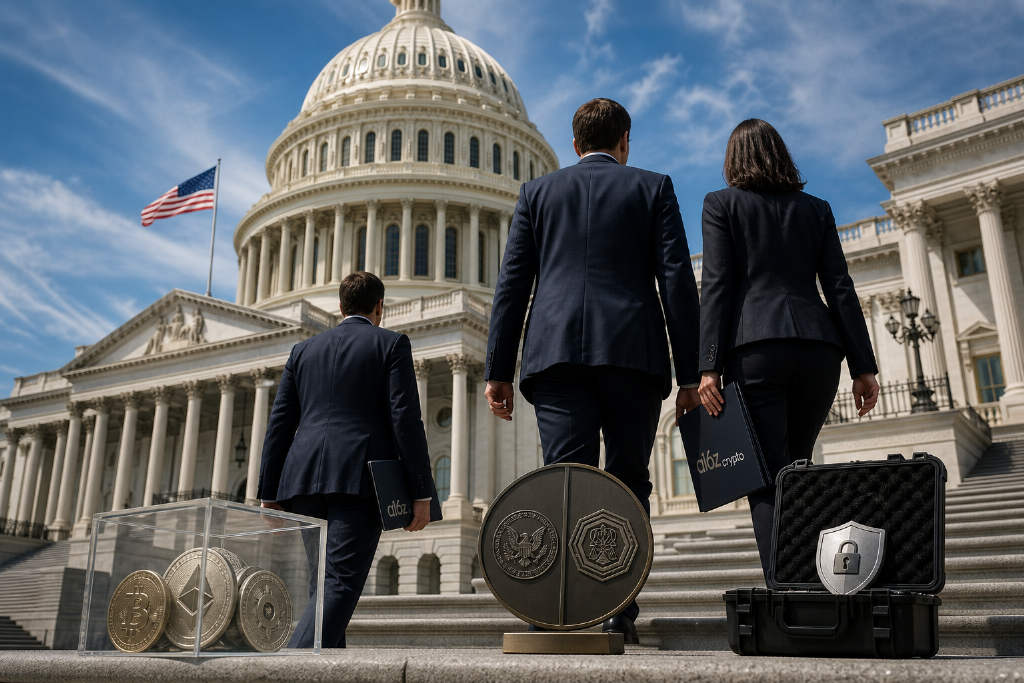
Crypto is no longer a niche market, according to a16z crypto, which argues that stablecoins now carry trillions of dollars in annual transaction volume and that major banks and payment companies are already building on-chain products. Yet the federal rulebook in the US remains incomplete. In a recent video discussion, a16z co-founder Marc Andreessen and a16z crypto founder Chris Dixon said that gap is why the CLARITY Act has become urgent.
The piece was published by a16z crypto as a Q&A based on that conversation and later translated and republished by ChainCatcher. Andreessen and Dixon focused on why the industry needs clear, durable rules now, how the CLARITY Act could protect consumers, why regulatory ambiguity tends to reward bad actors, and what the bill could mean for sanctions enforcement, privacy, developer liability, securities law and US technology leadership.
A larger market, but an unfinished federal framework
The two investors said the crypto sector has changed sharply since the Bitcoin white paper. What began as a space used mostly by hobbyists and technical enthusiasts has turned into an industry with maturing infrastructure and rising institutional participation.
a16z crypto pointed to the scale of stablecoins, saying they process trillions of dollars in transactions every year, a level it said is comparable to the Visa network. Banks, asset managers, card networks and fintech companies are developing products tied to stablecoins, tokenized stocks, tokenized deposits and other digital assets. The underlying networks have also improved. Transactions that once cost several dollars can now settle in less than one second on widely used blockchains for under $0.01.
In a16z crypto’s view, US regulation has effectively been split into two buckets: stablecoins and everything else. The GENIUS Act, which takes effect in July 2025, creates a federal framework for stablecoins. But the blockchain networks and trading markets that support those stablecoins still do not have a complete federal regime.
Andreessen said, 「We’re not trying to get some edge. We’re not asking for subsidies, protectionism, or some other kind of support. We just want a long-term, stable framework so people can operate responsibly. To me, that is a completely natural request on many levels.」
a16z crypto said agency guidance can fill some gaps, but it cannot replace legislation. A new administration or a different agency head can change that guidance. Companies deciding whether to invest in a business that may take five or even 10 years to pay off need to know what the rules are, which regulator has jurisdiction, and whether a product built today will still be legal tomorrow.
How the bill is framed as consumer protection
One of the most basic consumer protection problems in crypto, according to the discussion, is that trading platforms are not subject to a full federal regime comparable to the one that covers venues such as the New York Stock Exchange and Nasdaq.
Those traditional markets have clear federal oversight. Crypto trading platforms, by contrast, lack a market-wide structure for registration, supervision, audits, disclosures, trade monitoring and customer asset protection. The CLARITY Act is presented as a way to create a clear path for digital assets to move from Securities and Exchange Commission oversight to Commodity Futures Trading Commission oversight.
Federally registered crypto trading venues would be subject to audits and financial control requirements. They would have to safeguard customer assets, follow anti-fraud and insider trading rules, and provide operating information to regulators. Firms that refuse to meet those standards would not be able to operate legally in the US.
a16z crypto tied that argument to the collapse of FTX. The article said that, according to allegations, FTX moved funds between affiliated entities, lacked internal controls and did not hold the amount of customer assets it claimed to hold. Federal oversight cannot guarantee that fraud will never happen, Andreessen said, but it can make fraud much harder to hide and give regulators a chance to step in before a problem turns into a disaster.
Andreessen said, 「You need a system first. Companies need risk controls, compliance, and audits ... We need it to stop disasters from happening and to avoid more FTXs.」
The same logic, the article said, also applies to products sold under the label of stablecoins. Terra-Luna had been marketed as a stable asset, but it lacked dollar reserves and did not have other stable reserve assets backing it. Under a stablecoin framework, compliant dollar-backed stablecoins must be fully reserved and audited. The CLARITY Act would bring similar constraints to other parts of the crypto market.
Why ambiguity, in their view, benefits non-compliant rivals
a16z crypto said vague rules create a race to the bottom.
A US company that takes compliance seriously may have to spend heavily on lawyers, internal controls, audits, sanctions screening and customer protection. That work is expensive and can slow product development. Offshore rivals can skip those costs, copy the product, offer it more cheaply and move faster, with that speed coming precisely from not doing the compliance work.
The result, Dixon said, is that uncertainty punishes responsible companies while offshore competitors benefit. Law-abiding US venues absorb the cost of compliance while non-compliant offshore platforms may still try to serve US users.
Dixon said, 「Right now, it is highly unclear which entities are subject to which rules. I came to realize that wherever regulation leaves gray areas, markets usually end up in a race to the bottom ... That ambiguity ultimately gives bad actors an advantage.」
The CLARITY Act, as described in the piece, would draw those lines more clearly: which firms count as intermediaries, which rules apply to them, which agency oversees them, and what happens if they refuse to comply. Any company that holds customer funds or helps complete financial transactions would have to follow the same type of anti-money laundering, sanctions and Treasury rules that apply to payment providers, fintech firms and similar financial intermediaries.
The article’s point was direct. Clear rules help companies willing to meet the standard. Gray zones help those looking for loopholes.
Sanctions enforcement, blockchain trails and privacy
On sanctions enforcement, a16z crypto argued that privacy is not the same as concealment. Public blockchains are often described as anonymous systems, but many of them are highly transparent in practice.
Transactions are recorded permanently on public ledgers. Wallet addresses do not directly display legal names, but investigators can trace fund flows and connect that activity to exchanges, accounts, devices or other identity markers. Those records remain available years later, which means law enforcement may uncover evidence in the future that was not available when the transaction first occurred.
Some payment methods leave no public trail at all. Blockchains do. That is why, the article said, some national security officials have described crypto as a way of leaving evidence for future prosecutions.
Dixon said, 「It applies the same anti-money laundering and Treasury rules that govern other market intermediaries to crypto intermediaries as well.」
At the same time, the piece drew a line between traceability and personal privacy. People should not be forced to reveal every medical payment or transfer to the whole world simply because they use blockchain networks. The current financial system also recognizes that ordinary users need privacy while regulated institutions still have to meet sanctions and AML obligations.
Andreessen compared the debate to earlier fights over internet encryption. Strong encryption was once treated as a threat because criminals could use it, and export controls even grouped it with military technologies at one point. But encryption also made secure banking, e-commerce and confidential communications possible.
Andreessen said, 「If bad people use encryption to do bad things, does that make encryption bad? Or is encryption valuable in itself because it is the basis for trust, commerce, and law-abiding citizens at home and abroad cooperating and doing business with one another?」
a16z crypto said blockchain privacy sits on the same line: privacy protects legitimate activity, while concealment designed to evade the law should still face enforcement.
Stablecoin rewards, banks and on-chain finance
The discussion also addressed the fight over rewards on stablecoin balances. Banks have argued that stablecoin issuers and wallet providers should not be allowed to rebuild deposit-like accounts outside the banking system by paying interest on balances. Their concern is that consumers could move deposits out of banks and into stablecoin products, reducing funding that banks use to make loans.
The CLARITY Act answers that concern by barring interest on stablecoin balances and by prohibiting products that are functionally or economically equivalent to interest-bearing accounts.
It does not, however, ban all rewards. The article said the bill would still allow transaction-based rewards. Wallet providers or retailers could reward customers for using stablecoins in purchases, much like credit card points or retail loyalty programs. The distinction is that one reward comes from spending activity, while the other is paid merely for holding a balance.
a16z crypto said that compromise largely addresses the main concerns raised by banks without reaching so far that ordinary rewards programs would be blocked. Many programs already used by card networks, payment apps and retailers follow a similar model.
The article also noted that the banks raising these concerns are themselves adopting blockchain technology. It named Goldman Sachs, Fidelity, BlackRock, Stripe, Wells Fargo and JPMorgan as large financial institutions that have already developed or backed blockchain products.
Dixon said, 「One of the things blockchain does for finance is give everyone a common framework so they can say, ‘Okay, let’s all move into the 21st century together.’ So it solves not just a technology problem, but also a coordination problem.」
In his telling, banks and crypto companies are looking at the same opportunity. Existing financial infrastructure is fragmented and hard to upgrade. Blockchain offers a shared framework that can reduce layers of intermediation, settle assets on common infrastructure and let institutions modernize without requiring every bank to rebuild separate systems and then connect them all again.
When software developers should be liable
On developer liability, the CLARITY Act distinguishes between knowingly helping criminal conduct and publishing general-purpose software.
Under the framework described by a16z crypto, developers would still face liability if they built tools for criminal use, marketed those tools to criminals or directly assisted unlawful activity. What the bill rejects is the idea that developers should bear unlimited responsibility for every downstream use they cannot foresee and do not control.
Open-source code can be copied, modified and deployed by people the original author has never met, in settings the author never imagined. If developers were held responsible for all of those later uses, the article argued, open-source software would become nearly impossible to build or finance.
Andreessen said, 「It just can’t work, and it would make software development impossible, because no developer can predict how software will be used in the future. You don’t even have to limit the point to software. The same logic applies to any product. If I run a hotel and a criminal stays there and plans a crime, does that make me a co-conspirator?」
The article extended the point beyond crypto. Academic research, startups, venture capital and open AI models all depend on open-source software. a16z crypto said a workable liability line has to rest on intent and actual participation: someone who knowingly helps a crime should be accountable, but the later misuse of a neutral tool should not automatically make its developer liable.
How the bill treats securities law and digital assets
a16z crypto said a security does not stop being a security simply because it is placed on a blockchain. Tokenized stocks are still stocks and still fall under SEC oversight. A company cannot avoid disclosure, registration and investor protection obligations merely by moving an asset on-chain or calling it a token.
Dixon said, 「What the CLARITY Act does is write that into law and define it clearly. That way, people know exactly where they stand and do not have to litigate every time to find out.」
The more difficult question, the piece said, is how to regulate digital assets tied to blockchain networks when the nature of those assets can change as a network evolves.
a16z crypto described the bill as a risk-based framework. A new blockchain network often begins with a centralized actor, whether that is a founder, a company or a small team. At that stage, the people behind the network may control it, hold information the public does not have and make decisions that affect the value of the token. In that phase, the asset would fall under SEC oversight and face security-like requirements, including disclosures, insider restrictions and lockups for founders and early investors.
As the network develops, control may become more dispersed. If it reaches the bill’s decentralization threshold, the asset may come to look more like a commodity than a corporate security, and oversight would move to the CFTC.
That does not mean the asset would become unregulated. Commodity regulation still covers fraud, market manipulation and cornering. The regulator changes because the nature of the asset changes.
The bill would also introduce limits that are not yet clearly defined today. While a network remains under centralized control, founders, venture firms and other insiders could face longer lockups and stricter disclosure duties. The aim is to prevent insiders from selling into the market before ordinary participants have comparable information or before a product has developed into a sufficiently decentralized network.
What happens if Congress does not pass it
a16z crypto said crypto regulation will not vanish if the CLARITY Act fails. The SEC, CFTC and the US Treasury have already been issuing guidance and using existing authority to write rules within their own jurisdictions, and they would probably keep doing so.
The problem, in the firm’s view, is that agency interpretations can change when political leadership changes. A company could spend years building under one set of assumptions only to find that an election or a change in agency leadership produces a completely different interpretation.
That uncertainty affects investment, but the article said it also affects consumer protection. A durable framework could define agency powers while requiring companies to register, disclose information, protect customer assets and follow market rules. Without legislation, those responsibilities remain scattered across different regimes and open to dispute.
Dixon said, 「If the rules under your feet keep changing, companies are naturally going to be less willing to spend large amounts of time and money building.」
a16z crypto said the more likely outcome is not that the industry disappears, but that companies continue moving to other jurisdictions after years of aggressive enforcement and political hostility. If that happens, US oversight would shrink rather than grow. American regulators would have a harder time supervising offshore firms, law enforcement would have a harder time reaching them, and those firms would have less reason to build products around US standards.
Technology leadership and the list of supporters
Andreessen and Dixon also framed the bill as part of a broader fight over where new technology gets built. Once a technology is invented, the article said, it usually does not disappear. The real question is where it develops, which companies lead it and whose rules shape it.
a16z crypto argued that the US has benefited for more than a century from having major technologies created and scaled at home. Technology leadership brings companies, jobs, tax revenue and expertise. It also creates economic capacity for national priorities and can produce security advantages.
Andreessen said, 「Regardless of political views, every American citizen should want the United States to be the global technology leader.」
The article pointed to the history of strong encryption export controls. When the US restricted exports, foreign competitors did not stop developing those tools. They built them outside the country and users turned to those products instead. Only after those restrictions were adjusted could US firms fully participate in building the secure internet economy. a16z crypto said blockchain now presents a similar choice: the future financial system, the technical standards and the leading companies will emerge somewhere. If that happens mainly overseas, the US would lose both economic opportunity and regulatory influence.
On support for the bill, the article said backers include lawmakers, law enforcement groups, financial institutions and technology companies. It described the legislation as the product of years of bipartisan work in Congress to build a federal framework for digital asset markets.
The Fraternal Order of Police, which the article described as the largest law enforcement organization in the US, has also come out in support of the bill and rejected claims that it would weaken sanctions or anti-money laundering enforcement.
Dixon said, 「The Fraternal Order of Police just announced support for the CLARITY Act. It is the largest law enforcement organization in the United States.」
Support also comes from finance. Goldman Sachs chief executive David Solomon has endorsed the CLARITY Act, while other financial institutions and fintech firms are already developing blockchain products. For a16z crypto, that mix of support points to an emerging consensus: the US needs clear, enforceable rules for digital asset markets.
The closing argument in the piece was not a comparison between the CLARITY Act and some idealized alternative law. It was a comparison between the bill and the current state of play. a16z crypto said that if responsible companies are given a clear path to build under US law, the result could be stronger consumer protection, support for law enforcement and a better chance that the next generation of financial technology is built in the US.