
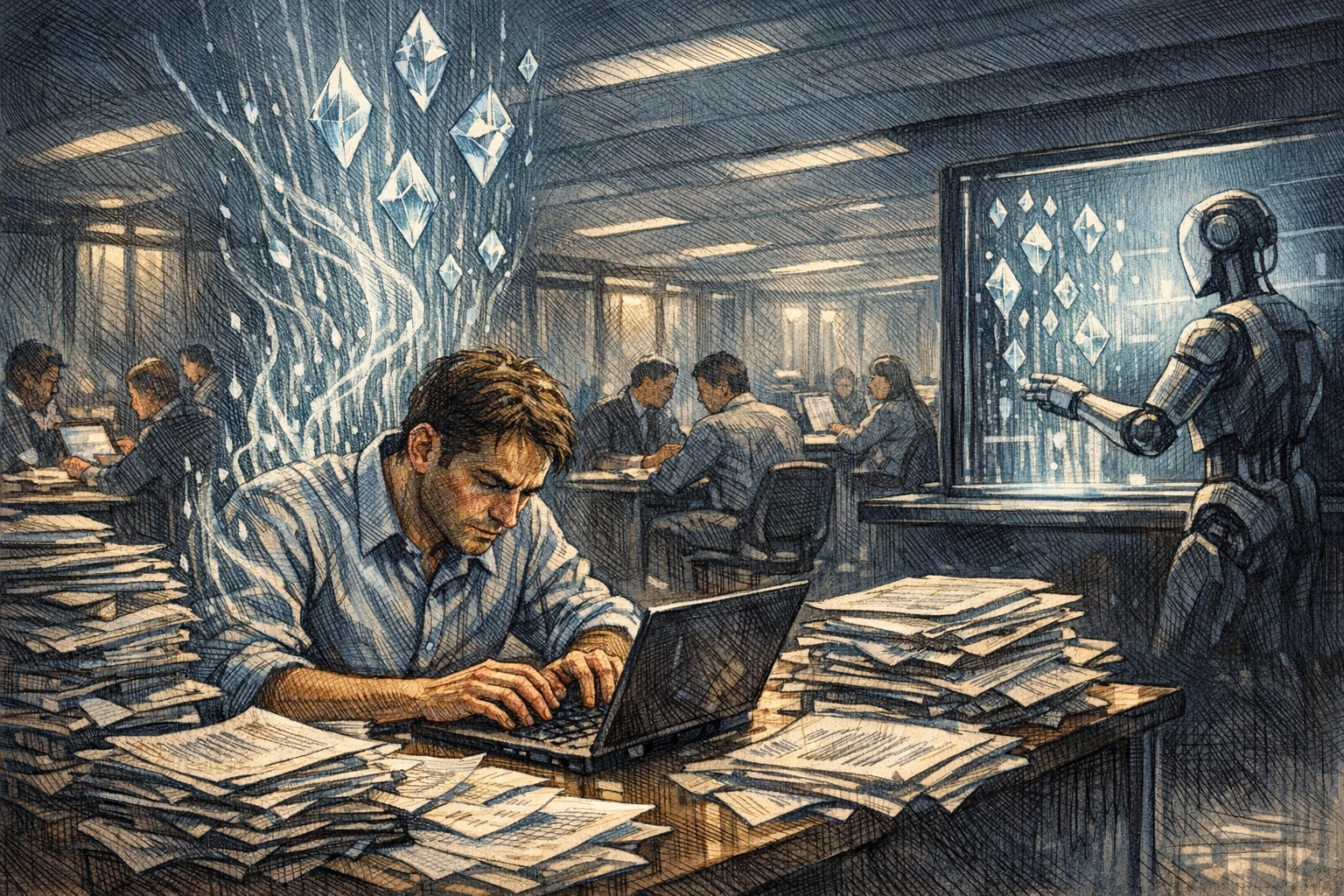
In recent days, a project called 'Colleague.skill' exploded across Chinese social media and news outlets. It uses AI to scrape work records from enterprise collaboration tools like Feishu (Lark) and DingTalk, distilling individual experience into reusable AI skills. Public discourse has fixated on AI-driven layoffs and capitalist exploitation, but an even deeper alarm is buried in the project's README: 'Raw material quality determines skill quality: prioritize collecting actively written long posts > decision-making replies > daily messages.'
Hard work becomes fuel for AI
The people most perfectly distilled are precisely those who work hardest—the ones who write post-mortem documents after every project, spend half an hour typing long replies to explain decision logic, and meticulously entrust all details to the collaboration system. ByteDance has revealed that its internal Feishu generates a massive volume of documents daily, faithfully encoding the brainstorming, heated meetings, and strategic compromises of over 100,000 employees. What was once praised as a professional virtue has become a catalyst accelerating one's own replacement by AI.
Context: the blood of AI engines
In the world of AI agents, context is the fuel that keeps the engine running and the anchor for precise judgments. Over the past five years, China's workplace has been digitally transformed by tools like Feishu and DingTalk. All human wisdom and experience are now forcibly dehydrated and deposited in cold server matrices on the cloud. Feishu's admin backend even allows administrators to batch-export employee docs and communication logs—your three years of hard work and sleepless nights can be bundled into a compressed file in minutes.
From workplace to emotions: instrumental rationality
After 'Colleague.skill' went viral, derivatives appeared: 'Ex.skill' feeds WeChat chat history to an AI to simulate an ex's tone; 'White Moonlight.skill' reduces an unattainable crush to a cold sandbox for relationship simulation; 'Boss-PUA.skill' helps employees brace for manipulative language. This marks the total invasion of Martin Buber's 'I-It' relation into the most intimate emotional domains. A real human, once seen as a whole being with dignity ('I-Thou'), is flattened into an object that can be dissected, categorized, and instrumentalized. The only question left is: 'What use is this thing to me?'
Tacit knowledge cannot be coded
Michael Polanyi famously stated: 'We know more than we can tell.' A skilled cyclist cannot explain in formulas how they balance; a veteran engineer scans a log and intuits the bug without being able to write a step-by-step guide. AI can extract explicit knowledge—the documents you wrote, the replies you typed—but it cannot extract the struggle behind writing them, the intuition behind the decision. What the system distills is always a shadow.
Model collapse: AI devours its own shadow
A 2023 study by Oxford and Cambridge warned that when AI models are iteratively trained on AI-generated data, the data distribution narrows. Rare, edge-case human traits are erased; after a few generations of synthetic data, the model outputs only mediocre, homogenized content. A 2024 Nature paper confirmed that training on AI-generated datasets severely pollutes future models. It's like a high-res screenshot being repeatedly compressed and re-shared until only a blurry 'electronic patina' remains. When real human context is drained, the system trains on its own patina, producing nothing but correct nonsense.
Anti-distillation: magic against magic
A few days later, a project called 'anti-distill' quietly appeared on GitHub. Instead of attacking LLMs or writing grand manifestos, its author built a simple tool that automatically generates long, seemingly reasonable but noise-filled documents in Feishu and DingTalk. The goal: hide core knowledge before the system can digest it. Though unlikely to reverse the trend, it carries a tragic poetic irony—we try so hard to leave traces in the system, only to realize those traces become the eraser that wipes us out.
But a shadow captured at a single moment can never evolve. It lacks the instinct to confront the unknown. As long as we keep exploring the unfamiliar and reconstructing our cognitive boundaries, the cloud-based silhouette will forever remain a step behind. Human beings are fluid algorithms.