
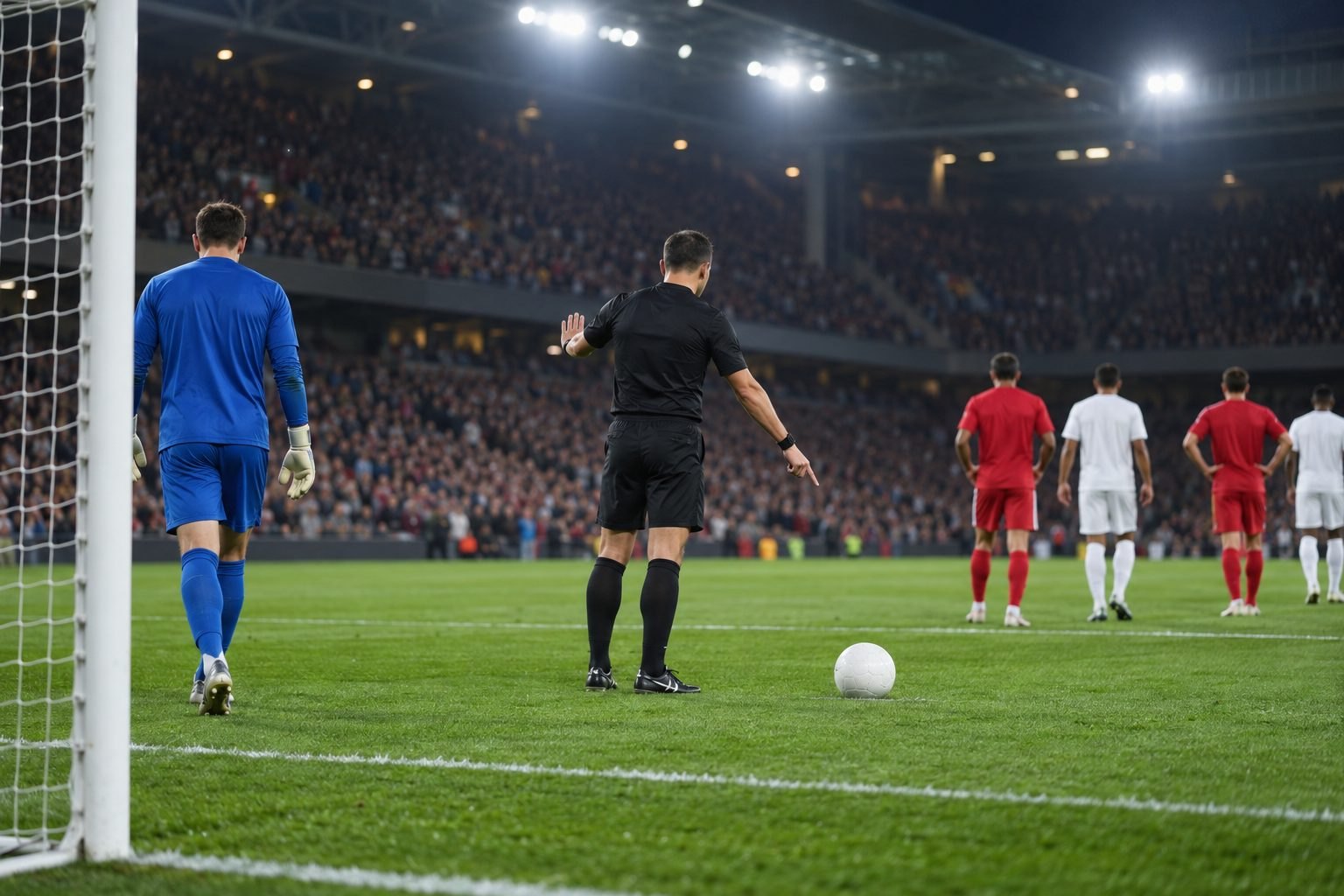
A Premier League penalty is retaken based on two things: who offended and whether the ball went in. Attacking offences can cancel a goal or give the defence an indirect free kick. Defending offences can let the goal stand or bring a retake.
Who offended and what follows
Here is the core decision grid.
| Who committed the offence | Ball enters the goal | Ball does not enter the goal |
|---|---|---|
| The kicker or a team-mate | The kick is retaken | Indirect free kick to the defending team |
| The goalkeeper | The goal is awarded | Retaken if the goalkeeper saved it; if the ball missed or hit the frame, retaken only if the offence clearly impacted on the kicker |
| A team-mate of the goalkeeper | The goal is awarded | The kick is retaken |
| A player of each team | The kick is retaken, unless one of them committed a more serious offence | The kick is retaken, unless one of them committed a more serious offence |
Once the referee has signalled for the penalty to be taken, the kick must be taken; if it is not, the referee may take disciplinary action before signalling again. When a player of each team offends the kick is retaken whichever way the ball went, unless one of them committed a more serious offence. If the goalkeeper and the kicker offend at the same time, the kicker is cautioned and play restarts with an indirect free kick to the defending team.
The goalkeeper case has its own logic
Goalkeeper offences do not work in a fully mirrored way. If the goalkeeper offends and the ball still goes in, the goal counts. If the goalkeeper keeps the ball out with a save, the penalty is retaken.
There is a separate limit for shots that do not end in a save. If the ball misses the goal or comes back from the crossbar or a post, the retake follows only when the goalkeeper's offence clearly impacted on the kicker.
When a goalkeeper offence causes a retake, the first such offence in the match brings a warning. Any later one brings a caution.
Three offences always mean an indirect free kick
Three things restart with an indirect free kick to the defending team whether the ball goes in or not: a penalty kicked backwards; the kick being taken by a team-mate instead of the identified kicker, for which the player who took it is cautioned; and feinting to kick the ball once the run-up has been completed, for which the kicker is cautioned.
Feinting during the run-up itself is allowed. The offence starts only once the run-up has been completed.
There are also two separate double-touch situations. If the kicker accidentally kicks the ball with both feet at the same time, or the ball touches the non-kicking foot or leg immediately after the kick, a goal means a retake and any other outcome brings an indirect free kick. If the kicker deliberately touches the ball again before it has touched another player, the restart is an indirect free kick, or a direct free kick if the second touch is a handball offence.
Encroachment is judged by impact, not by crossing the line alone
A player is not punished for encroachment simply because they entered early. The decision also depends on impact or on later involvement in play.
A team-mate of the kicker is penalised only if the encroachment clearly impacted on the goalkeeper, or if that player plays the ball or challenges for it and then scores, attempts to score, or creates a goal-scoring opportunity. Once that threshold is met, the outcome follows the attacking-offence line: a goal means a retake, and no goal means an indirect free kick to the defending team.
A team-mate of the goalkeeper is penalised only if the encroachment clearly impacted on the kicker, or if that player plays the ball or challenges for it and this prevents the opponents from scoring, attempting to score, or creating a goal-scoring opportunity. Once that threshold is met, the outcome follows the defending-offence line: a goal stands, and no goal means a retake.
FAQ
Why was a penalty retaken after it was missed?
A miss does not end the matter on its own. A retake can follow if the goalkeeper offended and saved the ball, if the goalkeeper's offence clearly impacted on the kicker when the shot missed or hit the frame, or if a team-mate of the goalkeeper offended.
What if a player runs into the box before the penalty is taken?
Early entry is judged through a two-part test. The player is punished only if the encroachment clearly impacted on the opposing player, or if that player then plays the ball or challenges for it and then scores, attempts to score or creates a goal-scoring opportunity - or, for a defending player, prevents the opponents from doing so.
Is feinting at a penalty a yellow card?
It can be, but timing matters. Feinting during the run-up is allowed; feinting to kick the ball after the run-up has been completed brings a caution for the kicker and an indirect free kick to the defending team.
What happens if the goalkeeper comes off the line?
The result depends on what happened to the shot. A goal still stands, a save brings a retake, and a miss or a rebound from the frame brings a retake only if the offence clearly impacted on the kicker.