
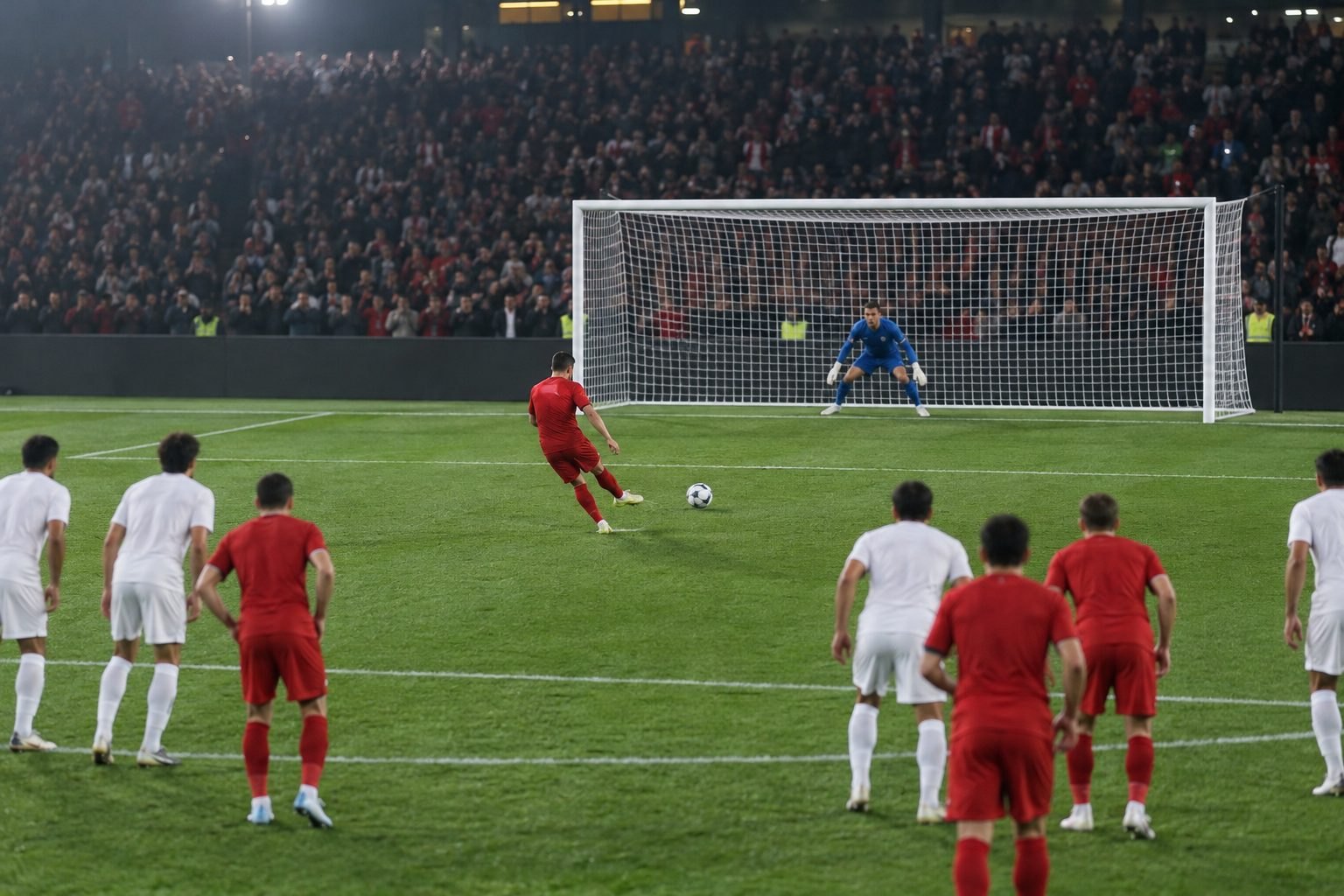
A penalty is taken with the ball stationary on the penalty mark and the kicker clearly identified. The goalkeeper must stay on the goal line, facing the kicker and between the posts until the ball is kicked. Everyone else must be at least 9.15 m from the mark, behind it, inside the field and outside the penalty area.
Where the penalty is taken and when it starts
A penalty kick is awarded when a player commits a direct free kick offence inside their own penalty area, or off the field as part of play. A goal may be scored directly from a penalty kick.
Before the kick, the ball must be stationary, with part of it touching or overhanging the centre of the penalty mark. The goalposts, crossbar and goal net must also be still. Once everyone is in the required positions, the referee gives the signal for the kick to be taken.
Where everyone has to be
Here are the required positions and duties before the kick is taken.
| Who | Where they must be |
|---|---|
| The kicker | Clearly identified before the kick; kicks the ball forward from the penalty mark and does not touch it again until another player does |
| The defending goalkeeper | On the goal line, facing the kicker, between the goalposts until the ball is kicked, and with part of one foot touching, in line with, or behind the line when it is kicked |
| Every other player | At least 9.15 m (10 yds) from the penalty mark, behind the mark, inside the field of play and outside the penalty area |
The goalkeeper has two separate duties at two separate moments. Up to the kick, the goalkeeper must remain on the goal line, face the kicker and stay between the posts. At the moment the ball is kicked, at least part of one foot must be touching, in line with, or behind the goal line.
Every player other than the kicker and goalkeeper must meet all of the listed conditions at once. Distance alone is not enough; position relative to the mark, the field and the penalty area also matters.
What the goalkeeper and kicker may and may not do
The goalkeeper must not act in a way that unfairly distracts the kicker. That includes delaying the taking of the kick or touching the goalposts, crossbar or goal net.
The kicker must kick the ball forward. A backheel is allowed if the ball moves forward. The ball is in play when it is kicked and clearly moves, and the kicker may not play it again until it has touched another player.
If any of these requirements are broken, the restart depends on who offended and what followed, and it can involve a retake, a caution or an indirect free kick.
When the penalty kick is over
A penalty kick does not end the instant the ball is struck. It continues while the ball is moving and play has not been stopped.
The penalty kick is completed when the ball stops moving, goes out of play, or the referee stops play for any offence. Those points decide when the penalty kick is over.
FAQ
Where does the goalkeeper have to stand for a penalty?
Before the ball is kicked, the goalkeeper must be on the goal line, facing the kicker and between the posts. When the ball is kicked, at least part of one foot must be touching, in line with, or behind the goal line.
Can a goalkeeper move before a penalty is taken?
The position requirement holds right up to the kick: the goalkeeper must remain on the goal line, facing the kicker and between the goalposts. The goalkeeper must also not unfairly distract the kicker by delaying the kick or touching the goalposts, crossbar or goal net.
How far away do other players have to be?
Every other player must be at least 9.15 m (10 yds) from the penalty mark. They must also be behind the mark, inside the field of play and outside the penalty area.
Can you backheel a penalty?
Yes. The key requirement is that the ball moves forward when it is kicked.