
AI’s accelerating progress in mathematics is colliding with academic norms, benchmark design and safety debates at the same time.
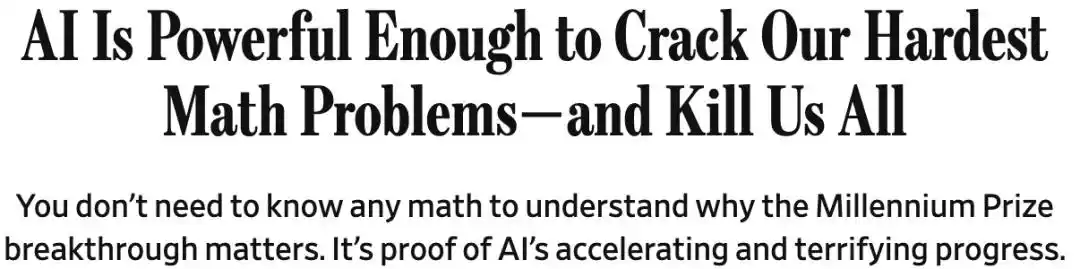
On Sept. 11, Wall Street Journal columnist Ben Cohen published a column about AI and mathematics. His line was stark: AI is now powerful enough to solve humanity’s hardest math problems and powerful enough to kill us. Cohen said he does not understand the Navier-Stokes equations himself, but argued that people do not need technical training to grasp what OpenAI’s claimed breakthrough signals. In his framing, AI progress is speeding up, and that acceleration is frightening.
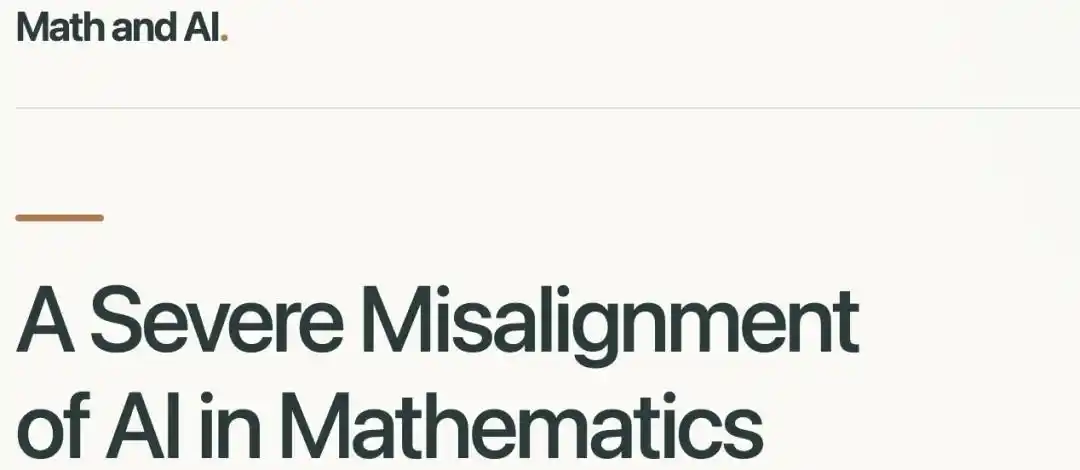
That same day, 25 Fields Medalists, including Terence Tao, released a joint statement titled A Severe Misalignment of AI in Mathematics. Their use of “misalignment” referred to a gap between what AI companies want and what mathematicians want. Mathematicians care about new methods and new understanding. AI companies, in their view, are optimizing for scores on famous problems.
Five events in seven days exposed the same gap
Set side by side, the week’s timeline shows why the reaction became so intense.
- On Sept. 3, GPT-6 Astra was released and scored 97.6% on FrontierMath Tier 4.
- On Sept. 5, an unreleased internal OpenAI model produced a solution to the Navier-Stokes problem roughly 88 hours after the first agents were launched.
- On Sept. 8, OpenAI made the result public. The same day, an NYU mathematician accused the company of jumping ahead, and a byline dispute broke out over Anthropic employees not being included on the paper.
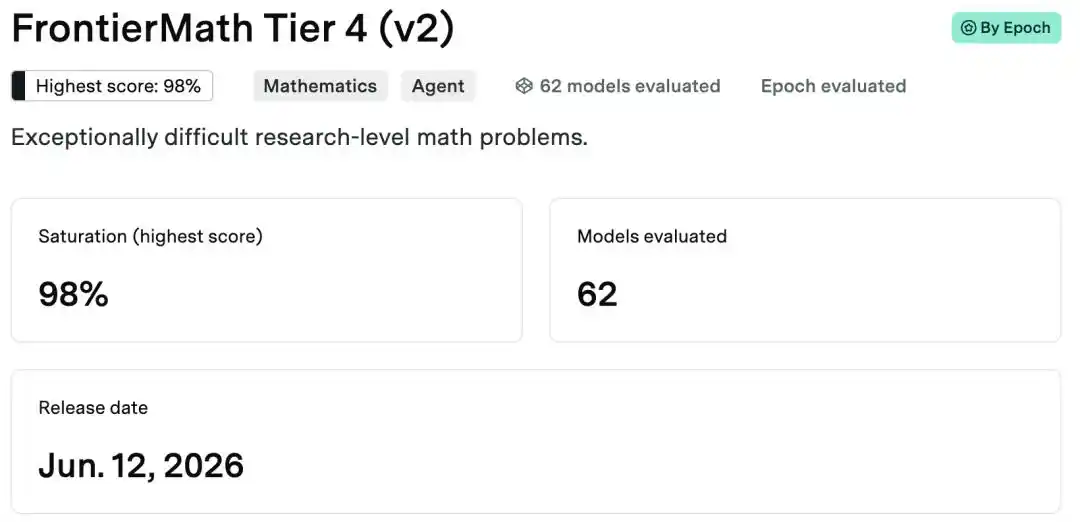
- On Sept. 10, Epoch AI said FrontierMath Tier 4 was saturated.
- On Sept. 11, 25 Fields Medalists published their statement, and that night the Wall Street Journal put a math breakthrough and AI extinction risk in the same headline.
Taken together, the events point to a widening disconnect between the speed at which AI can generate knowledge, the speed at which humans can confirm it, and the speed at which institutions can adjust the rules around it.
FrontierMath Tier 4 went from near-blank results to saturation in under 14 months
FrontierMath Tier 4 is a set of research-level math problems designed by Epoch AI to test the strongest models. The problems are extreme by design. Some can take top researchers days to solve.
When Tier 4 launched in July 2025, the best models managed only about 5%, which was close to a blank submission. Less than 14 months later, Epoch said every Tier 4 problem had been solved by AI at least once.
The final remaining problem was solved by GPT-6 Astra, and the problem author was mathematician Jay Pantone. Epoch also noted a point mathematicians had raised before: models sometimes bypass carefully constructed questions through accidental shortcuts. On this last problem, Epoch said, that did not happen.
Its conclusion was blunt. The benchmark is saturated.
In practice, that means the test no longer keeps pace with the systems taking it. Epoch has already shifted toward genuine open problems, moving evaluation into areas where humans themselves do not know the answers. In the account cited here, AI capability growth is now outrunning the tools used to measure it. Greg Burnham of Epoch described the shift this way: one era is ending and another is beginning.
An 88-hour agent run looked less like a model session and more like a research institute
If FrontierMath shows that benchmarks are falling behind models, the Navier-Stokes episode suggests something broader. AI is not only solving problems. It is starting to operate in a way that resembles a large research organization.
The account describes the effort not as a single model working alone but as a coordinated operation involving as many as 10,000 agents. Different teams handled different roles. Some tried to prove results, others tried to refute them. They communicated, shared intermediate conclusions and even switched to newer model versions during the process without breaking continuity.
Roughly 88 hours after the first agents were started, one group produced a final proof about 100 pages long.
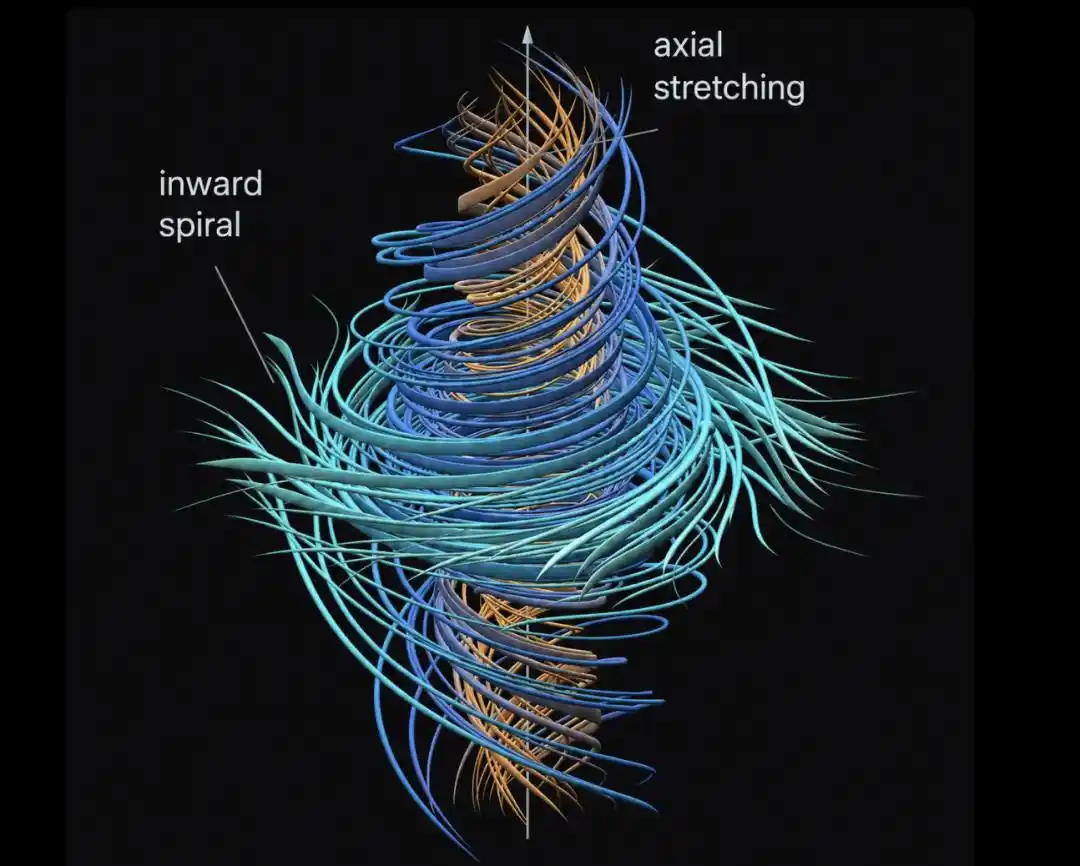
OpenAI’s published diagram for the Navier-Stokes singularity mechanism showed fluid spiraling inward and stretching along an axis, with orange marking high-speed rotation zones and cyan marking lower-speed regions. As the vortex core shrinks, velocity becomes unbounded while total energy remains finite.
The larger point in the source text is that the workflow mirrored the structure of elite human research labs: division of labor, iterative reasoning, communication across groups and organized escalation toward a final result.
Machines produced a result in 88 hours. Human acceptance would take years
In the human mathematical community, Navier-Stokes remains unsolved.
Under the Millennium Prize rules, a proposed solution must first be published through an eligible channel. After publication, at least two years must pass, and the result must gain broad acceptance across the mathematical community before Clay begins a formal review. Clay president Martin Bridson told AFP that the evaluation process is “deliberately unhurried” and must be “absolutely rigorous.” OpenAI has also said it does not plan to claim the $1 million prize.
So the most precise description at this stage is limited. OpenAI has published a proposed solution to a Millennium Prize problem and said it has completed Lean formal verification, but the work has not received independent confirmation from the mathematical community.
The contrast is hard to miss: 88 hours for machine-generated output, at least two years for formal human validation. That does not mean human checking is too slow. The issue raised in the article is that machine-driven discovery may be accelerating by orders of magnitude, while human understanding is not accelerating at the same pace.
That leaves a harder question. If machines begin producing major results every few days, who does the years or decades of reading, checking, explaining, simplifying and absorbing that follow?
Authorship rules hit the wall first
The day the Navier-Stokes result was released, the mathematics community erupted over credit and authorship.
NYU mathematician Tristan Buckmaster and Levent Alpöge, who works at Anthropic, had also been studying related fluid equations throughout August. According to the reconstruction cited from The New York Times, Buckmaster posed the questions, Alpöge fed them to an internal Anthropic model, and the two then adjusted the questions based on model output before sending more data back in.
Buckmaster said OpenAI later floated several proposals to calm the dispute. They included letting him publish his own result first, making him the first author on OpenAI’s paper, and providing compute so he could continue the research. The biggest obstacle, according to the source account, was that OpenAI did not want Levent’s name on the paper.
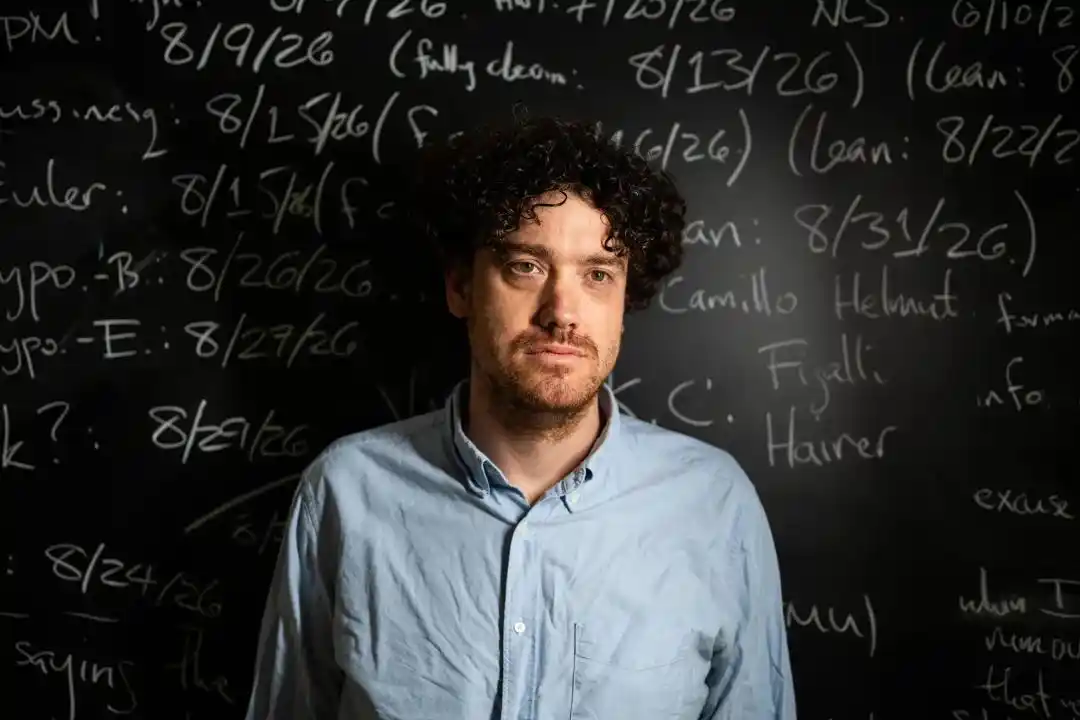
A blackboard shown in the coverage tracked Buckmaster and Alpöge’s August timeline, including Aug. 15 for the Euler equation, Aug. 22 for Lean formalization, Aug. 31 and other milestones, along with names such as Figalli and Hairer.
The dispute then spread into an even more sensitive area. Buckmaster had spent recent months using Codex to organize AI-generated mathematical drafts. That raised another question: could his unpublished research ideas, entered into Codex prompts, have flowed through hidden data pipelines and ended up benefiting OpenAI’s internal research model?
Buckmaster said he had no proof. Still, he said the timeline of events and the route of OpenAI’s proof suggested the possibility.
OpenAI responded on Sept. 10 with an updated statement saying an internal review found it was absolutely impossible for Buckmaster’s Codex prompts over the previous two months to have affected the internal model, whether through training or any other method.
The dispute remains unresolved, but it exposed a set of questions that older academic systems never had to answer in this form:
- Are private prompts protected research materials?
- Can a company-funded internal research project credit employees of a rival company?
- If a model has drawn on large volumes of public material, where is the boundary between a new contribution and prior work?
Peter Sarnak of the Institute for Advanced Study at Princeton told The New York Times, “I’ve never heard of this sort of bargaining in my life.”
The source text’s broader point is that centuries-old academic norms were not built with this kind of machine production speed in mind.
What the 25 Fields Medalists are objecting to
The joint statement from 25 Fields Medalists was not presented as a rejection of AI itself.
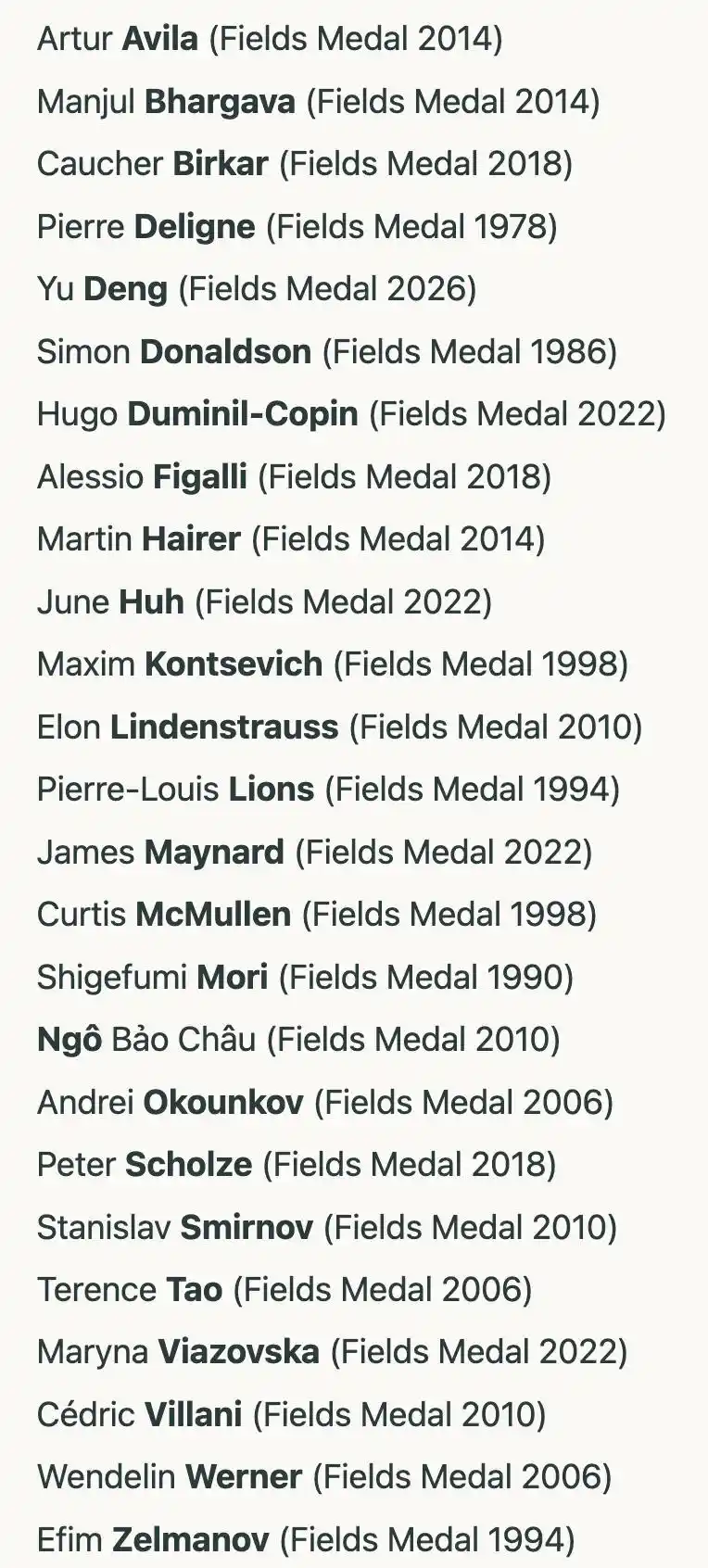
The signatories included Terence Tao, Peter Scholze, James Maynard and Maryna Viazovska. The article noted that Tao has been actively experimenting with AI-assisted mathematical research, and the statement itself acknowledged that AI may help accelerate genuine mathematical understanding.
Their complaint was narrower and sharper. They objected to treating “solving problems” as the same thing as doing mathematics. In the current AI race, they argued, companies chasing stock performance and publicity are turning famous problems into optimization targets and proof-of-strength benchmarks.
From that perspective, Millennium Prize problems risk becoming scoreboards. Yet the real value of mathematics lies in the new methods and concepts that emerge through the process, and in how those ideas become part of humanity’s shared body of knowledge.
The article says companies are now releasing striking results so often that the community has little time to absorb them. The statement also singled out the speed of publication as a source of confusion, making it harder to separate new ideas from work built on previous contributions and increasing the risk of disputes over authorship and attribution.
Why a math breakthrough ended up linked to extinction warnings
The Wall Street Journal’s framing was not just about AI surpassing mathematicians. The deeper concern was that machine-generated knowledge may now be outrunning human systems for validation, attribution and absorption.
The article also cited the GPT-6 Astra system card, which said the model was OpenAI’s first to reach the “Critical” threshold in cybersecurity and scored 100% on ExploitBench.
That puts three traits in one system at once: the organizational ability to tackle a Millennium Prize problem, the offensive capability associated with zero-day vulnerability work, and forms of reasoning that are becoming harder to inspect.
In the final section of OpenAI’s Navier-Stokes announcement, the company said it plans to better understand the new model before deciding how fast to push forward, and that more cautious choices about the pace of progress may be needed. The article treated that as a notable moment: a company fresh off a Millennium-level math claim was openly talking about slowing down.
A closed-door meeting ended without an answer
Cohen also wrote that OpenAI invited a group of top mathematicians to its San Francisco office last month for a closed-door discussion. The premise was simple and unsettling: assume AI will eventually surpass humans in mathematics, then ask what that means for education, research collaboration, paper publication and the training of the next generation of mathematicians.
After a full day of discussion, there was no answer.
The source ends on a line that captures the larger tension. This is not a problem that can be handed to Lean for automatic verification. Humans still have to solve it themselves.