
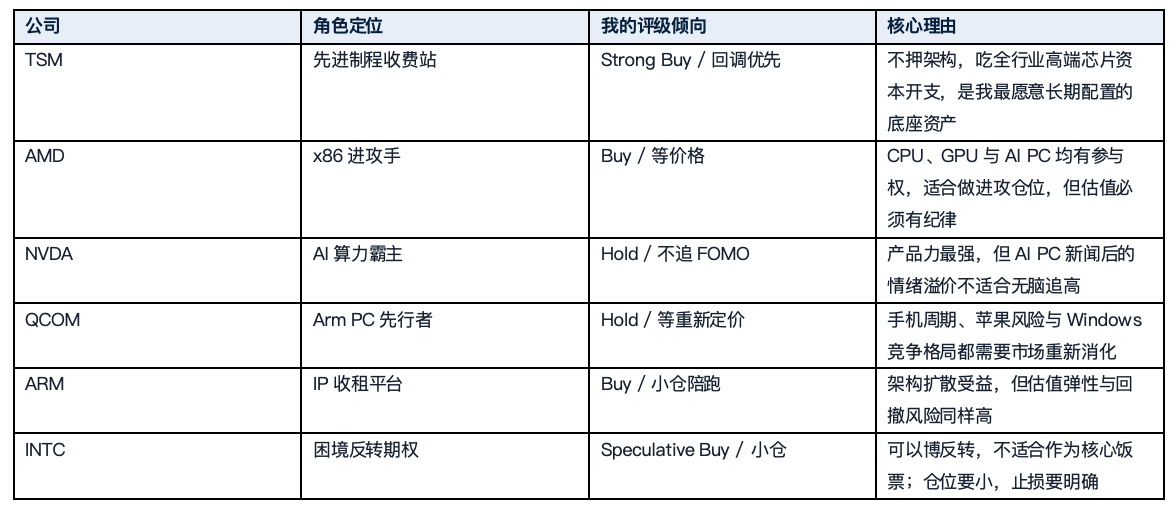
My core conclusion is straightforward: In the AI PC battle, don't bet on camps—bet on tollbooths. TSMC serves as the foundation, AMD as the offense, ARM as a small companion position, Intel as a lottery ticket, Qualcomm awaiting a repricing, and NVIDIA not worth chasing the post-news FOMO.
The entry of NVIDIA and MediaTek into AI PCs appears to add a new chipset combination for consumer PCs, but it essentially signals that Windows on-device AI ecosystem is moving from a single‑player trial to multi‑player competition. This war should not be reduced to a religious debate between x86 and Arm; what truly matters is who can survive the replacement cycle and consistently capture margins, cash flow, and industry pricing power.
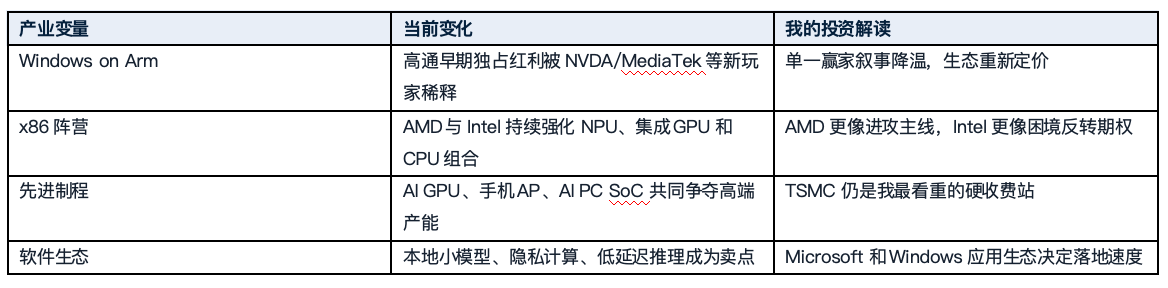
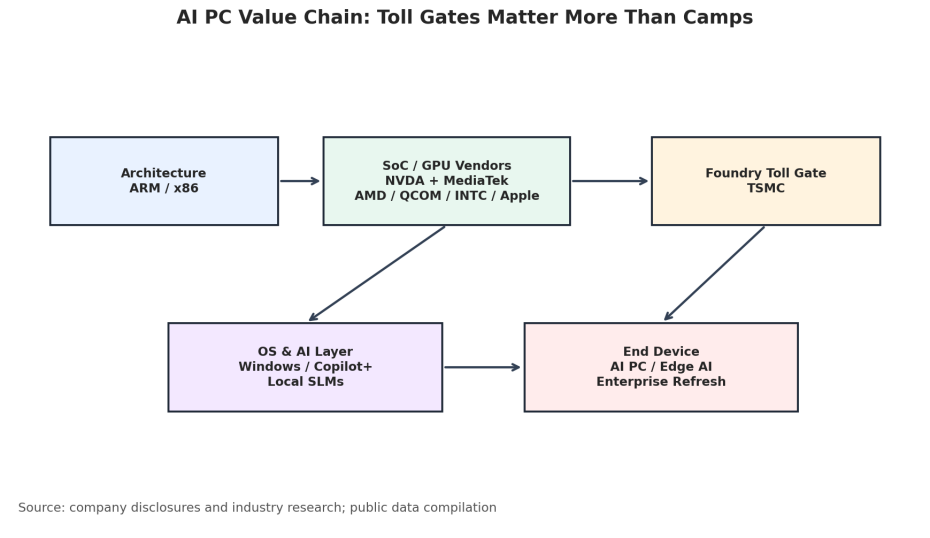
I view the AI PC opportunity in three layers. The first layer is the advanced process tollbooth—no matter who wins, TSMC collects the tolls. The second layer is compute and platform spillover, with AMD and NVIDIA representing the x86 offensive and the extension of GPU software stacks, respectively. The third layer is architectural proliferation and turnaround plays, where ARM and Intel both offer elasticity but require stricter position discipline.
Shipment Data Validates Long‑Term Standardization
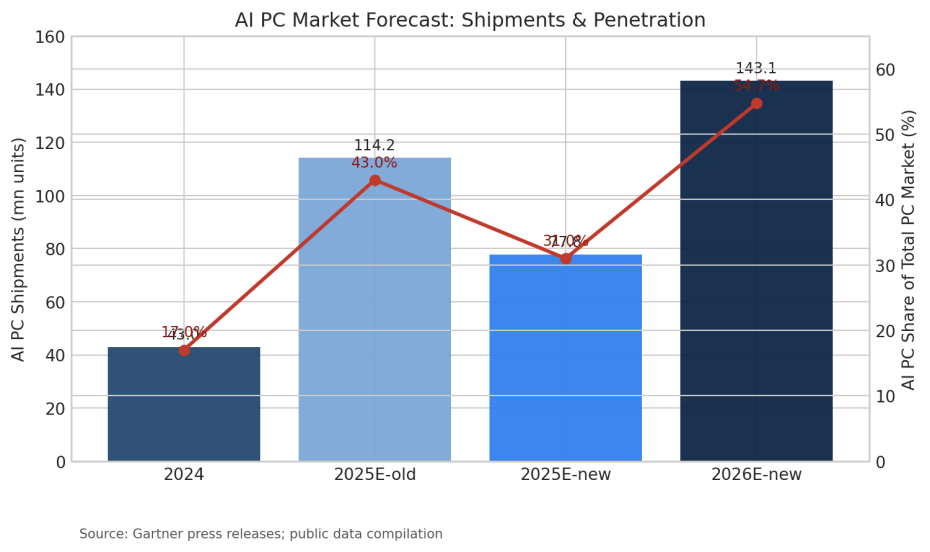
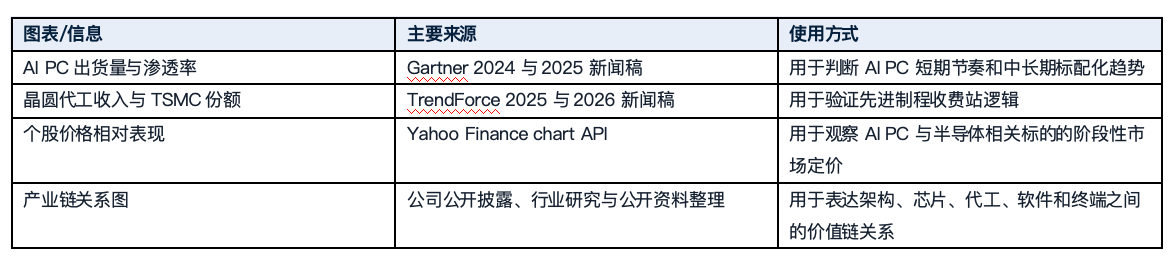
In 2024, Gartner projected AI PC shipments would reach 114.2 million units in 2025, representing 43% of the PC market. After updates in 2025, affected by tariffs and procurement rhythm disruptions, the forecast was revised down to 77.8 million units, or 31% share. However, 2026 is still expected to reach 143.1 million units with a penetration rate of 54.7%. The lesson from these figures is not that AI PC demand has been disproven, but that short‑term fluctuations are normal while the long‑term trend toward standardization remains intact.
From an investment perspective, the real challenge of AI PCs is not whether they have an NPU, but whether users are willing to upgrade for a local AI experience. If applications remain limited to meeting summaries, image generation, and simple assistants, the refresh elasticity will fall short of the market's most optimistic expectations. However, if enterprises begin adopting privacy computing, low‑latency inference, and local knowledge bases as standard configurations, the AI PC story transforms from a consumer electronics narrative into an enterprise IT upgrade cycle.
Tollbooth Logic: TSMC's Process Advantage
On the surface, the AI PC narrative is about Arm challenging x86. But I care more about where the profit pool is migrating. NVIDIA is strong in GPUs and AI software stacks, AMD excels with x86 CPU and GPU combos, Qualcomm dominates in low‑power and connectivity, and Intel retains strength in legacy ecosystems and enterprise channels. They all have unique advantages, but share one commonality: cutting‑edge chips cannot bypass advanced process nodes.
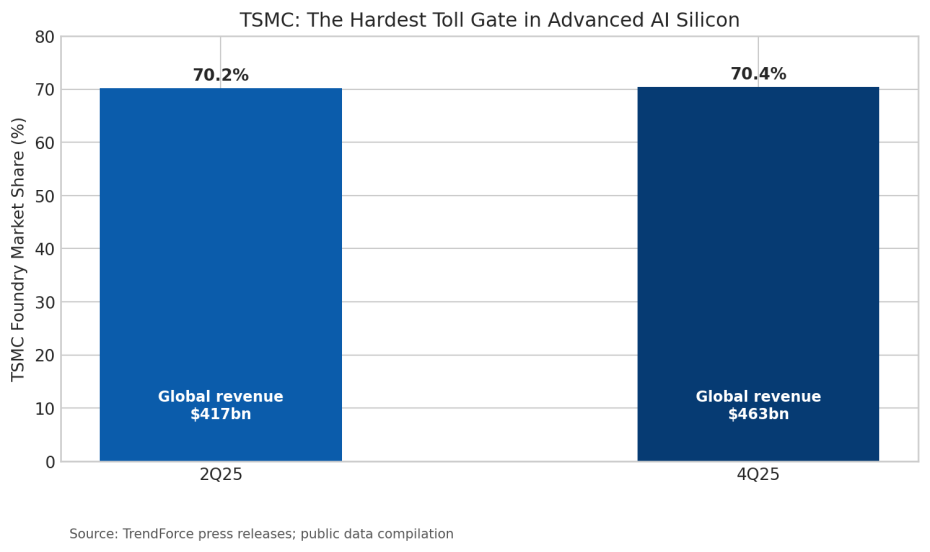
According to TrendForce, global wafer foundry revenue reached about $41.7 billion in Q2 2025, with TSMC holding a 70.2% share. By Q4 2025, revenue grew to approximately $46.3 billion, and TSMC's share edged up to about 70.4%. This suggests that as long as AI PCs, AI servers, mobile APs, and edge AI chips continue to compete for advanced nodes, TSMC is not a simple cyclical stock but more like a tollbooth entry point for the entire AI hardware era.

Risk‑Return Layering Among Chip Players
Over the past year, semiconductor stocks have already priced in AI PCs, on‑device AI, and compute spillover. Yahoo Finance daily prices show that AMD, Intel, ARM, and TSMC all exhibit strong elasticity within the sample period, but their risk‑reward profiles differ. My approach is not to buy all AI PC‑related names together, but to layer positions according to certainty, valuation discipline, and position in the industry chain.
The core conclusion remains simple: this is not a war where only winners can be bought, but one where investors should buy tollbooths, platforms, and predictable cash flows. If the market overloads on emotion on the day of a product launch, I would rather wait. If a pullback brings a quality company's risk‑reward back into a reasonable range, I will prioritize TSMC and AMD, and only then consider the elasticity opportunities in ARM and Intel.
Five Key Risks That Cannot Be Ignored
The risks of this theme must also be acknowledged. First, AI PC applications may fall short of expectations, resulting in a weaker‑than‑anticipated replacement cycle. Second, if Windows on Arm compatibility improves too slowly, the narratives for Qualcomm and new entrants will be suppressed. Third, tariffs, corporate purchasing pauses, and macro uncertainty will affect PC demand. Fourth, a temporary mismatch in advanced process supply and demand could trigger valuation corrections for TSMC. Fifth, the entire AI supply chain trades at elevated valuations; once US equity risk appetite declines, the most elastic names tend to correct the fastest.
Therefore, I prefer to treat AI PCs as a long‑term industrial migration rather than a short‑term news trade. The truly professional approach is not to buy slogans on launch day, but to buy ecosystems, tollbooths, and companies that can sustainably deliver cash flows after the emotional tide recedes.
This report is prepared by a guest analyst. The views expressed are solely those of the author and do not represent the opinions of BIT. This material is for reference only and does not constitute investment advice.