
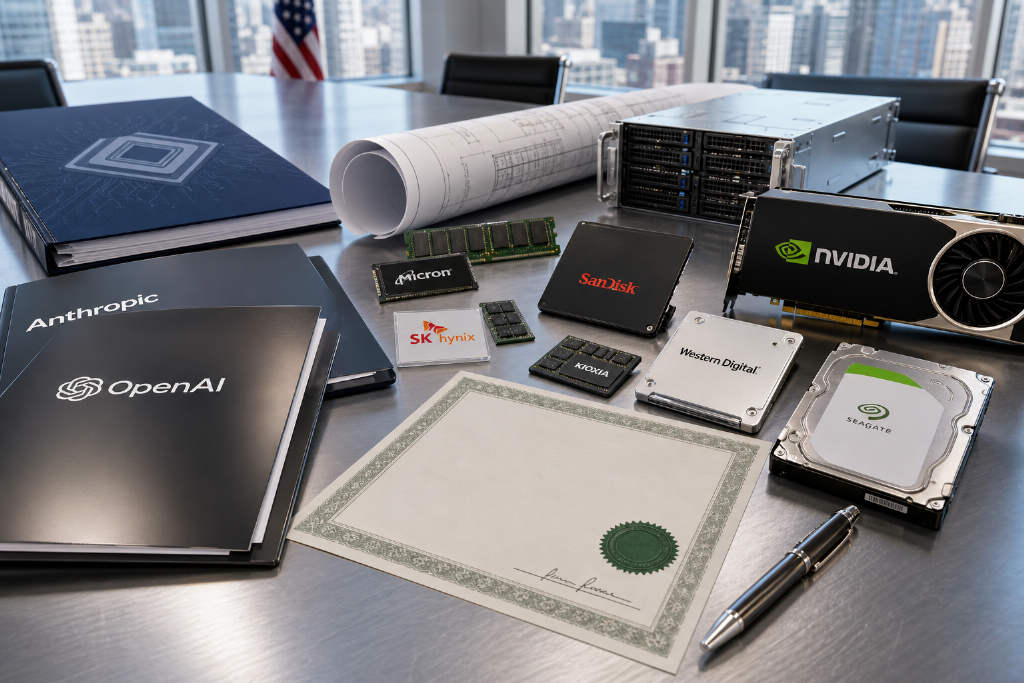
AI revenue updates and Nvidia support lift chips and memory stocks
AI enthusiasm got another boost this week after Anthropic and OpenAI reported strong financial updates, while Nvidia extended support for data center construction with a pledge tied to financing. The move helped storage stocks rebound and pushed the semiconductor complex back into bull market territory.
On Monday, Micron rose 4.13% for a fifth straight gain, its longest winning streak since January. The stock climbed 17.5% over the five sessions. SanDisk jumped 8.88%, SK Hynix gained 3.04%, Western Digital added 5.4%, and Seagate rose 2.2%. Kioxia ADR surged 13.44% after a sharp rally in Japan. Teradyne and Applied Materials both advanced more than 5%.
Powered by the storage rally, the Philadelphia Semiconductor Index, or SOX, spent only 21 days in bear market territory, the shortest such stretch since March 2020. The index closed up 1.6% at 12,621 on Monday, more than 20% above its July 29 low and back in a technical bull market.
Anthropic and OpenAI are the key near-term catalysts
According to people familiar with the matter on Monday, Anthropic’s annualized revenue reached $65 billion at the end of July. Annualized revenue extrapolates short-term sales across a full year and is often used for AI companies growing at a rapid pace.
Internal documents reviewed by media outlets also showed that Anthropic generated more than $11.5 billion in revenue in the second quarter, up from $787 million in the same period in 2025. More importantly, Anthropic posted adjusted operating profit in the quarter. Earlier reports said the company could go public in the U.S. as soon as September or early October.
Separately, OpenAI CFO Sarah Friar told investors last Friday that enterprise revenue has already surpassed consumer revenue and that annualized revenue has reached $40 billion, according to media reports. OpenAI has also filed confidentially for an IPO, though no listing date has been reported.
Jordan Klein, a trading analyst at Mizuho, said in a client note that the revenue growth at Anthropic and OpenAI suggests their long-term compute leases are intact and that data center demand remains active. He called the latest financial updates from the two companies the most important near-term catalyst for chip stocks, adding that both are racing toward IPOs.
Klein said market consensus puts Anthropic’s full-year recurring revenue at $75 billion to $100 billion. Other reports suggest that figure could rise to $180 billion to $200 billion by the end of next year. That would translate into large purchases of AI chips, memory components, networking gear and other data center hardware.
Nvidia is trying to help customers fund compute buildouts
Last Monday, Nvidia reached an agreement with several of Wall Street’s largest financial firms to raise large sums of capital to help its customers finance compute purchases. The firms aim to deploy more than $500 billion of outside capital over the next few years.
In simple terms, large companies are using their stronger credit ratings to help lower financing costs for customers, while Nvidia is acting as the deal lead rather than the capital provider.
This Monday, reports said OpenAI signed a data center lease deal worth as much as 10 gigawatts with SB Energy, a SoftBank company, with partial backing from Nvidia. The project is located in Ohio and could become one of the largest AI data center campuses ever built.
People familiar with the matter said Nvidia will support the project through a pledge designed to help SB Energy raise debt financing while limiting Nvidia’s own risk exposure.
Nvidia CEO Jensen Huang previously posted on X that the company may offer residual-value support of up to 25% for related opportunities, on a case-by-case basis. He wrote: "Our job is to help unlock a large amount of independent capital while maintaining strict risk exposure."
Some analysts said Nvidia’s push is tied to the rising cost of AI infrastructure. Large GPU clusters and data centers can require billions of dollars in investment, and the biggest concern for investors is rapid hardware obsolescence. Once new-generation GPUs become widely adopted, the resale value of older equipment can drop, lengthening payback periods.
By offering partial residual-value support, Nvidia is effectively lowering the barriers to capital flowing into compute infrastructure while also encouraging more GPU orders and data center construction. More importantly, this is not just a simple backstop. Nvidia is trying to package AI compute as an asset that can generate stable cash flow, with large asset managers helping open equity and debt funding channels.
SanDisk’s long-term guide gives memory stocks a new valuation anchor
SanDisk was also one of the main contributors to the rebound. Last week, the company held an investor day and issued upbeat long-term guidance. It said revenue growth would be around 10% to 15% across fiscal 2028 to fiscal 2030, with its fiscal year ending in late June or early July.
CFO Luis Visoso said SanDisk expects adjusted gross margin to stay around 80% in that period. The company said that outlook is supported by customer commitments and tight supply control. SanDisk has signed new business model, or NBM, agreements with eight customers. These are multi-year supply deals with committed volumes and structured pricing, allowing the company to better match customer demand with capacity.
For Micron, that is also a positive sign, because it points to strong demand across the memory market and suggests shortages may not end soon. SanDisk focuses on flash storage for long-term demand, while Micron sells high-bandwidth memory and DRAM, products that are in strong short-term demand and are needed for smartphones and PCs to run smoothly.
Historically, memory has been a cyclical industry. Strong demand and tight supply lift prices and margins, which attracts more capacity until oversupply eventually pulls prices back down. But SanDisk’s investor day appeared to hint at a different path.
On August 17, Bank of America reiterated a Buy rating on Micron and kept its price target at $1550, saying SanDisk’s recent investor day may point to a more durable phase for the memory industry, rather than the boom-and-bust pattern seen in past cycles.
Bank of America analyst Vivek Arya said SanDisk’s 15% annual sales growth target and its margin outlook above 80% through 2030, supported by new customer agreements and supply strategy, offer a valuation framework for how investors may ultimately view storage stocks.
This article was originally published by 科创板日报. Author: Huang Junzhi.