
Alibaba on Monday released Qwen3.8-Max and called it the most capable model it has built so far. The model weights are set to arrive on Hugging Face and ModelScope next week, marking the first time Alibaba has given away a Max-scale model.
A 2.4 trillion-parameter model with 95 billion active
Qwen3.8-Max comes with 2.4 trillion total parameters, with 95 billion switched on at any moment. The report described parameters as the number of dials a model can handle.
That setup matters because it keeps resource use lower than a system that has to engage the entire parameter count at once. Decrypt compared it to a huge library where only the relevant shelf lights up for each question. In practical terms, that means small businesses and research labs with strong enough hardware can run a state-of-the-art model without taking on the same spending burden as a major datacenter.
Alibaba focused its pitch on endurance
Alibaba’s release post did not lean on the usual benchmark race. Instead, it highlighted sustained execution.
According to the release, the model spent 16 days building a coding tool by itself, producing 265 commits, 127 pull requests, and 151 issues, with no human touching the keyboard. In another task, it spent five days reproducing a research paper it had never seen code for and then exceeded the paper’s own result by 2.7 points. In a 24-hour machine learning contest, it finished ahead of 458 of 526 human teams.
Designed to work inside rival tooling
Qwen3.8-Max ships with instructions for Claude Code and Codex, the coding tools built by Anthropic and OpenAI. Alibaba’s API also speaks both companies’ protocols.
Decrypt said most of the model’s coding benchmarks were run inside Claude Code.
Mixed benchmark standings, stronger multimodal results
The benchmark table did not put Qwen on top across the board.
- Across 31 text tests, Anthropic’s Fable 5 took 15 first-place spots.
- OpenAI’s GPT-5.6 Sol took nine.
- Qwen took seven.
On the 12 coding tests, Qwen won exactly one.
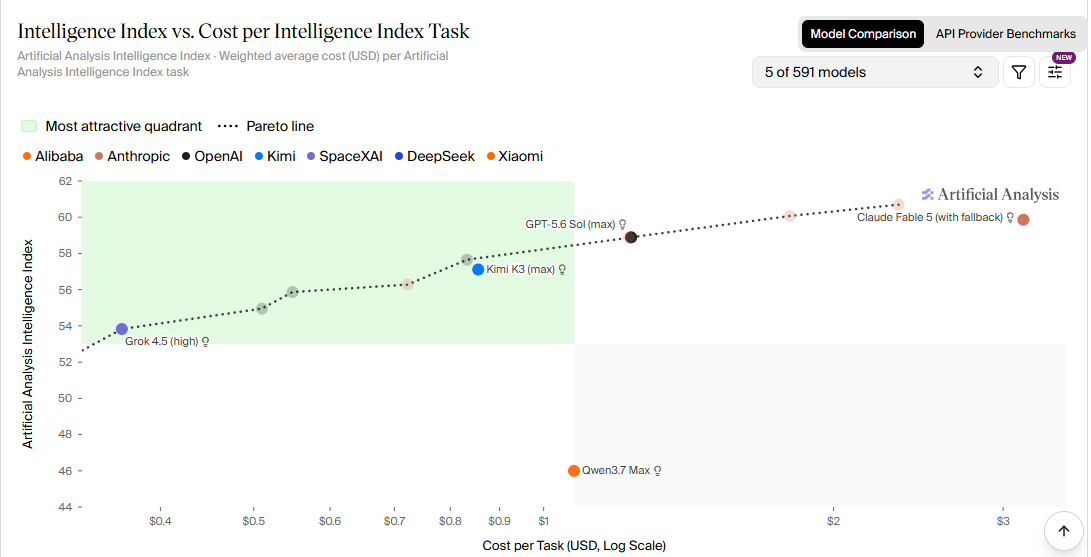
Even so, the report said the model is extremely cheap and efficient on intelligence costs. Even if it needs more iterations or extra reasoning, the cost of completing the job is much lower, at nearly 30% of what Claude Fable 5 charges.
The ordering changes in multimodal work. In tests involving documents, video, and spatial reasoning, Qwen led most of that table.
A reversal in strategy
The launch also marks a change in Alibaba’s business direction. Decrypt noted that in April, Alibaba removed the free tier of Qwen Code, while the team had been drifting toward closed, paid models after leadership departures. Its earlier review of Qwen 3.7 Max said the Plus version would be open while Max would remain behind the API.
That is no longer the case, and Decrypt argued the timing was deliberate.
Chinese open-weight models rose from under 2% of tokens on OpenRouter in late 2024 to roughly 61% by mid-2026, according to the report. Qwen also passed Meta’s Llama as the most self-hosted model in the world.
Distribution may matter more than paper rankings
At the same time, Washington restricted Fable 5 and Mythos 5 under export controls in June. Decrypt also reported that Beijing is weighing restrictions of its own on Chinese models going overseas.
In Decrypt’s framing, Alibaba may be trailing on paper while gaining on distribution. If users can download a model for free that comes close to the leaders, second place can still be a strong position.