
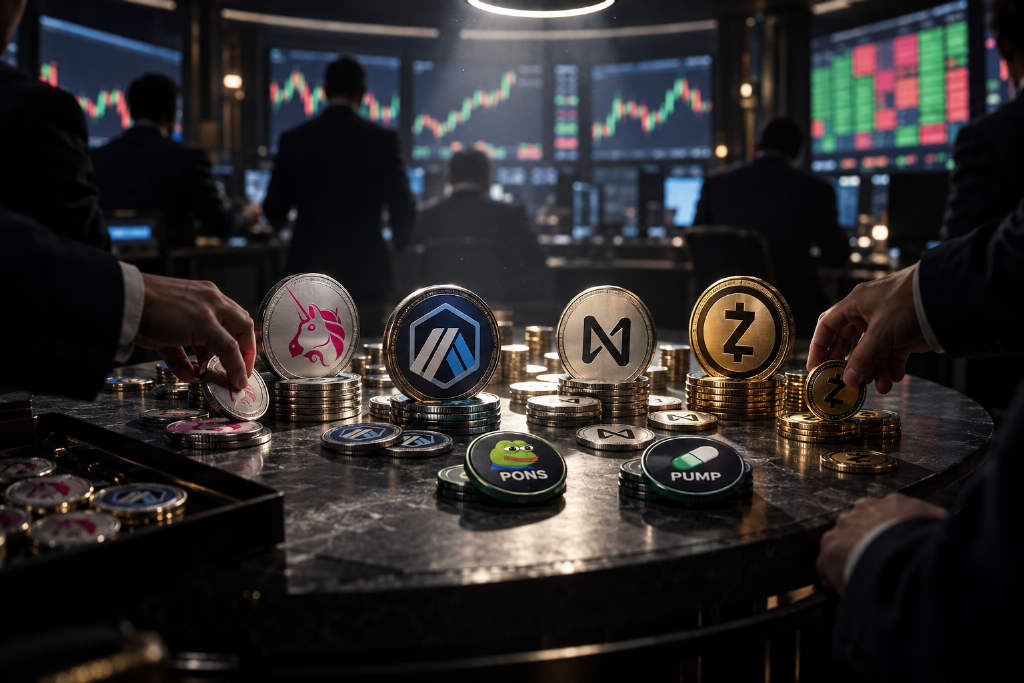
Altcoin season has not officially begun. But traders are already shifting positions, and the data is getting tough to brush aside.
In the past 30 days, meme-launch platform token PONS has jumped more than 350%. In DeFi, Uniswap’s UNI has climbed more than 110%, Arbitrum’s ARB has advanced more than 150%, and AI-focused NEAR is up around 180%. Privacy coin Zcash set a new high last week and pushed above $1,600. Bitcoin layer-2 token LIT and meme issuance platform token PUMP were also among the best performers in that stretch.
Those big moves are showing up in very different corners of the market, which tells you this is not one tidy, single-theme trade. And yet the price action also hints that plenty of traders are looking harder at projects with an actual business case people can point to.
The rally is not only about meme coins
ARB, UNI, Jupiter’s JUP, and Ondo’s ONDO have all logged sharp gains. Bankless podcast host David Hoffman said last Friday that these projects have one thing in common: they produce revenue and real earnings. His take is simple. Application value, not just raw speculation, is helping drive this move.
That said, fundamentals are not the only thing being priced in. Of the top 20 gainers last week, only two were meme coins. But 1inch co-founder Sergej Kunz said buyer growth over the past 30 days was strongest in meme coins, while DeFi protocols, privacy tokens, AI projects, and tokenized assets also pulled in heavy capital interest.
He framed the current setup as broad first, deep later. More wallets are buying a wider mix of tokens, but individual purchase sizes are usually small. In his view, the caution showing up in the data fits selective participation, not all-in bets.
The altcoin season index is rising, but the threshold has not been met
It is still too soon to say what, exactly, makes this cycle’s altcoin season different. CoinMarketCap’s official Altcoin Season Index has still not flashed a formal altcoin season signal.
The index is now at 64 out of 100, up from 48 a week ago, but it remains below the 75 threshold.
At the same time, a relatively small batch of tokens still controls market capitalization. Trading firm Talos says the top 10 altcoins now make up about 80% of total altcoin market cap, versus roughly 70% at the end of 2024.
Hoffman said the current rally is being powered by protocols that can generate income. Samar Sen, head of international markets at Talos, said the numbers show capital bunching into a small set of assets instead of spreading out across long-tail smaller tokens.
Sen said Talos’ September flow data also pointed to a very strong buying bias, with buyers in front on almost every trading day. That is a sharp break from late 2024, when buying and selling were more evenly matched and a post-election rally lifted a wide mix of tokens, including DOGE, ADA, and HBAR.
What capital is buying
Sen said the strongest pockets of demand are narrative-specific trades: revenue-generating protocols, onchain perpetuals, and DeFi projects, including HYPE, LIT, UNI, and MORPHO.
Privacy-linked assets such as ZEC, NEAR, and XMR have also turned in strong performance. AI-related tokens, including VVV and TAO, have also done well.
Talos has also recorded a pickup in trading tied to meme-launch platforms such as PUMP and PONS. The Robinhood ecosystem and the meme coin USELESS have also posted strong gains.
PONS has been the top-performing token over the past 30 days.
Kunz and Sen mostly see this the same way: the market is using much tougher filters this time around. In Kunz’s words, investors are focusing on specific narratives and ecosystems instead of treating altcoins like one giant undifferentiated bucket.
Buying has also picked up in tokenized gold and tokenized stocks, and AI tokens have moved higher too, though from a smaller base. Even so, the wider market has not fully made the jump from speculation to value investing. Several narratives are still running side by side. And competing for attention.
Boundaries between sectors are starting to blur
Earlier this month, Robinhood listed a large number of non-traditional trading pairs, and the lines between sectors started to blur. Tokenized stocks can now trade directly against meme coins, through pairs such as BONER/HIMS and SPACEHOOD/SPCX. One of those pairs posted high trading volume in early September.
Can utility lead this cycle?
Michael Egorov, founder of Curve Finance and Yield Basis, said the market seems more focused on real-world use cases and institutional demand than it was in earlier cycles.
He said, "Overall, the market currently prefers protocols that are genuinely useful, connect crypto with real financial activity, and can be validated in real deployment."
He pointed to stablecoins as an obvious example, especially in onchain foreign exchange and fintech applications. In his view, the biggest force will be the continued integration of crypto infrastructure with the real economy.
If that demand keeps building, it could bring a new source of buying power into this altcoin cycle, because crypto infrastructure would no longer be serving crypto trading alone. But whether that thesis actually plays out is still an open question.
Who is driving the current move
Talos data shows market-maker participation in altcoin trading has dropped from about 65% at the end of 2024 to 32% in September this year, yet flows have stayed heavily tilted toward buying.
Sen said this is a clear difference from the previous altcoin rally and suggests liquidity providers and market makers have so far had a weaker hand in the current move.
Meanwhile, trading barriers keep falling. In the past, traders had to go straight to decentralized platforms such as Raydium and Orca to get this kind of exposure. Now those trades are available on mainstream platforms too. Sen said that cuts the barrier to entry and brings in broader retail participation.
Professional traders also have more ways to track flows in this cycle, including wallet tracking and copy trading, which lets them watch capital move across wallets, protocols, and chains. Sen said this is creating a new setup: retail traders have more entry points, while professional traders have better tools to spot where capital is concentrating.