
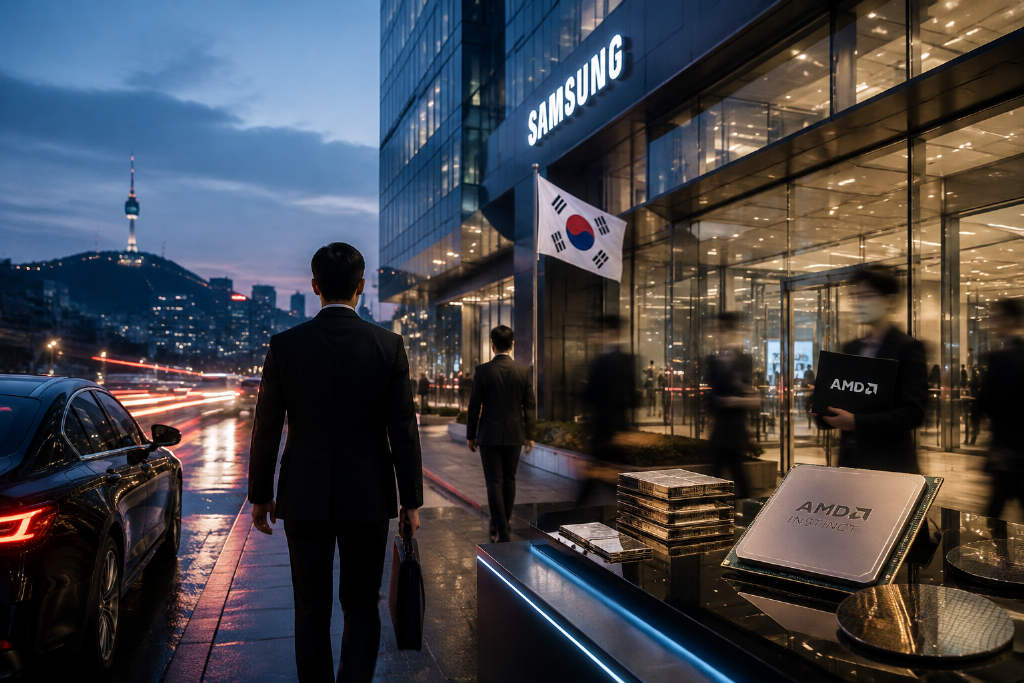
AMD Chair and CEO Lisa Su visited Samsung Electronics again on Oct. 7, returning to South Korea seven months after her previous trip. Industry watchers tied the meeting to AMD’s effort to secure high-bandwidth memory, or HBM, for its AI chips, with discussions reportedly covering the possibility of giving Samsung foundry orders in exchange for more stable supply.
Su says the talks cover a broader partnership
According to The Chosun Daily, Su arrived at Samsung’s Seocho building in Seoul’s Seocho District at about 4:44 p.m. on Oct. 7. She was greeted by Kim Jae-joon, executive vice president and head of strategic marketing at Samsung’s memory business, and Cho Sang-yeon, executive vice president at its Americas headquarters DSA unit. AMD’s computing and graphics chief Jack Huynh and Vice President Joseph Macri accompanied her.
Asked by reporters about the purpose of the meeting, Su said the two sides would discuss a “broader partnership” and added that AMD already works with Samsung in many areas. When asked whether she would also meet Samsung Chairman Lee Jae-yong, she said it was “difficult to disclose at this time.”
The trip had originally been scheduled for two days, but was shortened to one day because of another engagement in Washington. Su returned to the United States the same evening.
Earlier that day, she met Yoo Je-myung, vice minister at South Korea’s Ministry of Science and ICT, and joined a roundtable with 13 Korean AI semiconductor and infrastructure companies. The discussion covered plans for a Korean AI research center and infrastructure combining AMD CPUs and GPUs with domestically developed Korean NPUs. She also met SK hynix on the same day and said that “the semiconductor industry is a team sport.”
HBM4 demand is rising with MI455X
AMD’s push to deepen ties with memory makers comes as both AI chip shipments and memory content per chip continue to increase. Its latest AI accelerator, the Instinct MI455X, carries 432GB of HBM4, up from 288GB of HBM3E in the earlier MI355X, a 50% increase.
Su said the next-generation MI455X and the Helios system, both using HBM4, had already started shipping. She said Samsung and SK hynix had both provided strong support, and added that AMD’s HBM cooperation would not be limited to a single generation but would extend across multiple product cycles. She described both Samsung and SK hynix as core supply-chain partners for AMD.
Supply constraints, though, are unlikely to ease quickly. Market research firm TrendForce said on Sept. 29 that HBM and conventional DRAM share limited advanced-process capacity, while yield improvement and volume ramp-up for new products take time. It expects memory supply to remain tight through next year.
Su also said that “memory supply is very tight.” She said AMD is working with customers to optimize memory usage in order to meet more computing demand, while also asking suppliers to expand capacity as quickly as possible.
Samsung wants to turn memory supply into foundry and packaging business
For Samsung, AI-driven demand for memory creates an opening to expand its foundry footprint. The report said the two companies signed a memorandum of understanding in March during Su’s earlier visit to Korea. That agreement focused on HBM4 and next-generation DDR5 supply, named Samsung as one of the main HBM4 suppliers for the MI455X, and included discussions on whether Samsung foundry could manufacture AMD’s next-generation products.
At the time, Jun Young-hyun stressed that Samsung could provide memory, foundry services, and advanced packaging that links and assembles multiple chips into a single product. If Samsung reaches a deal with AMD, the business relationship would expand from memory supply into broader AI chip manufacturing.
AMD still depends on TSMC for advanced production
Even so, shifting advanced production is not simple for AMD. Its advanced CPUs and GPUs currently rely on Taiwan Semiconductor Manufacturing Co. (TSMC), and the MI455X also uses TSMC process technology. Bringing in a new manufacturer would require parallel validation of performance, yield, and delivery schedules, adding meaningful complexity.
AMD said last year that moving some products to a new manufacturer could delay launches or reduce yield and performance. At a time when AI chip shipments need to scale quickly, any added production risk could turn into supply disruption.
A senior figure in South Korea’s semiconductor industry, cited in the report, said AMD sees relatively high risk in handing foundry work to Samsung, but cannot ignore Samsung’s proposal if it wants stable HBM access. That overlap in interests made the latest meeting possible.
On the status of any potential cooperation, Su said only that having a broad supply chain is important and that Samsung is a comprehensive and strong partner, with both sides still looking for areas to work together.