
Solana trader Ansem said in an X post on July 16 that buybacks by themselves do not create value, and that the main force behind token valuation multiples is a project’s “trust premium” with its community.
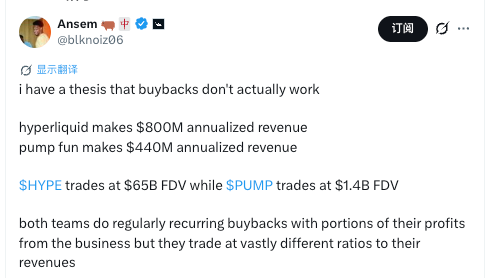
The thread quickly drew attention, logging more than 469,000 views, 3,240 likes and 509 reposts. Ansem used two of crypto’s strongest revenue-generating protocols as examples: Hyperliquid, with roughly $800 million in annualized revenue and an FDV of about $65 billion, and pump.fun, with about $440 million in annualized revenue and an FDV of only around $1.4 billion. Both are conducting large-scale buybacks, yet the valuation gap is close to 50x.
Heavy buybacks, sharply different valuations
Ansem’s point was that the difference is not revenue scale. He said it comes from trust built, or lost, through a team’s behavior over time.
In his breakdown, Hyperliquid routes 97% to 99% of protocol fees directly into HYPE buybacks and burns. Citing CryptoNews data, he said Hyperliquid’s cumulative protocol revenue had passed $1 billion as of June 30, with an annualized run rate near $840 million. The platform has burned more than 41 million HYPE tokens worth over $1 billion, reducing circulating supply by about 4.2%. At press time, HYPE was trading in the $60 to $67 range, implying an FDV of about $57 billion to $62 billion.
pump.fun has also been aggressive. The platform generated about $970 million in total revenue in 2025 and directed close to 100% of that revenue into PUMP buybacks, for a cumulative total of about $213 million, according to the article. In April 2026, the team carried out a one-time burn of PUMP tokens worth $370 million, equal to roughly 36% of circulating supply, and committed 50% of future revenue to ongoing burns. Even so, PUMP was quoted at about $0.0016, with an FDV of around $1.4 billion to $1.7 billion.
Ansem argued that pump.fun generates a little more than half of Hyperliquid’s annualized revenue, yet its FDV is still below 3% of Hyperliquid’s. If buybacks were the core driver of valuation, he said, that gap would be difficult to explain.
Why Hyperliquid gets a higher multiple
Ansem said the market gives Hyperliquid a richer valuation because founder Jeff and the team have built trust with users.
He pointed to several factors. Hyperliquid has not overpromised and has kept its attention on shipping products. User rewards were allocated according to pre-set on-chain metrics, without opaque adjustments. Its core user base also gives Jeff and the team a high degree of trust. In Ansem’s words, that trust premium “is a major reason why the token has traded so well.”
The project’s past actions line up with that argument. Hyperliquid did not take venture capital funding, allocated 70% of total supply to the community, and followed through on early expectations with a large airdrop at launch in November 2024. The platform also showed resilience during a market sell-off in February 2026, which Ansem said suggested a user base with many serious traders relying on it for day-to-day activity.
pump.fun and the cost of an unfulfilled airdrop
Ansem was more direct in his criticism of pump.fun. He said the platform has generated more than $1 billion in cumulative revenue and raised another $1 billion in its ICO, yet the airdrop promised to users has still not been delivered.
According to Protos, pump.fun said “airdrop coming soon” when it announced the PUMP token ICO on July 9, 2025, and promised to allocate 24% of supply to the community. By mid-July 2026, a full year had passed and the airdrop still had not happened.
Ansem had already criticized that issue on June 25. He wrote: “pump.fun is the only app in crypto that’s retained attention for multiple years. Even OpenSea couldn’t do that. But people are angry because they promised a 24% airdrop and never delivered, and now they’re just sitting on cash.”
The $370 million token burn in April 2026 was meant to repair trust, but the community reaction went the other way. Some users argued that the burned tokens should have gone to the airdrop, meaning the burn effectively erased what the community was supposed to receive. Citing Cryptopolitan, the article said the move was widely read by the community as something that “deepened distrust.”
Ansem’s view on what could change
In the latest thread, Ansem added a hypothetical: if pump.fun seriously honored its airdrop commitment and addressed the concerns of core users, the token price could rise 10x to 15x. He also said trading volume, attention and platform revenue could materially improve.
His broader argument was straightforward. Revenue can fund buybacks, but buybacks alone do not automatically produce a higher valuation. The multiple the market is willing to pay depends on whether a team keeps its promises and whether the community believes those promises will be honored.