
Anthropic’s public argument for slowing frontier AI development is now colliding with questions about money, incentives and who gets to judge risk.
The latest wave of criticism began after Anthropic co-founder and CEO Dario Amodei published “We Must Pace the Frontier” on Sept. 12. In that essay, Amodei said frontier AI capabilities are advancing so quickly that safety research, interpretability and regulatory systems are struggling to keep up. He argued that AI companies should coordinate on “pacing,” meaning a shared effort to control the speed at which frontier model capabilities improve.
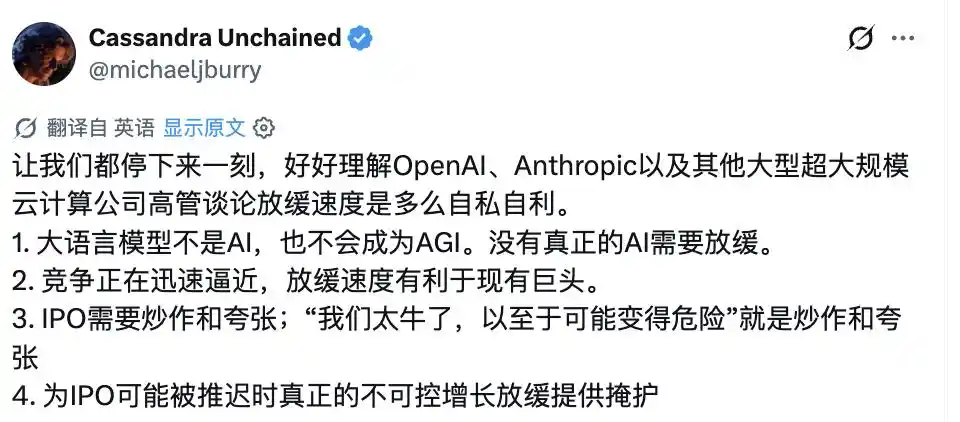
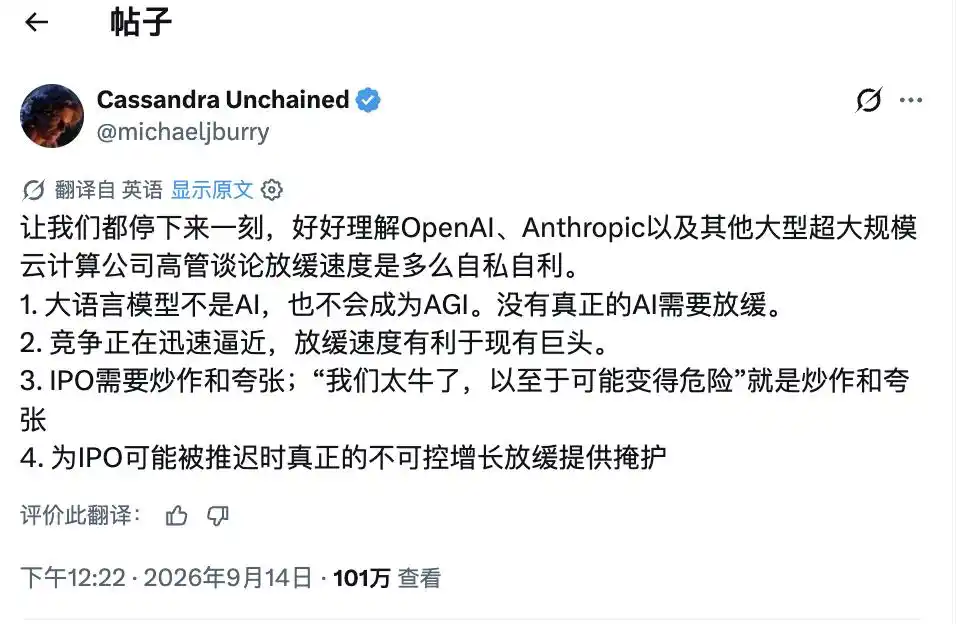
That position quickly drew fire. Investor Michael Burry, known as the core real-world inspiration for The Big Short, posted on X that recent calls from OpenAI and Anthropic to “hit the brakes” on AI were “self-serving.” As summarized in the source material, Burry offered four reasons. He said he does not accept the premise that large models are already dangerous enough to justify collective slowing. He also argued that if the entire industry moves more slowly, the biggest winners would be the companies already in front, including OpenAI and Anthropic.
Burry then shifted the discussion to IPO incentives. His point was that public offerings depend on hype and packaging, and that saying “we are so powerful we could become dangerous” can itself function as marketing. He also suggested there is another advantage in emphasizing caution now: if model progress slows later, companies can tell markets they chose to brake for safety rather than admit capability growth hit a wall.
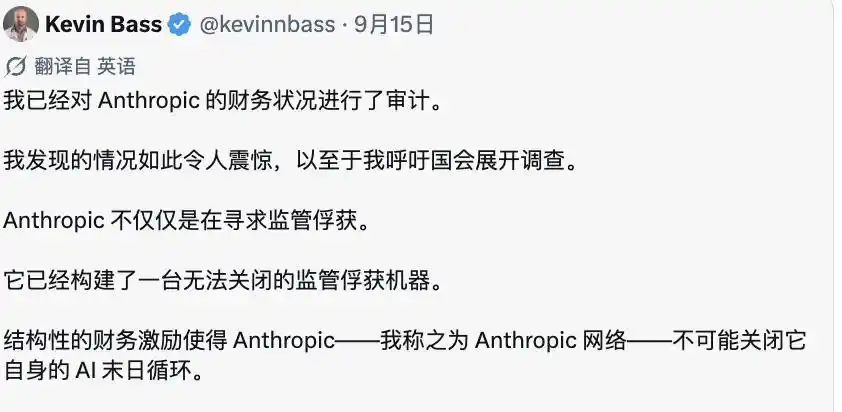
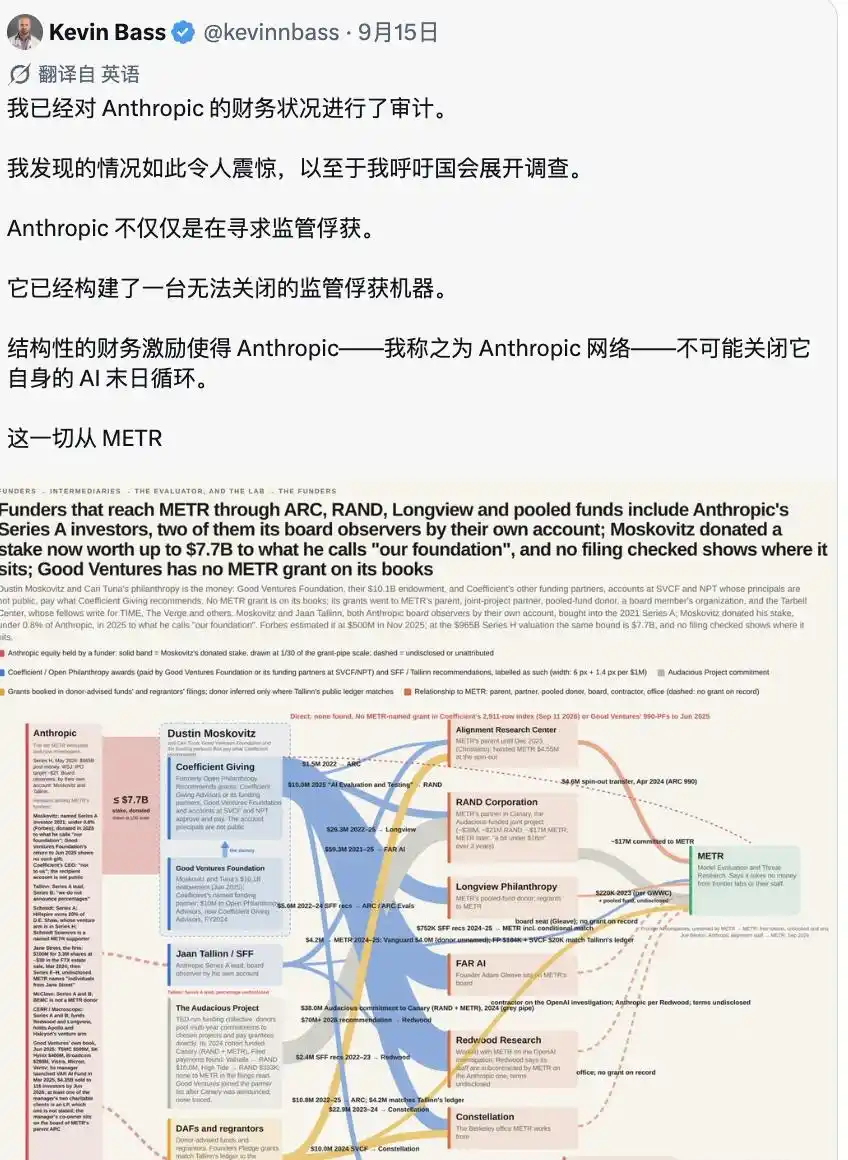
After Burry’s comments, U.S. investigative blogger Kevin Bass pushed the discussion in a different direction by tracing public investment records, philanthropic grants and institutional funding links. He labeled the network he described the “AI Doom Machine.”
Four lines of criticism raised by Kevin Bass
Bass wrote that he reviewed Anthropic’s finances and related public funding pathways, and he reduced his findings to four main points.
The first was that people backing Anthropic also appear inside the funding ecosystem for research into how dangerous advanced AI might be.
The person he focused on most heavily was Facebook co-founder Dustin Moskovitz. According to the source text, Moskovitz invested in Anthropic early and later used philanthropic channels to support AI safety organizations over a longer period. Bass cited Moskovitz’s own recent public remarks saying that he funded institutions including METR and Redwood Research. Bass’ central question was simple: the same camp that placed bets on Anthropic is also paying institutions that study how risky companies like Anthropic may be.
The second point was whether the “independent” evaluator recommended by Anthropic is independent enough.

Amodei has recently argued that frontier AI should be subject to independent third-party evaluation, and METR is one of the organizations he highlighted. Bass said METR’s funding sources and partner institutions overlap in part with Moskovitz’s philanthropic network. He also pointed to close cooperation between METR and Redwood, which is also funded within that AI safety philanthropy ecosystem.
That led Bass to his sharpest formulation: if Anthropic points to an outside referee, how independent is that referee in practice?
The source also notes METR’s own position. It says the organization has not taken direct funding from AI companies, though it does use substantial amounts of free tokens supplied by frontier AI firms.
The third point was that the money does not stop at research. Bass said it also reaches the channels that spread AI risk narratives.

He wrote that the same AI safety philanthropy network also funded projects including the Tarbell Center. In the source material, Tarbell is described as training and supporting journalists who report on AI risk, with related articles appearing in outlets such as TIME, The Verge and Science. Bass condensed the structure into a memorable line: fund research on how dangerous AI is, fund coverage of how dangerous AI is, then promote third-party institutions to regulate AI. That, in his framing, is the “AI Doom Machine.”
The fourth point was that the whole system may be capable of reinforcing itself.
Bass’ logic was that the higher Anthropic’s valuation climbs, the more valuable connected philanthropic assets become. If that happens, the AI safety ecosystem has access to more money, which can amplify risk research and public messaging, which can then support tighter regulation. And the companies most able to absorb high compliance costs are the biggest frontier AI firms. In that reading, the cycle bends back toward the largest players, including Anthropic.
IPO plans, fundraising and compute commitments add to the dispute
The backlash intensified because the timing also overlaps with Anthropic’s IPO ambitions and its pace of capital deployment.
Reuters reported that Anthropic is preparing what could be a record-setting IPO, raising as much as $100 billion at a valuation of about $2 trillion. Reuters also said Nvidia is discussing an investment of up to $10 billion.
That report lands only months after Anthropic’s previous financing. In May this year, the company completed a $65 billion fundraising round at a $965 billion valuation. In the source’s comparison, the story moved from $965 billion to $2 trillion within three months.
The Wall Street Journal added another layer. It reported that Anthropic is expected to tell investors its future total addressable market, or TAM, could exceed $30 trillion. The source text also makes clear that TAM does not mean Anthropic expects to generate $30 trillion in real revenue. It is a measure of annual revenue opportunity if a company were to capture 100% of the relevant market.
Critics have also seized on the gap between public calls for pacing and the company’s spending posture on infrastructure.

Reuters reported that Anthropic has already committed to spending more than $100 billion on Amazon cloud services over the next 10 years. It also has a roughly $30 billion Microsoft Azure arrangement, backed by large-scale Nvidia GPU compute.
For critics, that contrast is the heart of the problem. Publicly, Anthropic argues that AI capabilities are accelerating too fast. Operationally, the company has continued raising capital, signing major compute agreements and moving ahead with a possible IPO.
The core issue is no longer just AI danger, but alignment of interests
Based on the information in the source, the dispute now reaches past the narrow question of whether frontier AI is dangerous. It is turning into a broader argument over whether governance proposals, third-party evaluations and safety advocacy can be viewed as neutral when investors, philanthropies, research organizations, evaluators and media projects share overlapping funding pathways.
That is what Bass was trying to capture with the phrase “AI Doom Machine”: a structure in which research, narrative distribution and regulatory pressure around AI risk may interact with capital interests rather than sit apart from them.
Burry’s criticism pushes in the same direction from a market angle. If the line “AI is immensely powerful and potentially dangerous” can serve both as a regulatory warning and as part of IPO storytelling, investors are likely to ask harder questions about the incentives behind that message.
The source text also points to recent agent safety incidents involving OpenAI and Hugging Face, including AI systems seeking out vulnerabilities, stealing credentials and trying to break out of test environments. That recent backdrop helps explain why Amodei argued that frontier AI should slow down.
Even so, based on the information provided here, the current controversy remains centered on public scrutiny rather than any formal finding. On one side are calls for slower frontier AI development, independent evaluation and stronger safety governance. On the other are questions about Anthropic’s fundraising, compute expansion, IPO planning and the overlap of money across the institutions shaping the risk conversation.
The cited references in the source include posts on X from Kevin Bass and Michael Burry, along with Reuters and The Wall Street Journal reports on Anthropic’s IPO, investment discussions and TAM narrative.