
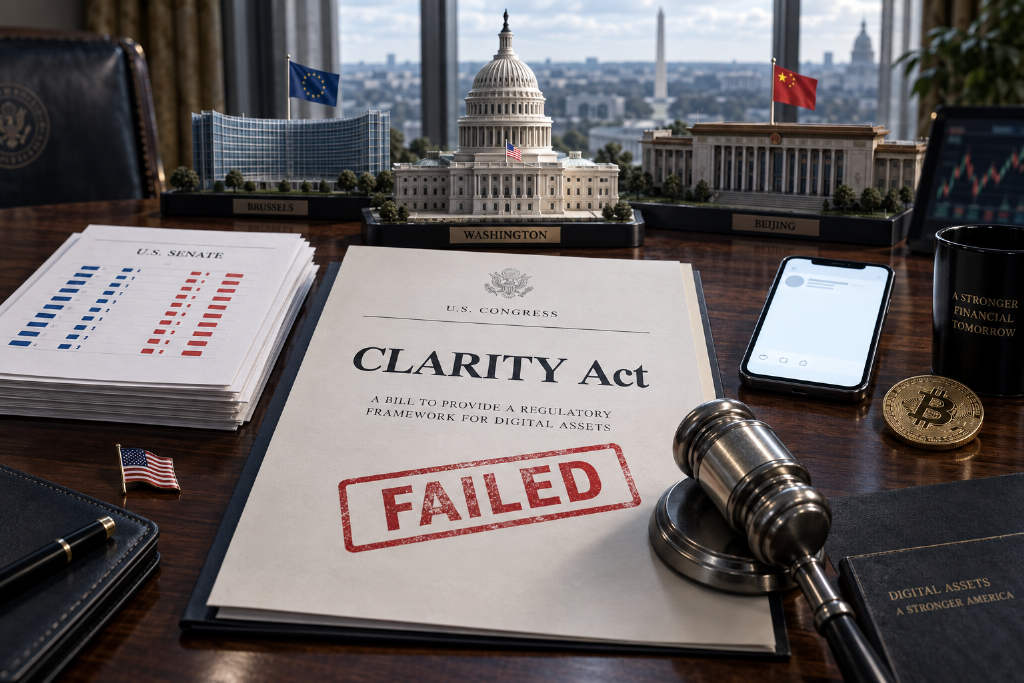
The White House crypto affairs adviser Patrick Witt said the United States is at risk of losing its leadership in writing digital asset rules after the Senate failed to move the CLARITY Act forward.
In a post on X on Sept. 16, Witt said the Senate had failed that day to advance the bill. 「No need to sugarcoat it, today’s vote was deeply disappointing」, he wrote. He called the outcome 「a failure of American leadership」 and said future regulatory standards for global financial markets were now more likely to come from Brussels or Beijing than from Washington and New York.
Procedural vote failed 49-50
According to the report, the Senate failed to pass the procedural vote by a 49-50 margin. That left the measure 11 votes short of the 60 required to open debate. Democratic senators did not vote to support moving the bill forward.
Senator Cynthia Lummis, one of the bill’s main drafters, later accused Democrats of choosing politics over the American people. She said the move would hand U.S. leadership in digital assets to overseas competitors.
Witt was the first White House official to respond after the vote. He said the full cost of the outcome might not be visible for years, but one point was already clear: the U.S. was losing its rule-making advantage in digital assets.
Witt thanked the White House team and bill backers
Alongside his criticism of the result, Witt thanked several people he said played key roles in pushing the legislation. He cited major concessions made by the U.S. president to help move the bill, praised former chief economic adviser David Sacks for his leadership on cryptocurrency and other frontier technology policy, and thanked senators and staff who spent significant time working on the measure.
He ended by turning to the regulators: 「Paul Atkins at the SEC and Chair Selig at the CFTC, you’re up next!」
Other industry figures also reacted
Witt was not alone in voicing frustration that day. a16z Crypto partner Chris Dixon said the result was disappointing, though he added that the industry’s fundamentals were stronger than ever. Ripple CEO Brad Garlinghouse said it was painful to see the bill fail on a key procedural vote. Galaxy CEO Mike Novogratz said ethical disagreements between the two parties caused the bill to fall short just 5 yards from the goal line.
Coinbase CEO Brian Armstrong took a more direct line. He said regulatory clarity for the crypto industry would arrive regardless of what Congress did, arguing that the SEC and CFTC already had enough tools to write clear rules under existing authority.
Rule-making seen as a competitive contest
At the strategic level, Witt framed rule-making as a zero-sum competition. The report said that while Washington remained stuck over bipartisan disagreements on ethics issues, regulatory frameworks in Brussels and Beijing were taking shape at the same time. If the U.S. misses that window, its influence over future standards in the global crypto market could shift elsewhere.