
Anthropic’s head of economic research, Peter McCrory, says AI has not taken jobs away from workers so far and has not led to a rise in U.S. unemployment, even with AI adoption spreading across businesses.
In a recent long-form post, McCrory wrote that quality-adjusted AI output grew by more than 2,000% in both 2024 and 2025, and about one-fifth of U.S. companies are already using AI in their operations. Even so, the U.S. unemployment rate was 4.2% in June, which he described as sitting at full employment.
His central claim is that AI, at least for now, is a skill-biased, labor-augmenting technology. In his framing, the systems are amplifying what people can do rather than replacing them outright. He also put a shelf life on that assessment: 12 months.
Labor data has not shown AI-driven damage in employment
McCrory laid out a chain of labor-market indicators to argue that the U.S. job market remains steady. He cited a 4.2% unemployment rate, a job-openings-to-unemployed ratio slightly above 1, an employment-to-population ratio for workers aged 25 to 54 near multi-decade highs, and initial jobless claims staying at low levels for four straight years. His reading is that U.S. employment conditions remain broadly stable and constructive.
He argued that aggregate figures are only the starting point. The sharper test is what happens inside occupations with high AI exposure.

McCrory and his colleague Maxim Massenkoff had previously examined occupations linked to tasks Claude is frequently used to automate, isolating those jobs to see whether their unemployment rates were worsening faster than in other occupations. He said the answer was no, and that the conclusion still holds after updating the analysis with the latest data from the Bureau of Labor Statistics.
He also noted that job postings for software engineering roles have rebounded since May 2025, with gains that outpaced the average increase seen in other occupations.
Younger workers were the one group he flagged for closer attention. McCrory acknowledged that it has become harder for younger people to find jobs in highly AI-exposed occupations, and said a paper from the Stanford Digital Economy Lab points in the same direction.
He also said that context matters. Since 2022, the U.S. has gone through what he described as the largest non-recession labor-market cooling on record. In a low-hiring, low-layoff environment, early-career workers are usually the first to feel pressure. On that basis, he said the evidence is not strong enough to attribute the whole effect to AI.

Why AI has not replaced workers at scale
McCrory’s explanation draws on several Anthropic research reports published over the past 18 months.
The first layer is task coverage. Across the full set of occupations in the U.S. Department of Labor’s O*NET classification, he said there is not a single job where Claude can systematically complete every associated task. Each occupation still contains elements AI struggles with, including interpersonal coordination, face-to-face interaction and work that involves the physical world.
In his argument, those hard-to-automate elements act as bottlenecks. They cap how much AI can lift total productivity in a role, and they also raise the value of workers who can handle what the systems still cannot do.
The second layer is the user side of the equation. Anthropic’s January report, Economic Primitives, found that the more complex Claude’s output becomes, the more specialized the user input tends to be. When the model produces a complex economic model, McCrory wrote, that usually reflects a skilled user giving precise instructions.

The March report, Learning Curves, found that after six months of using Claude, users increasingly treat it as a thinking partner and see higher interaction success rates. McCrory argued that if AI were already capable of independently doing the job end to end, that kind of learning effect should not be showing up so clearly.
The third layer concerns the agent era. Anthropic analyzed seven months of Claude Code usage data and found that task value kept rising without reducing the payoff to human expertise. Users were still handling planning and delegating implementation to Claude. More capable users achieved higher task success rates and recovered faster when Claude made mistakes.
That pattern suggests that the premium on pure coding execution may be shrinking, while the value of planning, judgment and error correction is moving higher.
McCrory added a survey-based signal from Anthropic’s June economic index. More than one-third of respondents expected AI to be able to do most of their work within 12 months, but the share expecting to lose their jobs as a result was much lower. Users with higher levels of AI-driven automation were, by his account, more optimistic about wages and job security.

Three singularities he says could change the picture
McCrory is upbeat about the current state of the labor market, but he did not avoid the longer-term scenarios that could break today’s pattern. He pointed to three ideas that appear in academic and industry discussions: the software singularity, the economic singularity and the Coase singularity.
The software singularity refers to AI automating innovation itself. Earlier general-purpose technologies could be powerful without inventing new categories of transport or production on their own. AI is different because it has been given general cognitive capabilities and could, in theory, accelerate its own iteration. McCrory explicitly discussed recursive self-improvement, or RSI, as a case where AI capability gains could move on a timeline no longer paced by humans.
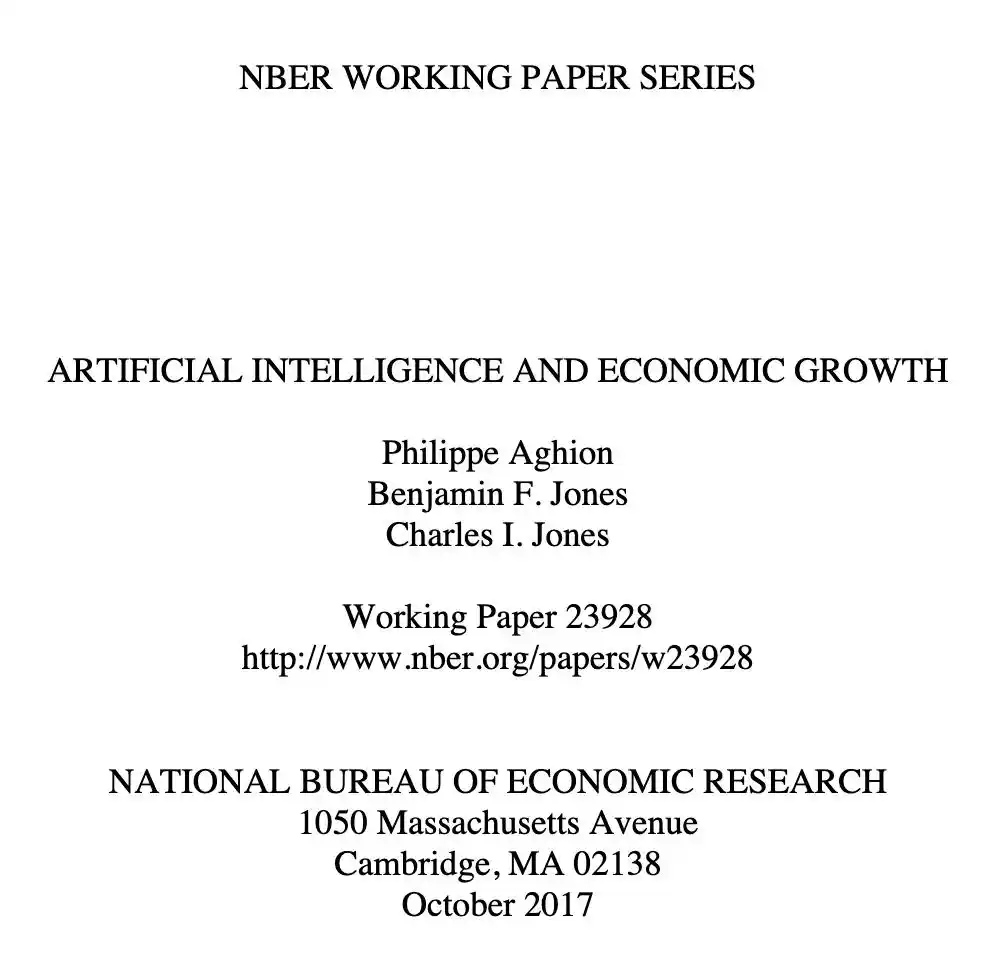
The economic singularity is the economic consequence of that software scenario. Citing a 2017 model by Aghion, Jones and Jones, McCrory said that if the innovation process itself becomes automated, standard economic models can imply “infinite growth in finite time.” He described that result as mathematically derived, even if it sounds like science fiction.
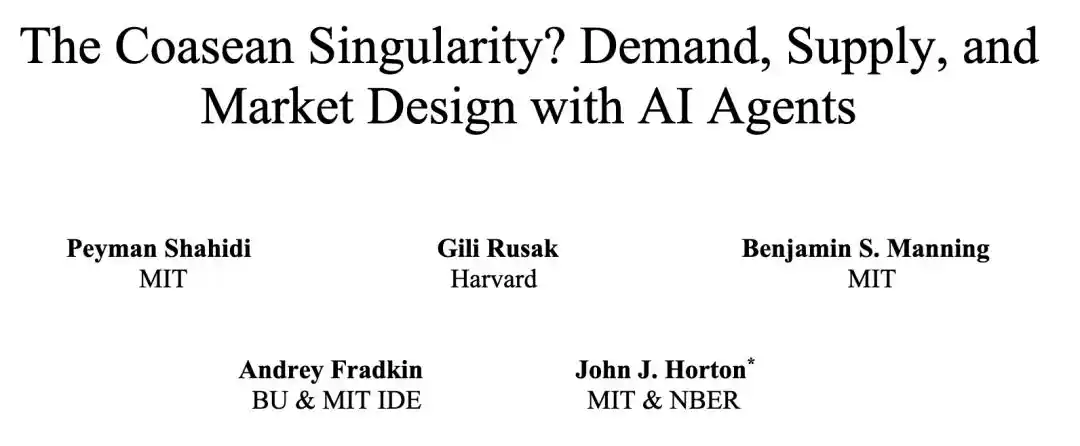
The Coase singularity targets organizational structure. A 2025 NBER paper by Shahidi, Rusak, Manning and others argues that if agents drive the transaction costs of search, bargaining, contracting and monitoring close to zero, Ronald Coase’s 1937 question about why firms exist becomes active again. If market coordination costs collapse, the rationale for the firm weakens as well.
McCrory’s discussion of agents fits naturally into that framework. If agents change not just how production is done but also how organizations are structured, the labor-market effects would go well beyond the simple question of who loses a job.
The common line of defense: bottlenecks
Against all three singularity scenarios, McCrory offered the same line of defense: bottlenecks. He drew the term from the Aghion, Jones and Jones paper, which argues that the ceiling on economic growth is not set by the best-performing parts of the system, but by the essential parts that remain hard to improve.
As long as some critical tasks cannot be automated, whether because of technical limits or social constraints, labor’s share of income does not collapse and firm structure does not fully disintegrate, in his view.
He pointed to programming agents as an early real-world test of that logic. According to the figures he cited, introducing programming agents lifted lines of code by 10x to 20x, but software releases rose by only 30%, while actual application usage did not increase at all. Code is only one stage of software production; testing, architecture design and product judgment still depend on people, and those are the current bottlenecks.
On that basis, McCrory made a direct prediction: one year from now, U.S. unemployment will not be materially higher because of AI.
He also set out two signals that would force him to revise the framework. The first is whether unemployment in highly AI-exposed occupations starts to diverge from other jobs. The second is whether the return to human expertise begins to decline in agent-heavy settings. If both indicators turn at the same time, he said the analytical model he is using would need to be adjusted.
The views were published in McCrory’s recent essay and cited in an article carried by the WeChat public account New Intelligence, written by ASI Qishilu and edited by Ma Ke.