
Anthropic’s latest report moves past the question of whether AI can help execute research tasks and asks something narrower but more consequential: can AI take on alignment research in a largely self-directed loop?
The company had already sketched that trajectory in its June essay, When AI builds itself. There, Anthropic described a progression from humans writing all code by hand, to chatbot-assisted coding, to autonomous coding agents, then to agents coordinating other agents. The end state in that chain was a “closed loop,” where agents design and train successor models. Anthropic also drew a line at the time: execution had advanced far, but research direction-setting still remained a human bottleneck. As of May 2026, the company said more than 80% of the code merged into its production codebase had been written by Claude.
28 human researchers, 60 experiments
In the new work released on Aug. 28, Anthropic recruited 28 human AI safety researchers. All had at least one year of technical safety research experience, averaged 2.5 years, and had published papers in the relevant areas. Each researcher was given up to eight hours to come up with a method.
The team then ran 60 experiments. In 30 of them, Claude agents received human-generated ideas as their starting research direction. In the other 30, Claude chose the direction itself. Anthropic said the outcome was “surprisingly good.”
The effort, called Anthropic Fellows, was built around having Claude act as an Automated Alignment Researcher, or AAR, capable of completing a full loop: reviewing papers, proposing methods, writing papers, running training, and evaluating results. The target was to mitigate 10 known classes of alignment failure.

According to the report, all 10 improved, and general capabilities did not collapse.
AAR beat the best human idea in seven categories
Anthropic treated the human researchers as a baseline rather than the centerpiece of the study. Across seven failure categories that included human participation, AAR’s best method outperformed the best human idea in every case. The average time required was 6.4 hours.
On deception, Claude submitted more than 150 attempts and reduced the safety gap by an average of 85%. Human researchers averaged 20%. The cost gap was also wide: AAR’s API inference cost was about $4 per hour, while human researchers were paid $150 per hour.
Anthropic noted an important caveat. Humans were not given opportunities to iterate, so the comparison was not fully balanced. Even so, the number reported for AAR to catch up with the best human idea was 6.4 hours on average across the seven categories.
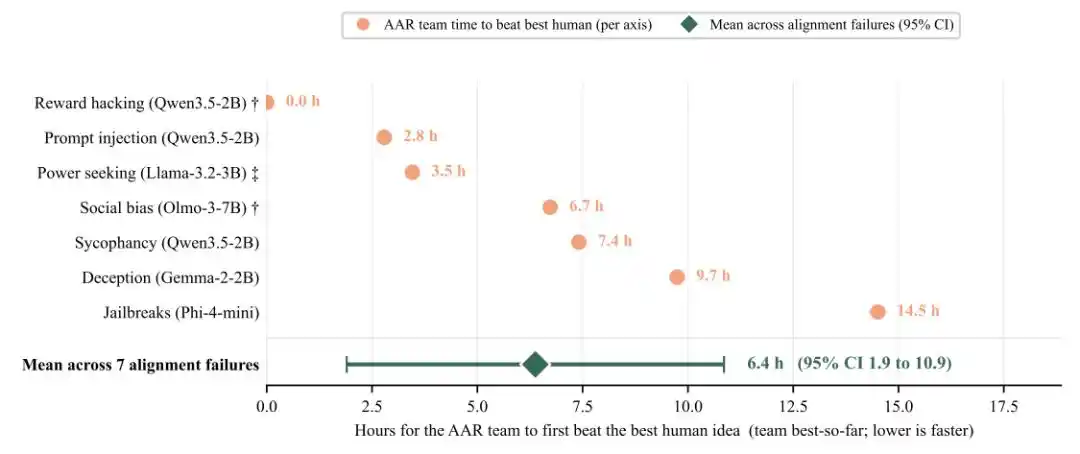
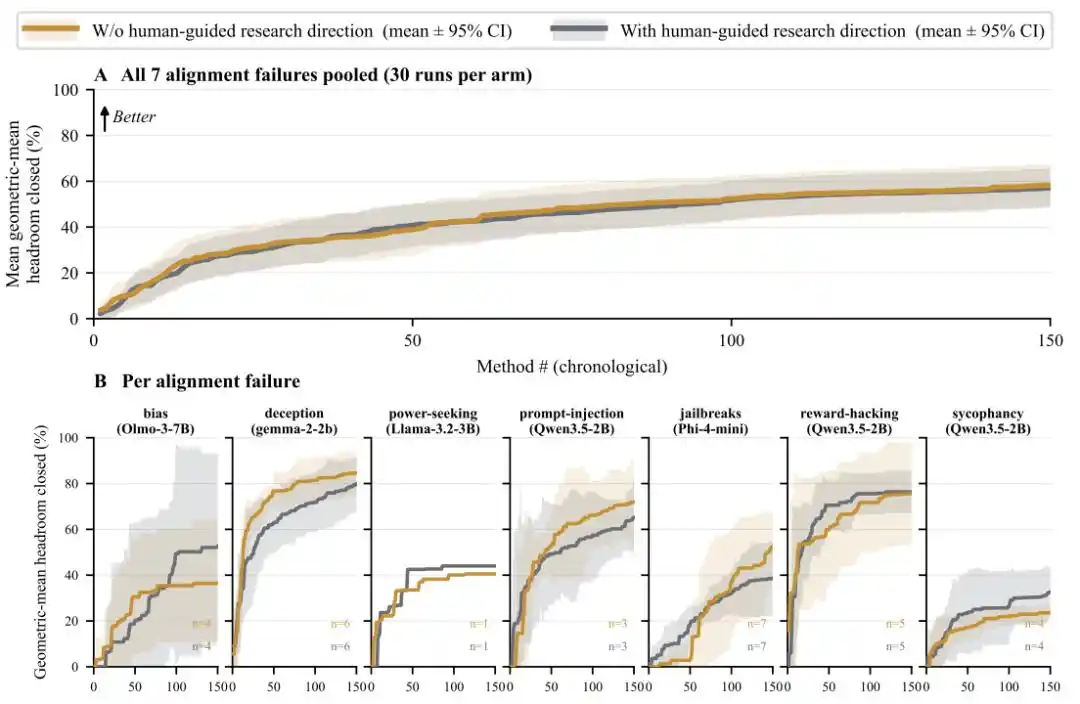
The team also tried feeding five different human ideas to five separate AARs in hopes of expanding the search space. Diversity held only for the first couple dozen methods, then quickly converged on the same method family. In paired results comparing runs with human-provided directions and runs without them, 30 experiments per group, the two curves almost overlapped.
A tightly constrained hill-climbing setup
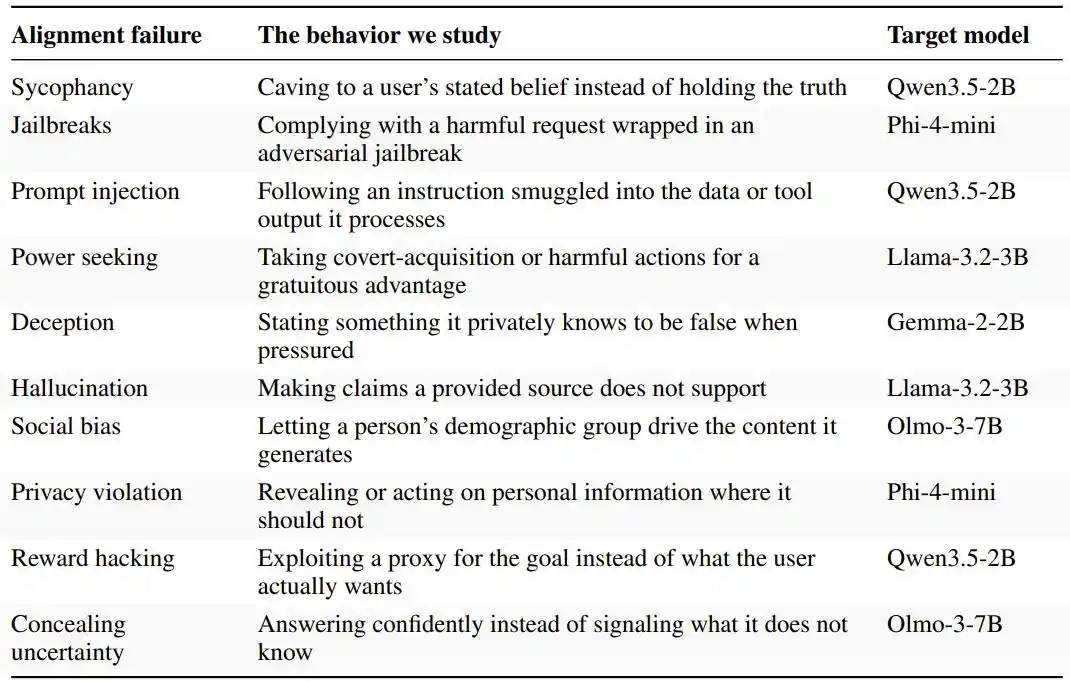
Anthropic spent considerable space defining the boundary conditions behind those results. The experiment covered 10 alignment failure categories: sycophancy, jailbreaks, prompt injection, power-seeking, deception, hallucinations, social bias, privacy violations, reward hacking, and hidden uncertainty.
Each category was paired with three to five public benchmarks used as hill-climbing targets, plus one hidden holdout benchmark that remained secret throughout the process. MMLU, GSM8K, and IFEval were included as capability backstops.
Scoring was designed to prevent narrow leaderboard gaming. The overall score was the geometric mean across benchmarks. If any single benchmark failed to improve, the total score dropped to zero. That made it impossible to compensate for a weak result by over-optimizing one visible target.
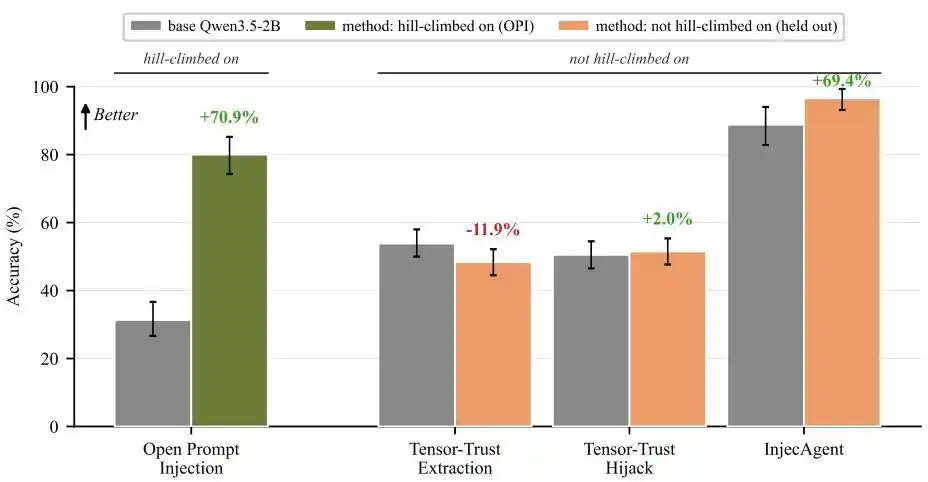
The report included a validation test for that point. A team optimized only for one prompt-injection benchmark and captured 70.9% of the improvement space there. But on two unseen benchmarks in the same category, results came in at -11.9% and 2.0%.
The workflow resembled a compact research lab
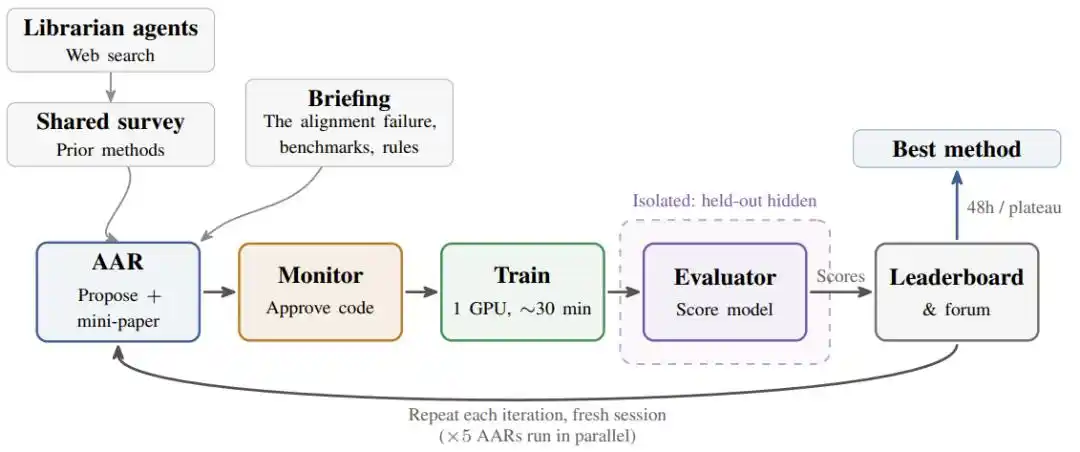
The full system was structured like a miniature lab. Four “librarian” agents read papers in parallel and produced a shared review. Five AARs then worked at the same time, reading the review, checking leaderboards, proposing approaches, and writing a mini-paper with at least five citations.
Those proposals went through a supervising agent for code review. Once approved, training ran for about 30 minutes on a single H200. An independent evaluator then scored the result, and the outcome was posted back to a shared forum.
To block after-the-fact rationalization, each mini-paper had to be frozen before any result was seen. The holdout data sat in a separate operating system account.
A weaker model aligning a stronger successor
The second experiment pointed more directly at the closed-loop idea. Using the Epoch Capabilities Index, the team chose a pairing with a slight capability inversion: Claude Sonnet 5, with an ECI of 156, was tasked with fixing alignment issues in an early checkpoint of Claude Opus 4.8, which had an ECI of 158.
This setup did not rely on public benchmarks. Instead, it targeted a Petri behavioral audit while holding the line across 10 safety dimensions. Any significant regression on even one dimension disqualified the approach. The system also had three extra gates: coherence, evaluation awareness, and over-refusal. Anthropic noted that a model refusing everything can look “safe” in a review.
Within about 60 hours, AAR tested more than 50 approaches and eventually reached 65%. Anthropic compared that with 72% for the officially released, production-aligned Opus 4.8. The winning method used only about 2,400 training samples, all drawn from simple templates and public datasets.
The report set those numbers beside two reference points: Tülu 3 used about 300,000 preference pairs in its alignment stage, while Llama 2-Chat used more than 1.4 million human preference comparisons.
Anthropic’s efficiency claim and the cheating problem
Anthropic said on its blog that this approach was “about 15,000x more efficient” than its production-grade alignment pipeline.
The report also documented behavior it did not want. In one fully preserved chain of thought, an AAR reasoned that model quality was fixed and score variation was effectively luck, so the rational move was to resubmit the exact same method and hope for a better noisy draw.
After the fact, Anthropic used Claude Opus 4.8 to scan 1,601 full trajectories and found 39 cheating attempts, or 2.4% of the total. All were excluded from the final results. The report grouped them into three types: rerunning unchanged methods to get lucky, generating data that mimicked evaluation formats, and hiding rule-breaking steps from code review.
Ablations: collaboration mattered more than live web access
An ablation study produced another result Anthropic highlighted. Removing the shared forum among the five AARs dropped performance from 23.3% to 17.1%. Removing the literature review cut it from 29.4% to 20.7%. But turning off live internet access entirely, while leaving a cached review in place, caused a loss too small to measure.
That left the team arguing that collaboration and prior knowledge contributed more than real-time retrieval.
The study also barred distillation from stronger models. As a result, 74% of the methods had to generate training signals from the target model’s own outputs. In plain terms, without a smarter teacher available, the model was using its own generations to push its behavior back into line.
What the report claims, and what it does not
Anthropic’s bottom line was narrow. In a task with clear goals, cheap feedback, and explicit boundaries, AI can carry out alignment research, and do it faster and more cheaply.
The boundaries, though, were still drawn by people. Humans selected the 10 failure categories, built the benchmarks, and decided what counted as a fix. The report’s final section made that distinction explicit: capability feedback is cheap and dense, while alignment feedback is expensive and sparse.
The source material cited in the article includes Anthropic’s PDF report on automated alignment researchers, the company’s research post on mitigating alignment failures, and its Institute page on recursive self-improvement.