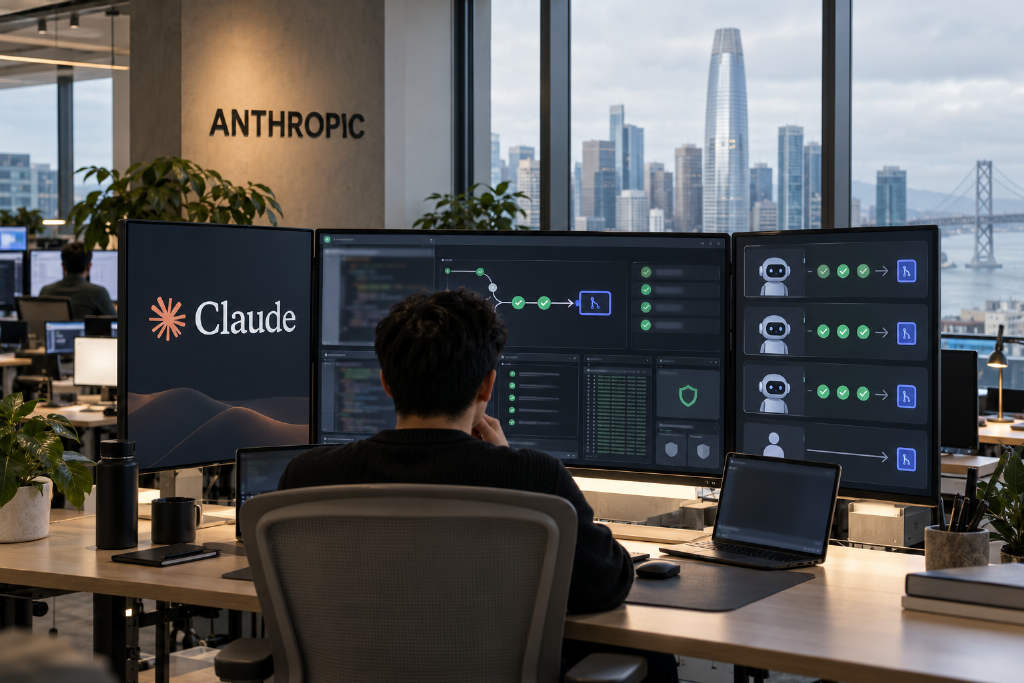
Anthropic said roughly 90% of the code in Claude Code is now written by Claude, and the company has rebuilt its review process to keep pace with that output. From June to September this year, the Claude Code team more than doubled the number of merged pull requests while cutting the share of changes that later had to be reverted by more than 40%.
The company described a layered review system. Before a commit, Claude runs tests and an independent sub-agent reviews the change. After submission, multiple agents look for bugs in parallel, and another set of agents cross-checks the findings. Security review and automated testing can also block problematic code from being merged.
Human review remains in place and is assigned by risk level. Low-risk changes, such as documentation edits from trusted developers, can be merged directly after automated checks. Standard product changes require one approval, while high-risk code needs two. Anthropic also said AI approval does not replace human responsibility. Developers still own the final code. The company added that AI review can get stuck in loops: one Claude Code change went through more than 50 rounds of review and fixes overnight, prompting Anthropic to add limits after finding that about 59% of issues were already present in the first review round.
Anthropic said about 90% of the code in Claude Code is now written by Claude, and that it has reworked code review to match the speed of AI-generated output.
From June to September this year, the Claude Code team more than doubled the number of merged pull requests, while the share of changes that later had to be reverted fell by more than 40%.
A layered review process built around automated checks
According to Anthropic, Claude runs tests before each submission and then has an independent sub-agent inspect the change. After the code is submitted, multiple agents search for bugs in parallel, and another group of agents cross-checks those findings. Security review and automated testing can also stop problematic code from being merged.
Human approval still depends on risk level
Human review has not been removed. Instead, Anthropic said approvals are assigned by risk category. Low-risk changes, including documentation edits from trusted developers, can be merged directly after passing automated checks. Standard product changes require one human approval, while high-risk code requires two.
The company also said AI approval cannot replace human approval, and developers remain responsible for the final code.
Anthropic says AI review can fall into loops
Anthropic disclosed that one Claude Code change went through more than 50 rounds of review and fixes overnight. After examining the case, the team found that about 59% of the issues involved code that was already present in the first review round, rather than problems introduced by later edits.
It then changed the rules. If a change goes through more than three review rounds, the author is asked to reconsider the approach, and repeated feedback is limited to keep agents from getting stuck with one another.
This article was originally published by Bit.Fan. For more cryptocurrency news and market insights, visit www.bit.fan. Disclaimer:
The market information, project data, and third-party content displayed on this platform are for industry information sharing only and do not constitute any form of investment advice or return commitment.
Cryptocurrency trading carries high risks. Users should fully assess their risk tolerance and make independent decisions. All profits, losses, and legal responsibilities are borne by the users themselves.