
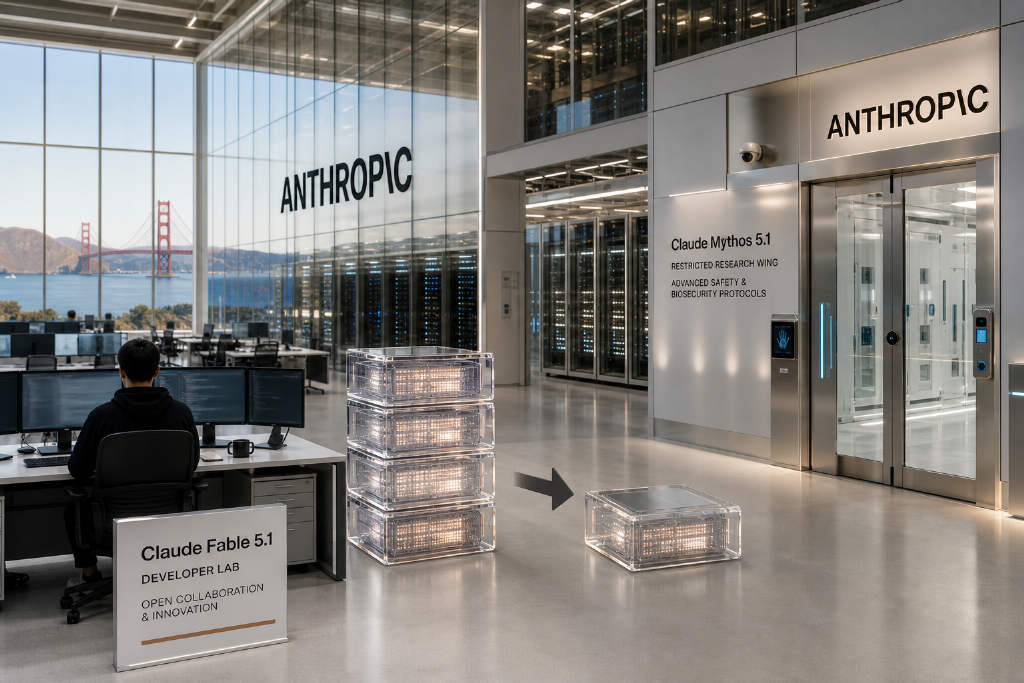
Anthropic announced on Sept. 1 the release of Claude Fable 5.1 and Claude Mythos 5.1, two new models built on the same base architecture but split by different safety guardrail levels. The company described the launch as a major upgrade for coding and knowledge work, while also cutting cache read pricing and introducing a more segmented access model for advanced research use cases.
Two models, different safety tiers
According to Anthropic, Claude Fable 5.1 and Claude Mythos 5.1 share one underlying architecture, but they are aimed at different users. Fable 5.1 is positioned for broader developer and knowledge-work use, while Mythos 5.1 is reserved for trusted cybersecurity and biotech research institutions.
The company said this is the first time it has separated two models based on safety guardrail levels. Compared with Fable 5.1, Mythos 5.1 has some stricter protections relaxed so it can support more advanced work in cybersecurity and life sciences.
Coding benchmark scores improved
Anthropic said the new versions set a new standard for coding and long-horizon reasoning. In agentic coding tests including Terminal-Bench 4.0, Claude Fable 5.1 posted a score of 55.8%, while Claude Mythos 5.1 reached 60.9%. The company said both scores were ahead of earlier models and competing offerings.
Cache read pricing drops to $0.25
On pricing, Claude Fable 5.1 keeps the same base rates as its predecessor: $10 per million input tokens and $50 per million output tokens. The biggest pricing change is in cache reads.
Anthropic said cache read pricing fell from about $1 to $0.25, a 75% reduction. The company estimates that this could cut average costs by about 25% for general workloads and by as much as 45% for highly agentic workflows that frequently reuse context.
The new models also support a default context window of 1 million tokens and let users control reasoning depth by adjusting the effort parameter.
Mythos 5.1 targets cybersecurity and life sciences research
Anthropic highlighted several research-related performance claims for Claude Mythos 5.1. In protein binder design, the company said the model achieved a hit rate close to 50%, which it described as the strongest result currently observed in testing.
In GPU kernel optimization tasks, Anthropic said Mythos 5.1 was able to use open-source code to speed up multiple deep learning models by as much as 2.5x within days. The company added that this could reduce compute costs for whole-genome analysis by 30% to 60%.
Lower false positives and new anti-distillation rules
For Claude Fable 5.1, which is intended for general users, Anthropic said it has addressed complaints about overly aggressive moderation. False positives in cybersecurity protections were reduced by about 60%.
Under the updated policy, developers are allowed to use the model to identify vulnerabilities in source code. Building attack tools or conducting malicious activity, including penetration testing, remains prohibited.
On compliance and model protection, Anthropic said it fully complies with the European Union AI Act and supports C2PA watermarking. The company also formally introduced an anti-distillation mechanism.
Anthropic said new API accounts created since late August can no longer preserve the Thinking block by manually altering multi-turn conversation context, a step meant to close off a common method of using strong models to train smaller ones.