
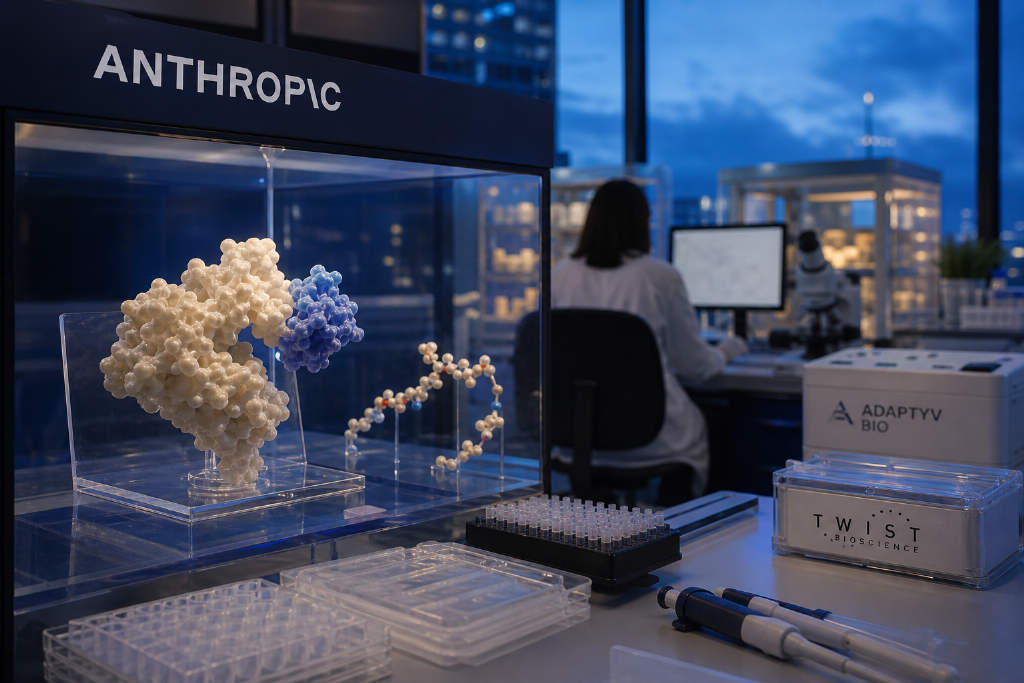
Anthropic says Claude has posted strong early results in de novo protein binder design, reporting successful binders for 14 of 15 targets and a peak hit rate of 35.1% in a single-target setup. The company said the figures were later validated in the lab by Adaptyv Bio and Twist Bioscience.
Anthropic tested Claude on 15 targets
In its official announcement, Anthropic said Claude Opus 4.8 and Mythos Preview were asked to design protein binders from scratch, a de novo design task. In the company’s description, that means the model was not matching against known databases, but instead generating entirely new amino acid sequences aimed at binding to a target protein.
Anthropic framed this as one of the earliest and most time-consuming stages in drug discovery, saying a human expert would usually spend weeks to months on a single target.
The test covered 15 targets. Anthropic said Claude produced successful binders for 14 of them. In multi-target mode, the run lasted 48 hours and used up to 12,500 NVIDIA H100 hours. Mythos Preview recorded a 26.7% hit rate, while Claude Opus 4.8 reached 22.6%. In a single-target mode, with 24 hours allocated to each target, the hit rate rose to 35.1%.
Anthropic compared that figure with an industry-typical range of 10% to 15%. It added that Adaptyv Bio and Twist Bioscience later synthesized and tested the designed molecules in the lab.
RBX1 stood out, while TNFα split the models
The strongest individual result came on RBX1. Anthropic said Mythos Preview reached a 40% hit rate on that target. In the same Adaptyv Bio competition, participants averaged 3.7%, and Claude’s highest-scoring design beat the winning entry among 245 submissions.
Results were not uniform across targets. On the inflammatory signaling protein TNFα, Anthropic said Opus 4.8 succeeded but Mythos Preview failed. The company said it does not know the reason. The report noted that TNFα is also the target of drugs such as Humira.
Beta-sheet designs also produced confirmed binders
Anthropic described another result as a step forward on beta-sheet design, a harder structural problem. In the company’s explanation, this class requires extended amino acid chains to line up side by side and is more prone to folding errors than helical structures.
Across six targets, Claude produced 15 confirmed binders containing beta strands.
Claude Opus 5 was also tested on chemistry analysis
A separate set of tests shifted from binder design to chemical analysis and used Claude Opus 5, which Anthropic described as available to general users. The setup involved feeding raw instrument files and two lines of instructions into the Claude Science environment, with no vendor software and no human operator.
On accuracy, Anthropic said the hydrogen count per peak differed from laboratory results by less than 0.08 hydrogen atoms. For purity calls, Claude returned 96.4% against a lab result of 96.33%.
In NMR work, Claude converted raw data into a corrected spectrum and a table covering 18 peaks. It also flagged four broad peaks that could be attached to nitrogen or oxygen and suggested a standard deuterium oxide exchange check. Anthropic said that judgment matched the conclusion reached independently by a lab operator three days later.
The company also disclosed an error in Claude’s first pass. It initially concluded that all four peaks had disappeared, then revised that after self-checking and found that only two had disappeared, bringing the output in line with the lab result.
The report also included weak or failed cases
All of the headline numbers came from Anthropic’s own announcement and self-assessment, and the company included examples where the system did not perform well.
One case involved BBF-14, a fully de novo designed beta-barrel protein that was used as a benchmark because of its novelty. Anthropic said Claude produced only three versions with mediocre affinity.
Another case was maltose-binding protein, or MBP. The report described it as a large, soft, smooth-surfaced, hydrophilic bacterial protein. None of 90 designs were confirmed to bind, and only one showed a weak signal.
Criticism and Anthropic’s own caveats
Former pharma figure Martin Shkreli publicly criticized the work, saying the result was not especially impressive. He argued that the binders showed low affinity, that none targeted intracellular proteins, and that they could not be considered useful probe molecules. He also questioned why researchers would not simply cut functional fragments from existing monoclonal antibodies instead.
Anthropic itself said minibinders are not a standard drug format and that producing a high-affinity binder is only the first step.
Peers are already closer to the clinic
The report also pointed to progress elsewhere in the field. Isomorphic Labs, which was spun out of Google DeepMind, released a new drug-design engine in February this year. According to the article, the company said the system more than doubled AlphaFold 3’s performance on the hardest protein-ligand cases, kept the work closed-source, and has already advanced designed cancer drugs into human clinical trials.
By comparison, the article said Anthropic still has a long way to go before reaching the clinic.