


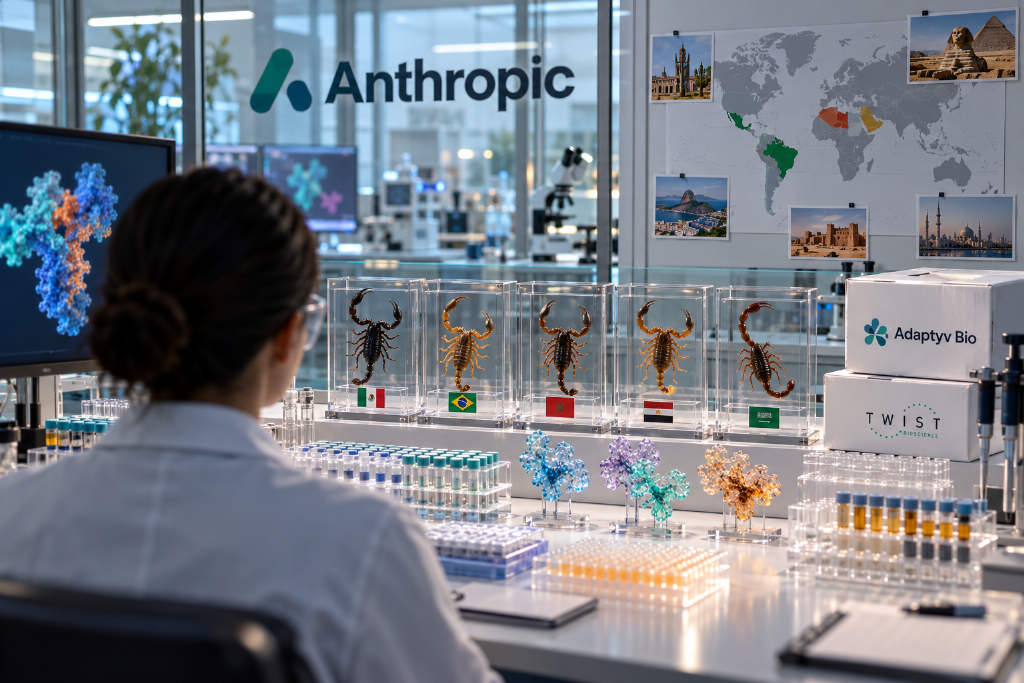
Anthropic on Oct. 20 Taipei time published research describing how its internal research model, operating in the Claude Science environment, worked with financial research firm Citrini Research to design minibinders from scratch for five scorpion neurotoxins known to threaten humans. The company said the system handled most of the process autonomously over about 64 hours.
The toxins are associated with regions including Mexico, Brazil, North Africa, and the Middle East. Anthropic said scorpion stings affect more than 1.2 million people each year and cause more than 3,250 deaths, adding that the area is often treated as an underfunded neglected tropical disease problem.
Anthropic repeatedly said the results should be read narrowly. The study validated binding to recombinant toxins, but it did not include cell neutralization tests or animal protection studies. The company said it is not claiming that it has produced an antivenom.
More than 318,000 designs generated in about 64 hours
According to Anthropic’s research summary and the technical report released alongside it, the model ran with an initial prompt and four follow-up instructions. It used 12 design tools, generated 318,484 protein designs, and carried out co-fold screening on about 553,052 design-toxin pairs. Anthropic put the compute used at roughly the 10,000 GPU-hour scale.
Claude first selected 180 designs. With the model’s assistance, the team added 31 more, bringing the total to 211 candidates. Those were sent to Adaptyv Bio and Twist Bioscience for binding tests using surface plasmon resonance, or SPR.
Seventeen designs met the binding threshold
Anthropic said 17 of the 211 tested designs met its binding standard, and every one of them targeted only a single toxin. The breakdown was seven for Cn2, four for AaH II, four for AaH I, and two for LqhIII. Ts1 produced no qualifying designs.
The company also said none of the multi-toxin designs met the threshold for more than one toxin at the same time. In the single-toxin group, 11 of 60 designs qualified, or about 18%. Anthropic said that rate is in line with a typical protein design campaign.
Top candidates showed strong affinity, but neutralization remains unproven
Among the leading candidates, Cn2-B1 and Cn2-B2 showed single-digit nanomolar affinity in both laboratories. Competition experiments suggested their binding sites may overlap with, or sit near, the site of the LR antibody, which is known to neutralize Cn2 and has previously protected mice.
Anthropic said that still does not establish functional neutralization. The company wrote that it has not yet validated neutralization in a cellular setting.
External reviewers called it a promising first step
Anthropic said the results were reviewed by external experts Susana Vázquez Torres and Timothy P. Jenkins. Both described the work as a promising first step. They also said that in the animal venom field, the real bottlenecks often come after binding is achieved, including efficacy, safety, affordability, and access.
The company also restated its dual-use warning. Anthropic said more autonomous biological research capabilities could speed up therapeutic development, but they could also be misused. It added that the relevant protein design capabilities are not broadly available to general users.
Citrini on the same day published a collaboration account describing how a non-expert team used Anthropic’s environment and the internal research model to refine prompts and move candidates into lab testing. Citrini also said functional neutralization has not yet been demonstrated.
From August benchmarks to a neglected-disease use case
Anthropic framed the project against its August protein binder work. Compared with the higher hit rates reported on benchmark targets in August, this effort shifted to scorpion toxins, where commercial incentives are weaker, to test whether AI can help non-experts engage with a real public health problem.
The approach was de novo binder design. Anthropic said that, to its knowledge, there is no public precedent for de novo binders against scorpion toxins.
The company said traditional antivenom production relies on animal immunization and is slow and expensive. Even if computational design can shorten the time needed to find credible binding molecules, the next steps still include venom-toxin validation, functional testing, animal protection studies, and regulatory work. Anthropic and Citrini both listed those as future stages rather than completed milestones.
What the release adds
For AI-driven biomedicine, the release stands out because it provides checkable binding data and a full design output, moving the question of whether an agentic model can produce lab-testable candidates within days into a form that others can examine. At the same time, Anthropic explicitly separated binding results from any claim of an antivenom or a drug.
The next data points to watch are cell neutralization results, animal protection data, and whether independent laboratories can reproduce the dataset.