
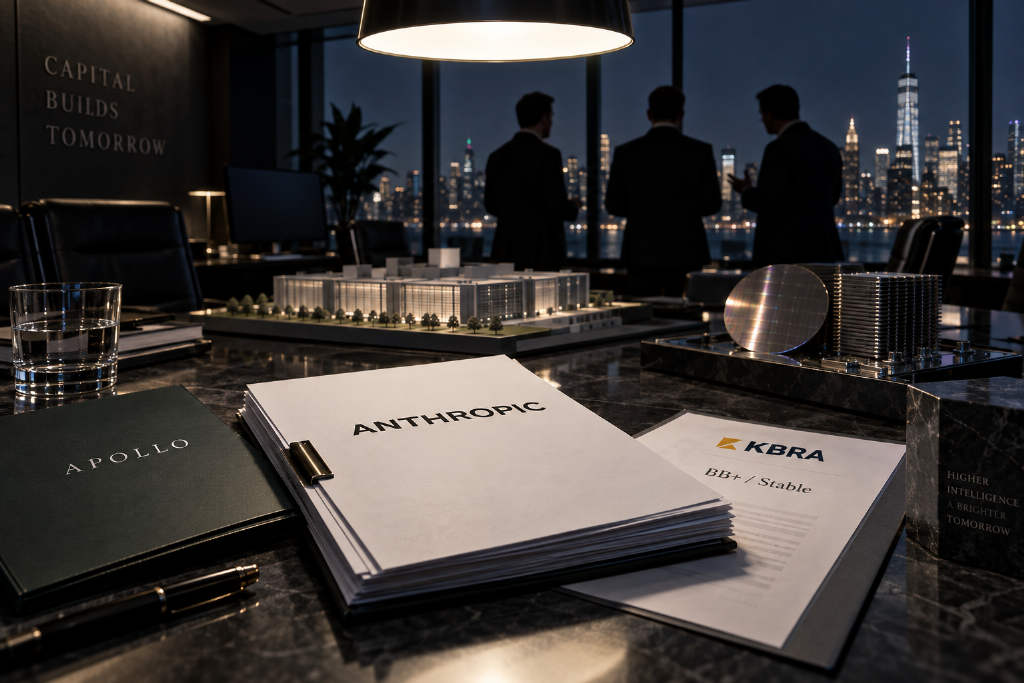
Anthropic has received its first publicly disclosed credit rating, offering a new look at how debt investors are viewing the AI startup as it lines up larger financing plans.
Documents obtained by the Financial Times show that Kroll Bond Rating Agency, or KBRA, assigned Anthropic a BB+ issuer rating in June. The grade is the highest tier within speculative, or junk, status and sits one notch below investment grade. The rating was issued before Anthropic completed a $35 billion chip-financing transaction led by Apollo and had not been publicly disclosed before.
A $60 billion debt plan is taking shape
The rating has direct implications for Anthropic’s financing options. Wall Street banks are preparing a new $60 billion debt package to help the company acquire more custom AI chips developed jointly by Google and Broadcom. That plan includes $18 billion of subordinated debt.
Whether Anthropic can move into investment-grade territory will determine how cheaply it can reach a broader institutional investor base, including life insurers and pension funds.
What KBRA rated and what it could see
KBRA assigned the BB+ rating with a stable outlook to about $4.4 billion of subordinated debt within the broader $35 billion financing package. Investors in that portion are directly exposed to Anthropic’s credit risk, while the rest of the package is backed by chipmaker Broadcom.
The documents show the subordinated debt was issued at an approximately 8.5% yield, while senior debt carried a 5.75% rate.
The rating was produced with limited disclosure. According to the documents, KBRA reviewed revenue, adjusted operating income, annualized run-rate operating revenue for the first quarter of 2026, and Anthropic’s internal forecast for second-quarter results. Key metrics including free cash flow and EBITDA were not disclosed.
As a result, analysts had to rely on assumptions and used a “risk score” in place of a full traditional financial model to assess the company’s credit profile.
Revenue keeps climbing, though growth has slowed from earlier this year
At a pre-IPO investor presentation on Wednesday, Anthropic said third-quarter revenue rose nearly 50% from the previous quarter to $16.8 billion. The company also said it had posted adjusted profitability for two straight quarters.
Even so, that pace marked a slowdown from earlier in the year, and the latest figures were below some of the market’s most optimistic expectations.
When the rating decision was made, Anthropic had projected second-quarter revenue of $10.9 billion. The Financial Times report said the actual number came in above that forecast at $11.5 billion. As of the end of June, the five-year-old company had zero debt on its own balance sheet, having previously relied on financing structures involving stronger-credit commercial partners and special purpose vehicles.
Convertible notes may follow, but the final judges are still ahead
The report also said Anthropic could issue as much as $42 billion in convertible notes to pay for leased semiconductors from Broadcom. KBRA was not given the detailed terms of those potential notes.
KBRA is smaller than Moody’s, S&P and Fitch, and those three agencies are expected to determine Anthropic’s formal post-listing credit ratings.
According to the report, banking advisers to Anthropic and rival OpenAI have been lobbying the major rating firms in an effort to secure investment-grade ratings for both companies after they go public. Investors expect OpenAI’s IPO valuation to exceed $2 trillion.
For Anthropic, an investment-grade rating is central to its long-term funding strategy. The company expects to spend more than $500 billion on computing resources and infrastructure over the next decade, a capital plan that the report said is also viewed as one of the pillars supporting the recent US stock-market investment boom.