



Anthropic CEO Dario Amodei said in a deep interview that over the next 10 years, pure coding work could be the first category of jobs fully displaced by AI models. He described the current moment as a tsunami already visible on the horizon, with society still acting as if the wave is not real.
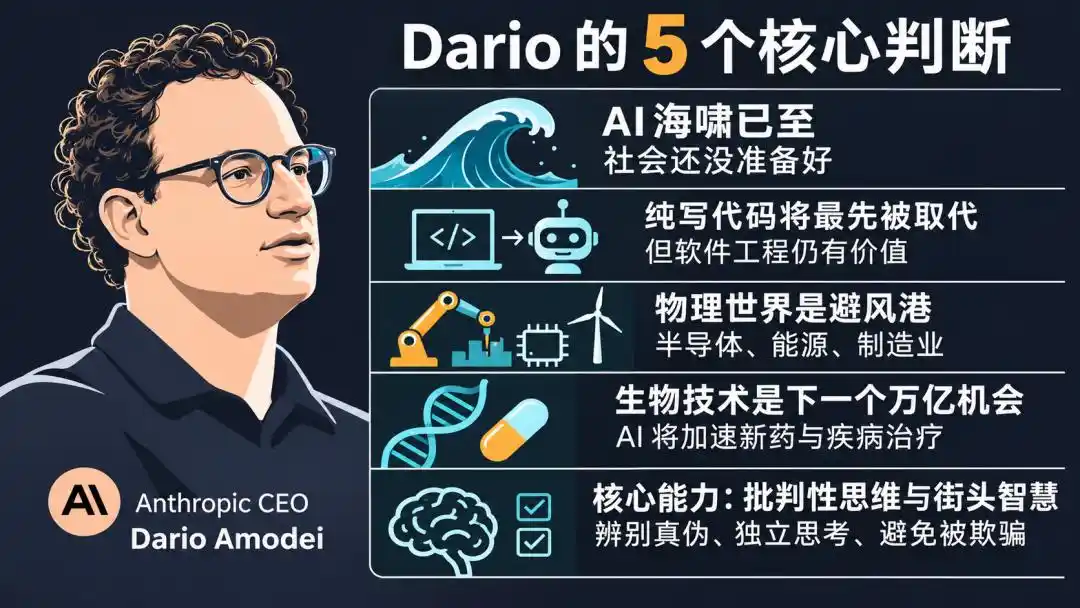
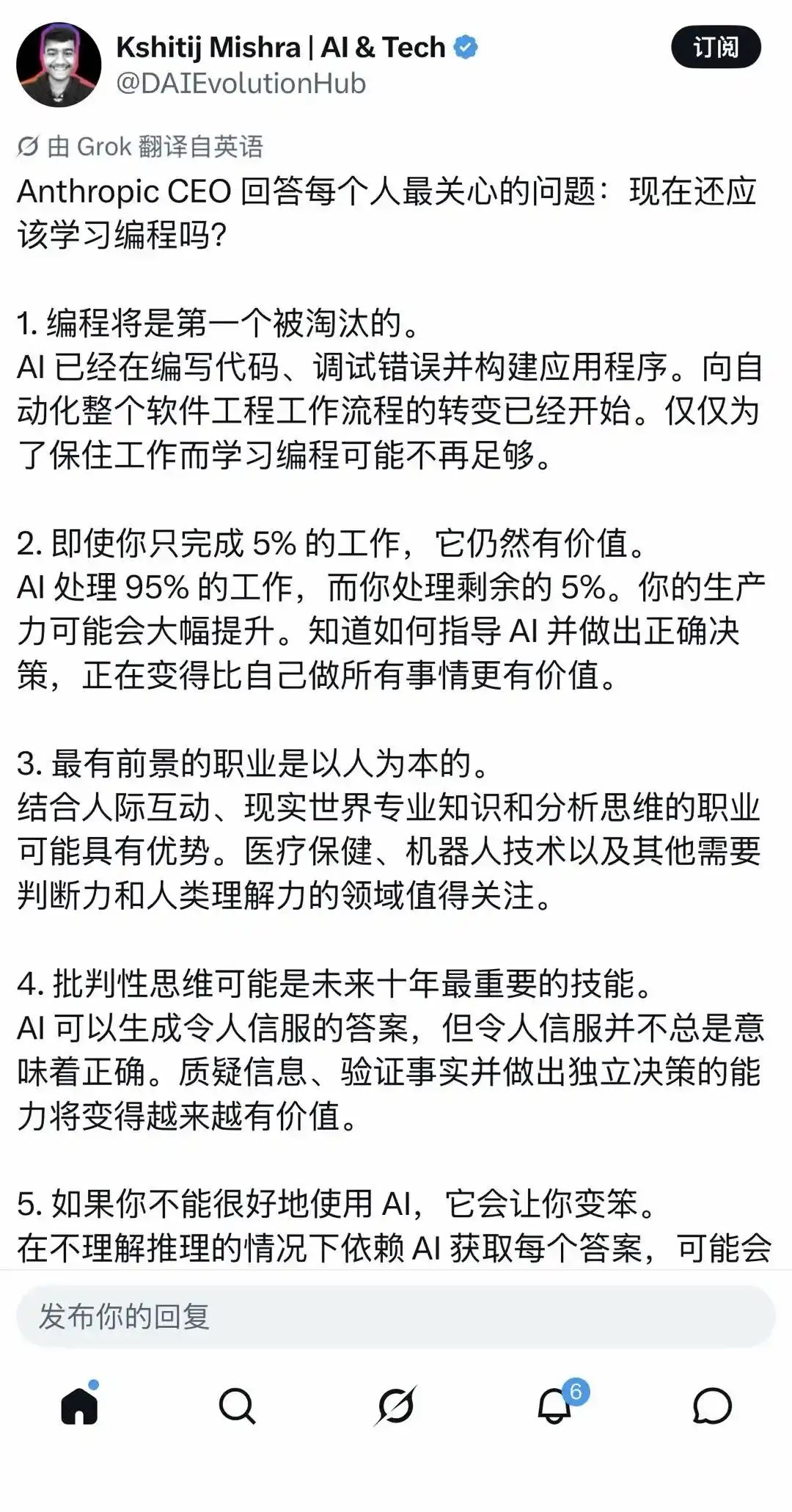
The discussion started with a blunt question: if someone is 25 today and wants career and financial success over the next decade, what should they study, and does programming still matter. Amodei’s answer was direct. He said coding would disappear first, or at least be the first area fully replaced by AI models.
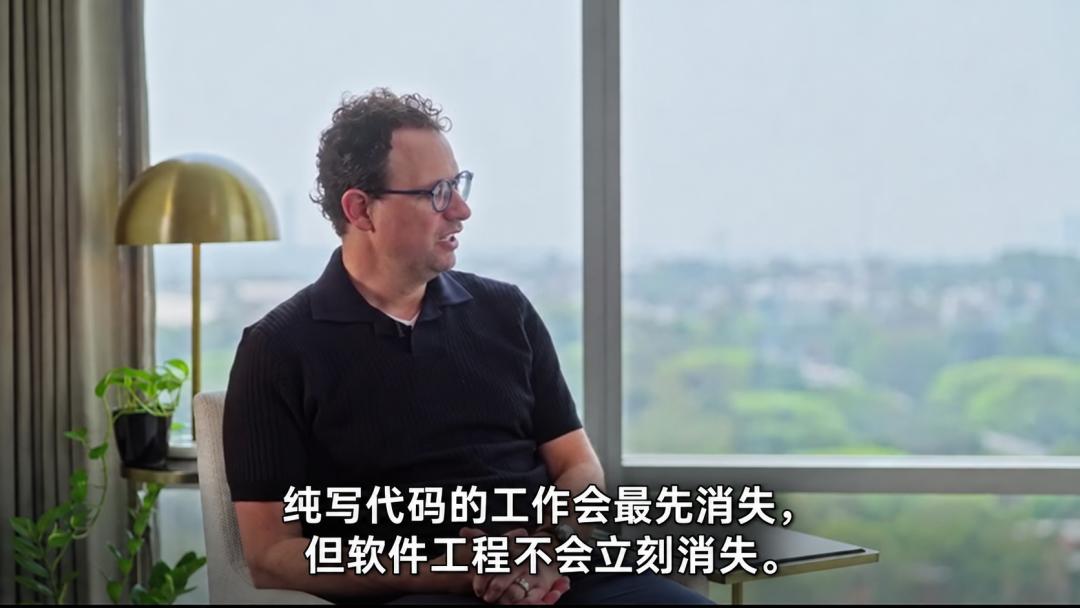
He did not, however, declare the death of the software industry. Amodei drew a distinction between coding and software engineering. Writing individual lines of code can be handed to AI, he said, but software engineering lasts longer because it includes system design, understanding real user needs, and managing teams of AI agents working together.
In his view, human comparative advantage has not vanished. It has shifted. In future workflows, AI may take on 95% of execution, while humans hold on to the most important 5%. That 5%, he said, comes down to judgment, taste, and knowing where to go. Under that split, productivity could rise 20-fold, allowing one person who understands business and human behavior to work with tireless AI systems and rival what used to require a large traditional team.
AI progress as a tsunami, not a distant possibility
Amodei used the image of a tsunami to explain how he sees the pace of AI development. He said he is struck by how close current models already are to human-level intelligence in some respects, while much of society still looks for reasons to believe the shift will not arrive so quickly.
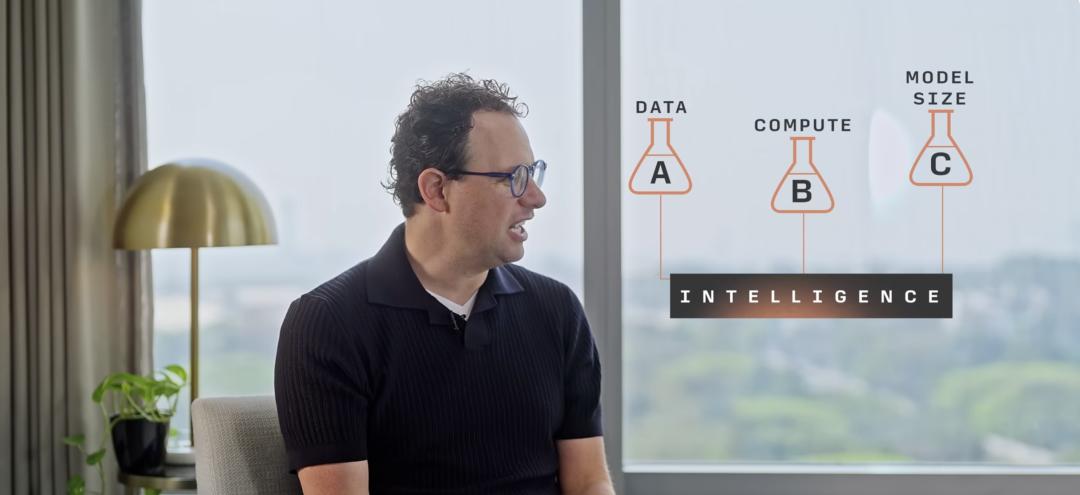
His confidence in that trajectory is tied to scaling laws, a concept he has long taken seriously. He compared it to a chemical reaction: if data and compute are fed into model scale in the right proportions, the output is intelligence. In that framework, as long as compute and data keep rising, AI keeps getting smarter.
He pointed to the change over the past five years as evidence of that curve. Five years ago, computers could not even generate a decent cat image. Today, he said, a user can send Claude a video of a monkey juggling and ask how many times the ball changed hands, and the model can answer accurately. The public, in his telling, still tends to project the future in a straight line, while the technology is moving on an exponential path.
Where he sees durable career moats
When the conversation turned to what ordinary people and their children should study, Amodei did not point back to standardized knowledge work. He pointed to areas that are harder for models to copy.
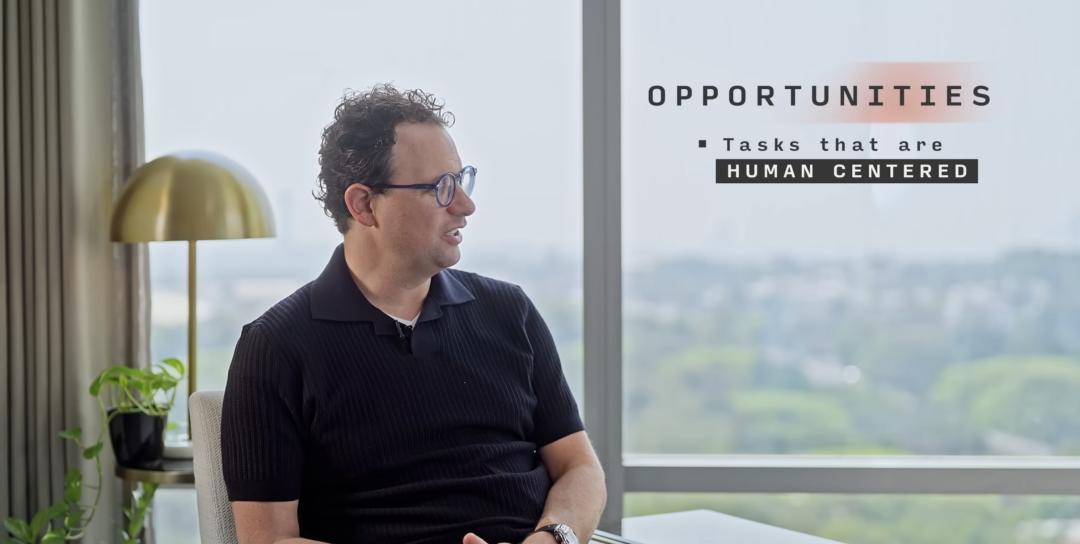
The first is work that is deeply human-centered. AI may write a polished business plan and may even produce highly accurate medical analysis, but it does not build trust across a dinner table and it does not hold a patient’s hand. Amodei used radiologists as an example. People once predicted AI would eliminate radiology because models could read scans more accurately than humans. That did not happen. Instead, as image reading became less central, doctors spent more time communicating with patients, explaining conditions, and easing anxiety.
He said future high-paying roles are likely to belong to people who can connect, understand, and mobilize other people. Emotional intelligence, empathy, and the ability to build complex social networks become more valuable under that scenario.
The second area is the physical world. No matter how capable AI becomes in digital environments, he said, it still struggles with tasks in the real world such as fixing plumbing or turning screws. He urged younger people to pay attention to fields where the physical world meets traditional engineering, including semiconductor manufacturing, new energy infrastructure, and advanced manufacturing.
His reasoning was simple. As software becomes more compressed by AI and competition intensifies, building in the physical world may offer more shelter because it is heavier, slower, and tied to real touch and real environments. If someone can combine AI’s analytical power with physical-world industries, he suggested, the opportunity set becomes much stronger.
The third is not a sector but a core capability: critical thinking and street smarts. In a world where AI can generate fake videos, fake images, and fake news at any time, he said, the ability to separate what is real from what is false becomes a basic survival skill. People need to avoid being misled by appearances, avoid forming false beliefs, and avoid being scammed.
Outside AI, he would back biotechnology
The interviewer also pushed him on investing. If he had only 100 dollars to buy one stock or bet on one industry, excluding his own AI field, what would he choose?
Amodei did not name Microsoft or Nvidia. He said biotechnology.

That answer fits his academic background. Before building Anthropic, which the source described as having a $40 billion valuation, Amodei trained as a physicist and biophysicist and also did postdoctoral work at Stanford Medical School. He said one reason he got into AI in the first place was that biological systems and protein structures were too complex for unaided human cognition, and AI could help in the effort to treat disease.
He said biotechnology is approaching an AI-driven renaissance and argued that many devastating diseases could become treatable. He singled out peptide therapies and cell-based therapies such as CAR-T.
His reasoning was that traditional small-molecule drug design often looks like trial and error, while newer biological approaches such as peptides and mRNA are more programmable. He compared them to computer code in biology, something AI can model digitally and optimize continuously. When AI compute meets programmable biology, he said, the fight against cancer, aging, and severe disease could see major breakthroughs.
Do not build wrapper apps; practice prompting like piano
The interview also addressed a broader fear: if AI takes over more cognitive work, will humans outsource their own minds and get worse at thinking. Amodei said that can happen if AI is used carelessly. He referred to research showing that students who simply let AI do their homework, or programmers who blindly copy AI-generated code, do see their skills degrade.
But he said the choice still belongs to people. He compared AI to the calculator. The invention of calculators did not erase human mathematical ability; it helped people compute things like lunar trajectories. He added that he still does mental arithmetic himself because it helps mathematics fuse more deeply with his own thinking process.
For people who want to build companies in the AI era or operate as highly leveraged individuals, Amodei offered several practical suggestions.
- Do not build wrapper products. If a founder is only calling the Claude or ChatGPT API, adding a polished interface, and packaging a few prompts, he said, there is no moat there.
- Build deep vertical barriers. He said Anthropic would not go after highly specialized verticals such as cross-disciplinary AI in biomedicine or heavily regulated financial services. The dirty work and domain knowledge that large companies ignore may be where smaller founders survive.
- Treat prompt engineering as a skill that requires practice. He quoted a line comparing prompt writing to playing the piano: no one should expect to sit down and play Beethoven immediately.
To make AI easier for non-technical users, Anthropic built Claude Co-work, which does not require coding. Even so, he said, tools do not remove the need for hands-on practice. Users still need to experiment, set context, and build agent workflows if they want to use the systems well.
First principles and the falling cost of intelligence
Near the end of the interview, Amodei returned to a method he said has guided him for years. Over the past decade, he said, he has repeatedly seen that simple curve extrapolation and simple logic can produce conclusions that sound absurd at first. Many people reject them as impossible. Then they happen anyway.
He framed that as first-principles thinking. In the AI era, the core implication is that the cost of intelligence moves closer and closer to zero. Any mental labor that can be reduced to logic, data, and repetition faces rapid compression in value.
From there, his prescription was straightforward: understand people, stay connected to the physical world, learn to direct AI, and hold on to the critical 5%.
The article was sourced from the WeChat public account "Xinzhiyuan" (ID: AI_era) and credited to ASI Qishilu. MarsBit republished the content.