
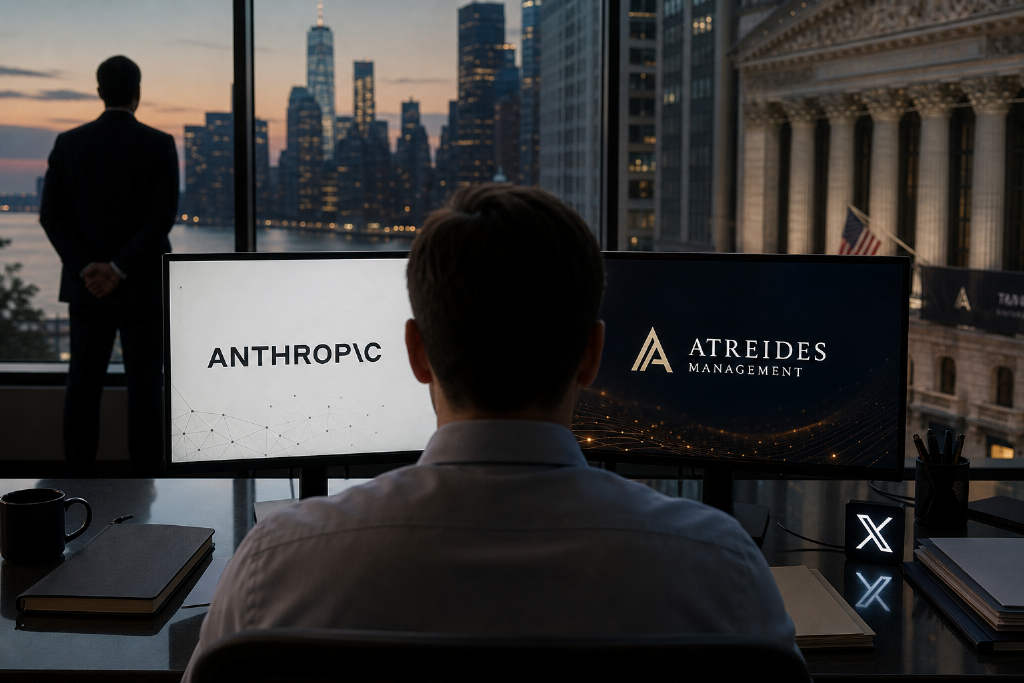
A public confrontation on X on Aug. 14 brought one of the AI industry’s deepest philosophical splits into plain view: whether powerful AI systems should be tightly controlled by a small number of labs or constrained through broad competition.
The exchange involved Sholto Douglas, a post-training researcher at Anthropic who works on reinforcement learning, and Gavin Baker, founder of Atreides Management, a technology hedge fund manager known for laying out AI infrastructure investment views this year on the All-In Podcast.
The dispute started with a claim about Dario Amodei
The immediate trigger was a comment Baker made on the All-In Podcast. He said he had heard from several sources he trusted that Anthropic CEO Dario Amodei had at one point said internally that Anthropic could eventually become "the only private company left in the world."
Baker added: "If this is true, I strongly recommend Dario stop saying this to anyone."
Douglas responded directly on X and rejected the claim in blunt terms: "Completely false." He said he liked Baker’s work, but added that whoever told him that was lying in order to make him believe a narrative that some people were trying hard to push.
Douglas then sharpened the point. The same people, he said, will tell you in one breath that Anthropic has no moat and in the next that it could become powerful enough to be dangerous. In his view, those two claims cannot both be true.
Baker did not keep pressing the factual point. He thanked Douglas for the clarification, then argued that the larger issue remained: many serious people in Silicon Valley had heard some version of the same idea and found it believable because, in his view, it matched Amodei’s public posture.
Baker’s case: AI is too dangerous to be concentrated
The real significance of the exchange was not whether Amodei ever said that line. It was the deeper divide underneath it: whether AI safety points toward centralized control or toward distribution and competition.
Baker framed that divide in a concise way on the All-In Podcast: "Anthropic and people in the effective altruism movement think this technology is so dangerous that it cannot be broadly distributed. Zuckerberg, Elon and Jensen think this technology is so dangerous that it cannot be concentrated."
His logic runs like this. If AI could become extraordinarily powerful and dangerous, labs such as Anthropic may conclude that strong regulation and careful control by a small number of "responsible" actors are necessary. Baker’s objection is that this path can end with regulatory barriers that lock in a handful of companies, restrict open source, and weaken competition.
He argued that history has repeatedly shown that concentrated and unchecked power does not end well.
Baker used gun rights as an analogy. Americans, he said, retain the right to bear arms even though guns can be misused, because that right also serves self-defense and resistance to tyranny. He said he wants an AI aligned with his own values and serving him personally, not an AI aligned with what Dario Amodei thinks is best for humanity.
Open-source models and the question of who decides what is best
Baker strongly backed open-source AI models. Citing a view from Dwarkesh Patel, he argued that Anthropic’s Claude, with its built-in "constitution" and alignment system, operates according to what Anthropic believes is the correct way to act.
He said he does not think the people at Anthropic are bad actors. His concern is different: allowing any one company to define what is best for all humanity is, in his view, dangerous in itself.
He also made an investment argument that cuts against a common assumption. In his view, the rise of open-source models does not necessarily reduce the value of frontier labs. He compared the situation to the Manhattan Project, saying that figures such as J. Robert Oppenheimer and Richard Feynman still needed thousands of ordinary scientists to carry out the work, and that elites can become more valuable when they have more "intellectual labor" to direct.
By the same logic, he said, open-source models can handle scale while frontier models deliver higher-value output. He described the relationship in shorthand as "150 IQ" models being orchestrated by "250 IQ" models.
Douglas’ reply: competition is already solving the problem Baker fears
Douglas did not spend much time on the rumor itself. He went after the foundation of Baker’s broader argument.
Linking to a long essay by Dario Amodei, Douglas wrote that the AI market is currently the most competitive market on Earth, with every major global company trying to offer smarter and cheaper models. If things go well, he wrote, the cost of everything could be pushed down toward the cost of energy. That is remarkable, but it threatens many existing moats, and those people are scared.
The implication was clear. Douglas was arguing that many of the people spreading the idea that Anthropic wants to monopolize the world are themselves tied to older business moats now under pressure from AI. In that reading, claims about Anthropic’s ambition or regulatory capture may be serving open-source advocacy, investment interests, or fear of rapid change.
He also returned to what he saw as a contradiction in Baker’s case. If Anthropic has no moat and will be overrun by open source, then fears that it could monopolize the world make little sense. If the company could become powerful enough to be dangerous, then claims that it lacks competitiveness do not fit either.
In another post, Douglas wrote that if AGI arrives, capitalism will become very strange and the concept of a "company" may look completely different. He linked to a Dwarkesh Patel article on what firms may look like in the AI era, suggesting that the issue is much more complicated than a simple centralized-versus-decentralized split.
The split comes from different assumptions about risk
The exchange stood out because neither side was obviously making a simple logical mistake. Their disagreement rests on different starting assumptions.
Baker’s assumption is that if AI becomes powerful enough to be weaponized, dispersed power is safer than concentrated power, much as democratic checks are safer than enlightened absolutism. His view of human nature is straightforward: no person or institution, however well-intentioned, should control a superintelligence without meaningful constraints.
Douglas starts elsewhere. He argues that the intensity of competition in AI is itself the strongest constraint available. In his account, there is no need to manufacture political narratives to "disperse" AI power because the market is already doing that job. Google, Meta, xAI, OpenAI, DeepSeek, Kimi and GLM, along with other major teams, are all pushing in the same direction. Under that structure, he argues, no single company can become "the only private company left in the world."
The harder question still hangs over the debate
The exchange also left a sharper question unresolved. If AI really could, as Amodei has said, wipe out 50% of white-collar jobs, then it is not obvious that competition and dispersion alone answer what comes next.
Competition can produce efficiency. It does not automatically produce fairness. Dispersion can reduce single points of failure, but it does not guarantee protection from system-wide risk.
Baker said he wants an AI that serves him personally. But if everyone has a superintelligence working on their behalf, what kind of social order follows from that is still unclear. At that point, the argument stops being only technical or commercial. It becomes a question of political philosophy.
Seen that way, the dispute between an Anthropic researcher and a hedge fund manager reflects more than a policy fight over regulation and open source. It also captures two basic anxieties about advanced AI: fear of a gatekeeper that becomes too powerful, and fear of a world with no gatekeeper at all.