
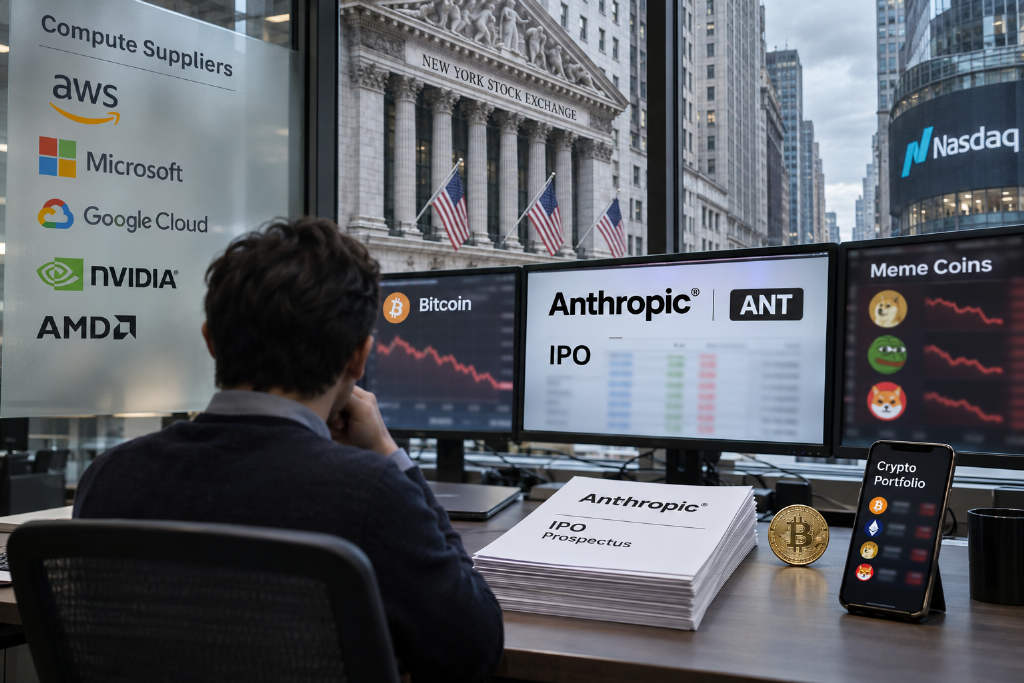
Anthropic has released more details about its planned initial public offering, setting a price range of $70 to $78 a share for 825 million Class A shares. At the top of the range, the offering would raise about $64.4 billion. Pricing is expected on Nov. 18, with trading scheduled to begin on Nasdaq on Nov. 19 under the ticker ANT.
About 20% of the deal is reserved for retail investors, roughly twice the allocation that individual investors usually receive in an offering of this size. Anthropic would be valued at $916 billion to $1.02 trillion on a basic-share basis, or as much as $1.405 trillion on a fully diluted basis.
In September, the company was reportedly considering a $2 trillion valuation. The Wall Street Journal said major investors now see the valuation landing closer to $1 trillion after last week’s selloff in artificial intelligence stocks. That would represent a 30% markdown in two months. The order book has reportedly been covered, but not oversubscribed.
ANT is trading on Hyperliquid at a valuation of about $1.8 trillion, with $100 million in daily volume and $200 million in open interest. Morning Minute described the market as large enough to offer some signal, suggesting that traders may be more bullish on ANT’s trading performance than Wall Street.
The compute-supplier placement
Alongside the IPO, Anthropic is arranging a $26 billion private placement of non-voting Class N shares. Seven of the company’s compute suppliers will buy the shares at the IPO price. Google and Nvidia are each taking about $10 billion, AMD is taking $2.5 billion, and Broadcom, Micron and Microsoft are taking about $1 billion each. TSMC is taking $500 million.
The shares have no lock-up. Combined with the public offering, the transactions would leave Anthropic with roughly $84.6 billion for general corporate purposes, most of which is expected to go toward compute.
Revenue growth alongside large losses and commitments
Anthropic reported $33.2 billion in revenue for the first nine months, up from $2.5 billion a year earlier. It also reported a $1.26 billion operating loss.
The company posted a $104 billion net loss, almost all of it a non-cash charge tied to convertible notes. Anthropic has also committed to $900.9 billion in spending, with $70.7 billion due within 12 months.
Could the IPO pull liquidity from crypto?
The liquidity-drain thesis has circulated since April. CoinDesk argued then that mega-IPOs can pull speculative money from the same pool that funds crypto assets. Retail allocations are the channel: a dollar set aside for an IPO ticket is a dollar not allocated to bitcoin or memecoins.
SpaceX offered a recent comparison. It listed on June 12 at a valuation above $2 trillion. Bitcoin fell 29% into the listing, reached a low of $58,500 on June 30 and then rose 37% from that low. Yet bitcoin’s effective bottom was already in on June 5, one full week before the SPCX IPO, at about $59,000.
The question, then, is not only whether an IPO draws money away from crypto. It is whether the effect has already taken place. Bitcoin fell roughly 15% from its early-October high through a $6.3 billion exchange hack, an artificial-intelligence capital-expenditure selloff and a Democratic sweep.
Morning Minute identified two reasons the Anthropic deal may be smaller for crypto than its headline valuation suggests. The retail portion is about $12.9 billion, compared with $22 billion for SpaceX, or roughly 59% as much. The $26 billion private placement also never reaches public-market liquidity because Anthropic’s vendors provide the capital and are then paid back through compute contracts.
If the SpaceX pattern repeats and the roughly 60% factor is applied, the analysis says bitcoin could fall another 5% or so into the Anthropic IPO. That level is close to the 200-week moving average. The effective bottom could arrive within the next one to two days, according to the newsletter’s scenario. The outcome remains dependent on market trading.
Crypto and macro markets
Major crypto assets were still in the red but rebounded after the previous day’s sharp selloff. Bitcoin was at about $74,000. Ether was down 2% at $2,055, SOL was down 1% at $84, HYPE was down 2% at $73 and ZEC was down 14% at $986.
Among leading altcoin movers, Gram rose 12%, SPX gained 6% and LIT advanced 5%. Oil rose 2% to $87, while gold fell 1% to $4,050.
Stock futures were broadly higher after a strong CoreWeave result eased some artificial-intelligence concerns. Dow futures were up 0.14% and Nasdaq futures were up 1.9%.
A consortium of 21 banks, including Goldman Sachs, Citigroup, Santander and Deutsche Bank, committed about $270 million to fund five years of operations for a U.S.-incorporated dollar stablecoin issuer. The project is internally known as Project Faro.
Nvidia erased its 2026 gains as the fallout from Spygate continued. The stock fell to $166.95 and was down 18.4% in November. House Foreign Affairs Chairman Brian Mast threatened to subpoena Chief Executive Officer Jensen Huang over his dealings with a former executive at a Singapore chip buyer.
Near AI disclosed a breach in which an attacker exploited a remote code execution flaw in the open-source SGLang inference engine to move through its infrastructure. The incident exposed names and email addresses for about 100 users, as well as chat histories from 18 AI agents.
Trump Media reported a third-quarter profit of $409.7 million after a $238 million loss in the second quarter. The company recorded $496.1 million in unrealized gains on digital assets and securities as bitcoin rose 42% during the quarter.
Grayscale pledged $1 million to nonprofits in the Zcash ecosystem. The money will come from reinvesting sponsor fees from its Zcash ETF for up to the fund’s first year. Four organizations have already received $100,000 each, alongside a full-page advertisement in The Wall Street Journal.
David Schwartz, Ripple’s former chief technology officer, said he had cut his crypto holdings from roughly 26 million XRP to 3 million, from 1,500 BTC to one and from 40,000 ETH to six. He described the sales as part of a longstanding agreement with his wife to sell into new highs.
The Commodity Futures Trading Commission warned Kalshi that it could bring enforcement charges over how the company notified the agency about new contracts. Politico reported that dozens of products are under review. Kalshi called the matter a “procedural error” affecting a handful of products.
ETF flows and meme coins
Bitcoin ETFs recorded $95 million in net outflows on Tuesday. Ether ETFs recorded $1.3 million in outflows.
Leading memecoins were mostly higher or unchanged. DOGE fell 2%, SHIB was flat, PEPE fell 5%, PENGU gained 1%, TRUMP fell 2%, SPX rose 5% and BONK gained 1%.
Leading tokens on the Robinhood chain were mostly lower. Pons fell 1% to a $102 million market capitalization, Cashcat fell 9% to $60 million, Orbio fell 4% to $28 million and AI fell 2% to $28 million. MEME rose 17% and v4 rose 90%, leading the top movers.
Solana’s leading movers included Mihao, up 17x; Nihao, up 175x; and Hold, up 25x. Stonk rose 2% to a $50 million market capitalization, while Ansem gained 13% to $55 million.
Token, airdrop and protocol tracker
Hyperliquid led onchain protocols in daily revenue at $2.53 million. Pump.fun followed with $1.16 million, and Papertrade recorded $1.01 million.
Jupiter launched four products that extend its business beyond trading. Baskets allows one-click token bundles that rebalance automatically, while Vaults supports curator-managed yield strategies.
Moody’s Ratings and Chainlink completed a pilot for distributing credit ratings across multiple blockchains. The test used Chainlink’s cross-chain protocol and Moody’s Token Integration Engine.
Decrypt added confidential transfers to its Money Account through Solana infrastructure firm Helius. The feature uses zero-knowledge proofs to hide transfer amounts from the public ledger while keeping viewing keys available for compliance.
NFT market
NFT leaders were mostly flat. Punks was unchanged at 30.4 ETH, BAYC fell 1% to 5.75 ETH and Pudgy fell 3% to 2.14 ETH.
Gimboz rose 35% and Gs on Ape gained 32%, leading the top movers.



