
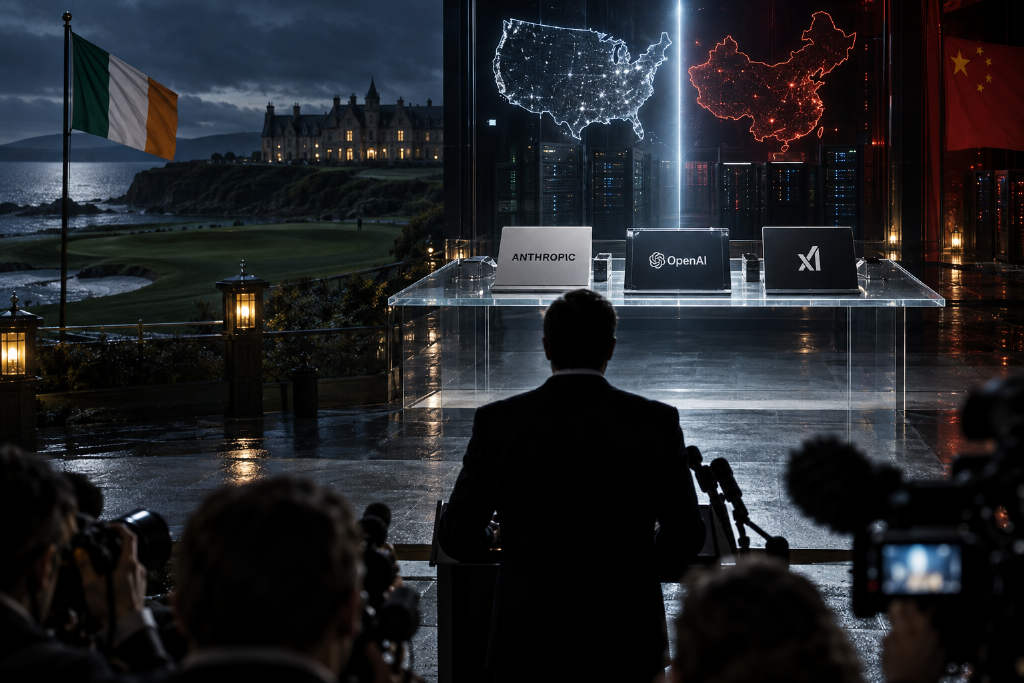
Anthropic CEO Dario Amodei, OpenAI CEO Sam Altman and xAI founder Elon Musk have taken a rare common position on AI safety, calling on the tech industry to rethink how fast frontier model capabilities should advance.
U.S. President Donald Trump has now weighed in on that debate. Speaking to reporters at a golf course in Ireland on Sept. 13, Trump was asked whether the AI industry should slow development or accept more regulation. He said the United States is currently ahead of China in AI, is the most advanced country in the world, and should remain in that position.
“We’re ahead of China in AI. We are the most advanced country in the world, frankly, and I want to keep it that way, because whoever wins AI, wins,” Trump said.
Amodei says frontier AI progress needs to be paced
Amodei recently published “We Must Pace the Frontier,” arguing that pouring more resources into AI safety is no longer enough. In his view, the industry also needs to control the speed of frontier model capability gains so that alignment work, safety testing, monitoring and interpretability research are not left behind by rapid model improvement.
He said the proposal is not a call to stop AI research. It is meant to buy time for safety research. Amodei outlined a three-stage framework:
- allow independent third-party evaluators to remain embedded inside frontier AI companies with access close to that of internal safety teams;
- have AI companies and governments in democratic countries build safety standards together;
- eventually create a global coordination mechanism on model capability progress that would include major AI powers such as the United States and China.
Altman and Musk back the idea
The position became more notable when OpenAI CEO Sam Altman, a direct competitor, publicly agreed. Altman said he supports the direction of Amodei’s argument that frontier development speed must be controlled, and added that the issue has been a major topic in OpenAI’s internal discussions in recent weeks.
On Anthropic’s proposal to let independent third parties enter companies and continuously assess safety, Altman said it was a good idea and that OpenAI would follow that approach as well.
Elon Musk, who has had a sharp rivalry with Altman, also offered direct support this time. His response was brief: “Dario is right.”
Trump focuses on the U.S.-China race
That helps explain the angle Trump took when he was asked whether AI should slow down. The risk he emphasized was different: if the United States eases off, China could use that opening to catch up.
Reuters reported that Trump has long resisted the increasingly prominent arguments centered on AI risk. When asked directly whether the industry should slow down or accept more regulation, he did not focus on runaway-model concerns. He focused first on the fact that the United States is ahead of China, then said flatly that “whoever wins AI, wins.”
Amodei says China is the hardest problem for any slowdown plan
Amodei himself has acknowledged the same problem. His third-stage proposal includes both the United States and China because a plan that asks only U.S. companies to slow research would be unlikely to produce a stable equilibrium.
If one side believes the other will keep accelerating, he argued, the incentive to speed up in secret becomes strong. Amodei said competition between the United States and China makes an international safety regime very hard to implement. Any real limit on the pace of model capability gains would require strict verification and inspection systems to confirm that neither side is secretly moving faster.
He also said such a system could take years to build, and whether it can work remains unknown.