
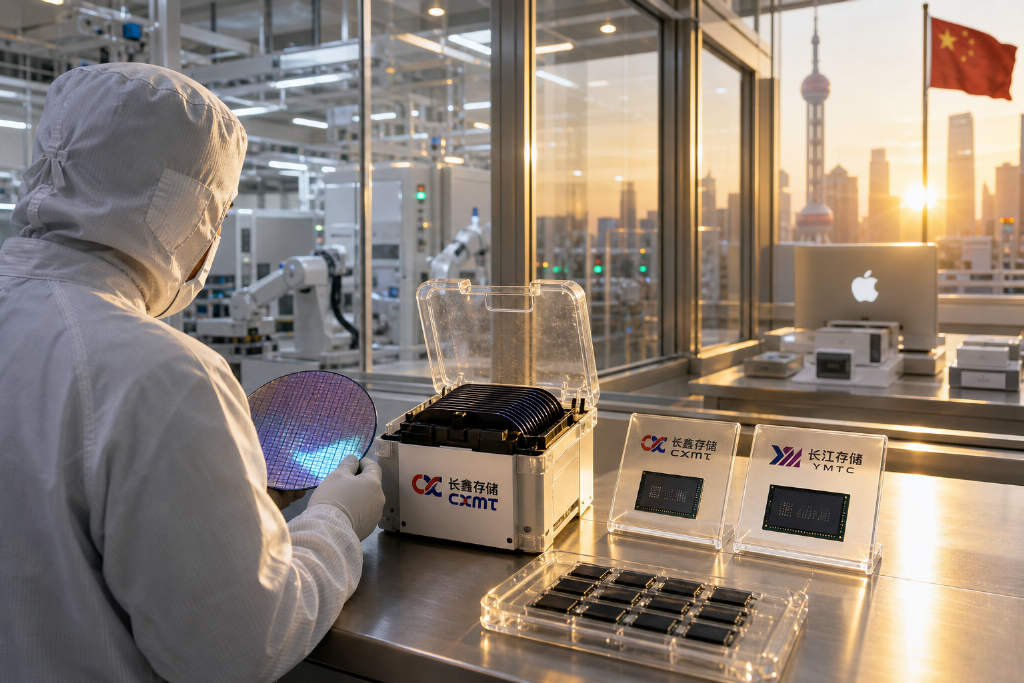
Apple is actively seeking to bring Chinese memory suppliers ChangXin Memory Technologies and Yangtze Memory Technologies Co. into its supply chain, according to a DIGITIMES report cited by ChainCatcher.
The report says both companies have continued expanding, and industry attention is now focused on whether they can enter Apple’s supplier system.
According to industry sources cited in the report, the two manufacturers are using Apple to help prove that Chinese DRAM and NAND Flash quality has reached international standards. At the same time, they are also shipping products indirectly to new North American cloud providers, or neocloud players, through third-party assembly channels to increase their share in cloud and enterprise markets.
Fundraising and production expansion
CXMT’s parent company, ChangXin Technology, has completed a 29.5 billion yuan fundraising round. YMTC is preparing for an IPO that is expected to raise about 33 billion yuan, with the proceeds earmarked for production-line upgrades and research and development.
The report says YMTC turned profitable in 2024. In the first quarter of 2026, its attributable net profit reached 33.379 billion yuan. Its phase-three new plant is now scheduled to begin production earlier than expected, in the fourth quarter of 2026. Total capacity is set at 100,000 wafers per month, with about 20% allocated to trial LPDDR production, making it the company’s first DRAM site.
How products are reaching North America
Supply-chain sources cited in the report said YMTC is selling NAND products to third-party module makers, where they are assembled into enterprise SSDs before shipment, a structure used to avoid sensitivity around country of origin. CXMT, meanwhile, has already completed certification with small and mid-sized cloud providers in the United States and Canada.
The report adds that private companies in the United States are, in principle, still allowed to buy from the two firms. The Entity List mainly restricts their access to U.S. technology and does not impose a blanket ban on private-sector purchasing. Cloud providers are also reducing compliance risk through arrangements such as leasing computing power or having assets held by third parties.
Apple angle and domestic supply outlook
According to supply-chain estimates cited in the report, the two companies could lift China’s domestic memory self-sufficiency rate to above 50% by the end of 2027 to 2028 at the earliest.
Still, the report says industry participants do not expect either company to ship large volumes to Apple or engage in price-cutting competition. It also says Apple’s influence over industry supply and demand has weakened, and even with capacity expansion, the two companies are unlikely to meet Apple’s China-market demand in the short term.