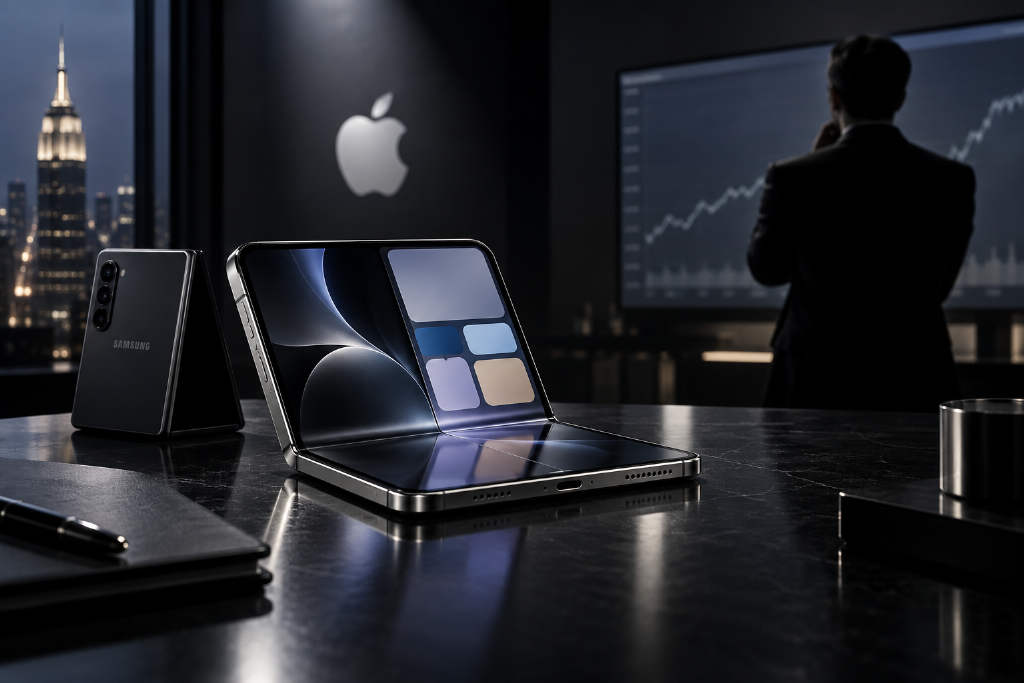
Apple has recently launched a foldable phone, and a Foresight article uses that release to revisit the investment logic behind Duan Yongping’s long-term bullish view on the company.
According to the article, the device has drawn criticism online from people who say it does not offer much in the way of technical innovation. Even so, several parts of the user experience have been widely praised. The piece points to an almost invisible crease, support for split-screen display of different content, and interface changes that move certain icons to the right.
User experience, not pure technology, sits at the center of the argument
One feature received particular attention: the phone shows a lens effect when it folds.
Not long after that, online posts circulated claiming that users had produced a similar effect on Samsung foldable phones, using that as evidence that the feature is not especially difficult to build. The original article is careful on that point and says the online claim has not been verified.
Even if the claim turns out to be true, the author argues that other handset makers will likely copy and implement these Apple features soon. For most products, purely technical barriers tend to be overcome quickly and are hard to defend as a lasting moat.
That is where Apple stands apart in the author’s view. Even when a feature may not be technically hard to replicate, other phone makers still failed to introduce those functions and characteristics before Apple did.
The article says this is what makes Apple so impressive: the amount of effort it puts into user experience, and the seriousness with which it approaches those details, remains unusual among current smartphone manufacturers.
A foldable design said to be six years in the making
The article also cites reports that Apple had been developing the foldable design for six years and that not even Tim Cook’s departure led to any leak of implementation details. It links that level of secrecy and dedication to the same moat Duan Yongping has repeatedly emphasized in his investment Q&A records.
Apple was not the first company to release a foldable phone. Still, the author believes the product could once again turn Apple into the benchmark for foldable devices after it reaches the market.
From a niche-demand view to a reassessment of market interest
The piece notes an irony here. Duan had previously thought Apple would not launch a foldable phone because he believed the category might remain a niche demand.
Now, based on the current level of attention, especially preorder volume, the author says demand may be larger than expected. On that basis, the article argues that the phone could help Apple generate profits for years after launch, reinforcing the idea that Apple remains a highly profitable company.
The article also looks back over a longer stretch of time, saying that nearly 20 years have passed since Steve Jobs returned to lead Apple again and introduced the iPhone. Through that period, Apple has remained highly profitable, something the author describes as rare among consumer goods companies.
Duan’s core view on Apple has barely changed since 2011
The author then returns to Duan’s earlier comments on Apple. From Duan’s first purchase of Apple stock in 2011 to today, 15 years have passed. Over that span, the article says, his comments have stayed largely the same, while Apple’s development has continued to move in the direction he had expected.
In the author’s telling, that ability to understand a company and anticipate its path more than a decade in advance is highly unusual.
The writer also adds a personal note: despite following Duan’s investment Q&A for two years, the author has never bought Apple shares, largely because of repeated doubts over whether the stock price was already too high and whether Apple could keep making money in the future.
The article recalls seeing a report last year saying Duan was still buying Apple either last year or the year before. At the time, that came as a surprise to the author, because buying at that level suggested Duan remained strongly confident in Apple’s future earning power.
Timing is about future profits, not how long a stock has existed
The article closes with a recent exchange. A netizen asked Duan whether it was already too late to buy AI stocks now.
Duan’s reply, in substance, was this: if that were the standard, then his purchase of Apple came even later, since Apple went public in 1980 and he only started buying in 2011.
The author says the point is straightforward. Whether it is too late to buy a company should not be judged by its past share price or by how long it has been listed. The real question is the future: can the company keep making money? If it can, and the current price is still cheap relative to that future earning power, then buying now is not necessarily late.
The original article ends with a standard disclaimer, saying markets carry risk, investment requires caution, and the piece does not constitute investment advice.