


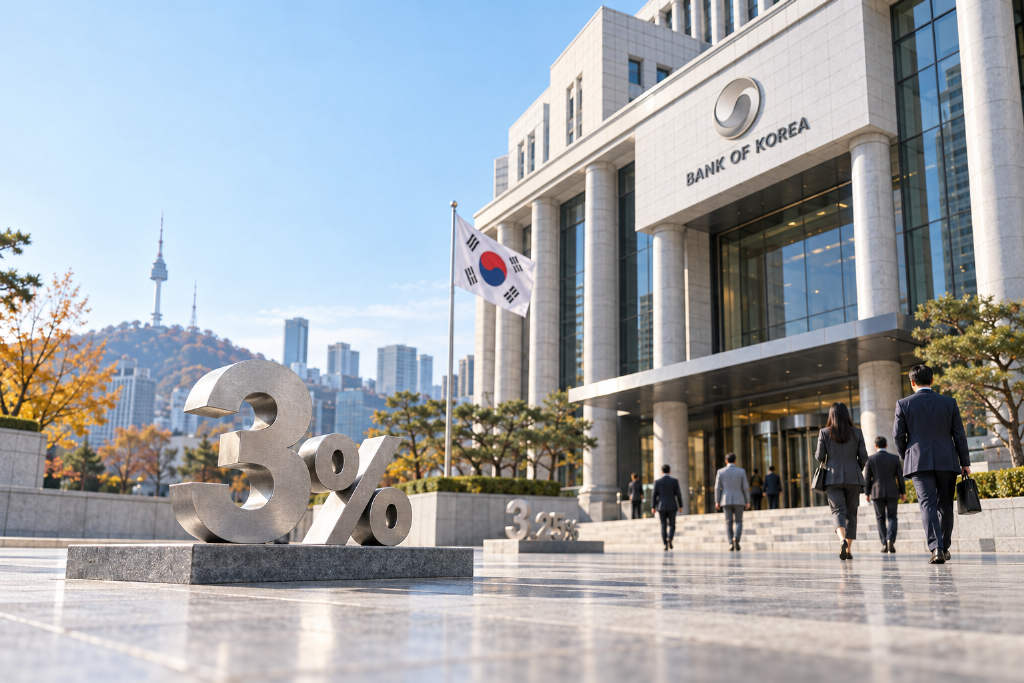
The Bank of Korea is expected to keep its benchmark interest rate at 3% on Oct. 22, with markets treating a hold as the base case. All 24 economists surveyed by Bloomberg forecast no change. Bloomberg said the central bank raised rates by 25 basis points in both July and August, marking its first back-to-back hikes in more than three years, and that this meeting is likely to be used to assess the impact of those moves.
The real split in market expectations is centered on Nov. 26, not this week. Most surveys cited in the report point to another quarter-point increase to 3.25% at that meeting. For the terminal rate in early next year, many forecasts cluster around 3.5%, while a smaller group sees 3.75%.
Why policymakers may pause after two straight hikes
Governor Rhee Chang-yong said at the Aug. 27 post-meeting press conference that the central bank needed time to evaluate the effects of two consecutive rate increases. He gave a more detailed explanation during a parliamentary audit on Oct. 12.
According to The Korea Times, Rhee said the Bank of Korea moved in August before the Federal Reserve’s September hike and that 「we bought ourselves time」. He said the economic cost of acting early was far lower than being forced into defensive tightening later under market pressure. Yonhap also quoted him as saying: 「When we conduct monetary policy, we always assess how much time economic agents need to adjust and whether they have the capacity to adjust.」 He also acknowledged that tighter policy places a heavier burden on lower-income borrowers.
The exchange rate is another reason a pause is being considered. Asiae reported that Rhee said during the same parliamentary session that the July and August hikes played 「a very important role」 in stabilizing the currency. As of the morning of Oct. 21 in Korea, the U.S. dollar was trading at about KRW 1,327.6, staying near the KRW 1,330 level.
Analyst commentary cited in the report also leaned toward a pause. Joo Won of Hyundai Research Institute told Yonhap that a third straight hike could place a considerable burden on households and domestic companies. Ahn Jae-kyun of Korea Investment & Securities said core inflation had stabilized to some extent and the exchange rate was holding in the KRW 1,330 range, leaving insufficient justification for another immediate increase.
Inflation has cooled, but base effects matter
Headline figures show some easing. Consumer inflation rose 2.9% year over year in September, down from 3.1% in August. Core inflation, which excludes food and energy, fell from 3.4% in August to 2.8% in September. Communication prices also slowed sharply, with annual growth dropping from 16.6% in August to 2.0% in September.
But the August reading was itself lifted by base effects. Telecom fees had been temporarily discounted in August last year, which pushed mobile phone charges up 26.7% year over year in August this year. South Korea’s finance ministry said that excluding that factor, August headline inflation would have been only 2.5%. A nationwide cap on fuel prices also reduced August inflation by 0.3 percentage points.
After those base effects faded in September, core inflation at 2.8% still remained above July’s 2.6% and above the 2% target. On Oct. 12, Rhee said inflation would stay above target for a considerable period. Earlier, on July 16, he said that if the semiconductor boom spilled over into domestic demand, demand-side inflation pressure was expected to rise gradually.
Housing and debt remain key policy variables
The central bank is also watching financial imbalances. During the parliamentary audit, Rhee said rising home prices in the Seoul metropolitan area and growing household debt were fueling concern, while default risks in vulnerable sectors remained in place.
Asiae reported that Seoul apartment prices rose 0.20% in the first week of September, equivalent to roughly 10% to 15% on an annualized basis. Household debt exceeded KRW 2,000 trillion for the first time in the second quarter, setting a new record.
November hike expectations remain elevated
The broader consensus still points to another move in November. Yonhap surveyed six economists, and all six expected a hike at the Nov. 26 meeting. The Seoul Economic Daily surveyed 20 experts, with 18 expecting a November increase; 16 of them said core inflation was the variable the central bank cared about most.
In Asiae’s survey of 13 economists, all expected the policy rate to reach 3.25% by year-end. Eleven saw the 2027 terminal rate at 3.50%, while some projected 3.75%. Money Today surveyed 11 bond-market specialists, and eight expected a November hike. Ahn Ye-ha of Kiwoom Securities said rates could rise to 3.75% if oil prices remain high. Citigroup and Morgan Stanley expect one quarter-point hike in November and another in early next year, taking the rate to 3.5% in the first quarter of 2027.
Prediction markets show a similar direction. On Polymarket, the probability of a 25-basis-point hike at the Nov. 26 meeting stood at 66.5%, while the probability of no change was 28.5%. The report added that total trading volume was only about $38,000, limiting its value as a reference point.
What markets will watch on Thursday
Beyond the rate decision itself, investors are focused on the signals that follow. The Korea Times reported on Sept. 10 that Senior Deputy Governor Park Jong-woo said the policy rate was already near the upper end of the central bank’s estimate of the neutral rate, though the bank is reassessing that estimate.
The report highlighted three things to watch on Thursday.
- First, whether any board members dissent in favor of a hike. Citigroup’s Kim Jin-wook expects one vote for a rate increase, while Morgan Stanley’s Kathleen Oh expects two. In Asiae’s survey, four respondents also expected a minority view in favor of tightening, and board member Jang Yong-seong was specifically mentioned.
- Second, how board members describe the rate outlook for the next three months.
- Third, the wording used by Rhee at the press conference. On Aug. 27, he said every subsequent meeting would be a 「live」 meeting.
With a hold at 3% widely expected this week, the key question is whether the Bank of Korea uses Thursday’s meeting to prepare markets for another increase in November as it weighs core inflation, housing prices, household debt and the spillover effects of the semiconductor boom.