


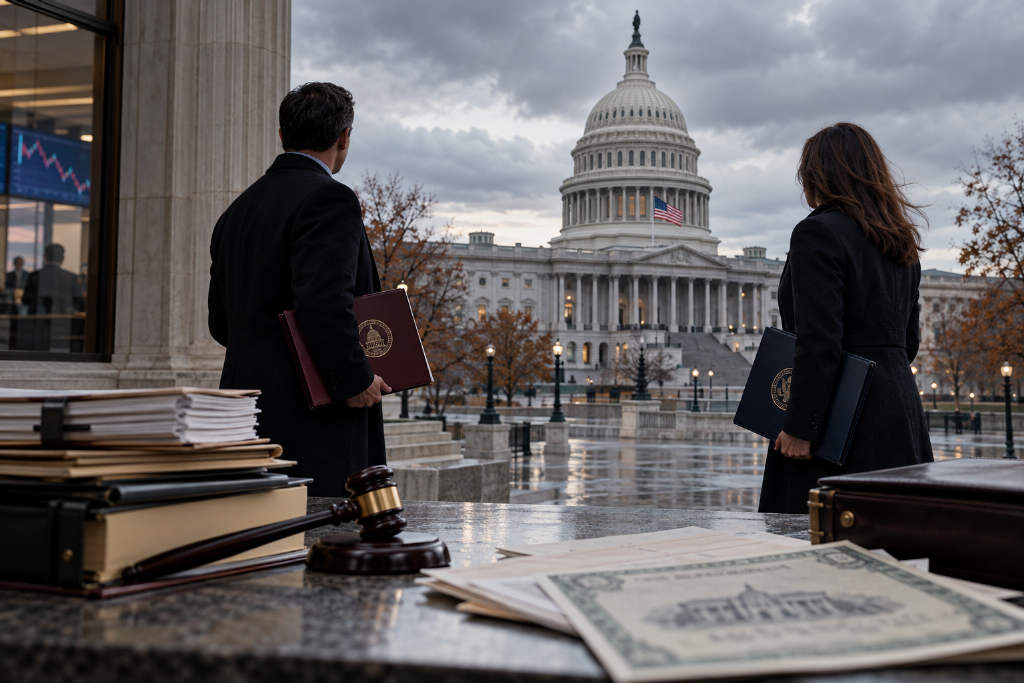
The Nov. 3 U.S. midterm elections will determine which party controls Congress during the final two years of President Donald Trump’s term. Republicans now hold a slim House majority, 218 seats to 214, and lead the Senate 53 to 47. Democrats need a net gain of four seats in each chamber to take control.

Most expectations point to a Democratic takeover of the House, while the Senate remains uncertain. Trump’s approval rating has fallen to the lowest level of his presidency, and polling shows Democrats in a stronger position in the campaign. Even so, winning one or both chambers would not give Democrats control of the executive branch. Trump would still be able to use the presidential veto and continue to exercise broad executive authority on tariffs, immigration and foreign policy.
Analysts, political strategists and economists interviewed by Reuters said a 2027 fight over the debt ceiling and federal government funding is likely no matter which party ends up in charge of Congress. Two economists said markets and investors could face a volatile year. Election officials also warned that the Trump administration could try to interfere with the election in multiple ways.
Scenario 1: Democrats retake the House while Republicans keep the Senate
If Democrats win only the House, Republicans could still use the Senate to block most of the Democratic policy agenda. The size of a Democratic House majority would shape how far the party could go in investigating the Trump administration, moving legislation and negotiating over the budget.
House majority of 5 to 20 seats
Under that outcome, Democrats would control House committees and gain subpoena power, allowing them to investigate Trump and his administration.
There would still be limits. Administration officials could refuse to cooperate, and a Justice Department loyal to Trump would be unlikely to enforce those subpoenas. Even so, Democrats could step up oversight through hearings, investigations and public questioning.
On legislation, Democrats could advance bills on healthcare, abortion rights, housing and artificial intelligence data centers to lay out their policy position. With Republicans still in control of the Senate, those bills would be highly unlikely to become law.
Trump, for his part, could keep relying on executive orders. Over the past two years, he has largely advanced his agenda by working around Congress, and that pattern could continue even if Democrats retake the House.
House majority of 20 to 40 seats
A larger House majority would give Democratic leaders more room to operate. Even if some Democratic lawmakers broke ranks, the party would still be in a stronger position to move its agenda.
That kind of margin could also amplify calls inside the party to impeach Trump, especially if dissatisfaction continues over disputed policies such as tariffs and the war with Iran.
At the same time, some Republican lawmakers could become more willing to put distance between themselves and Trump. If parts of his agenda prove unpopular with voters, members of his party may come under pressure to rethink their political stance.
Democrats would also gain more leverage in budget talks, giving them a stronger hand on healthcare, abortion rights and cost-of-living issues, while forcing Republican senators to take positions on those bills.
Analysts said Democrats could use that opening to push legislation on inflation control, limits on presidential war powers and opposition to some data center construction. Those measures would still face a Republican Senate and Trump’s veto, leaving little room for major legislative breakthroughs.
A 50-50 Senate split
If Democrats win the House and the Senate ends in a 50-50 split, Republicans would still control the Senate because Vice President JD Vance could cast the tie-breaking vote.
In close votes, a small number of senators willing to break with their party could become decisive. Reuters cited Pennsylvania Democratic Senator John Fetterman and some moderate Republicans as possible swing figures.
Fiscal negotiations could become more complicated as well. Raising the debt ceiling and funding the federal government would require agreement across factions, and a handful of senators could gain the power to shape or delay a deal.
Trump would still be able to use Vance’s tie-breaking vote to secure Senate confirmation for nominees. His executive actions on tariffs, immigration and foreign policy would also remain largely unconstrained.
For markets, a Democratic House without a Democratic Senate could mean a sharper phase of congressional oversight and budget confrontation. Analysts expect the debt ceiling dispute could flare up again by the summer of 2027, unsettling markets and investors.
Scenario 2: Democrats control both the House and the Senate
If Democrats win both chambers, Trump would face stronger congressional checks. Senate control matters more directly than House control in one respect: the Senate reviews nominations for judgeships, senior cabinet posts and ambassadorial positions.
Still, the size of the Democratic Senate majority would determine how much room the party actually has.
A Democratic Senate majority of just 2 seats
In that case, Democrats would control Senate committees and the chamber’s agenda. They could block confirmation of many of Trump’s judicial nominees and might try to delay filling a U.S. Supreme Court vacancy until after the 2028 presidential election.
Republicans, meanwhile, could try to speed through Trump nominees before the new Congress takes office in January 2027.
On legislation, Democrats would still run into Senate procedure. Most bills need 60 votes to overcome a filibuster, and even with a simple majority Democrats would struggle to reach that threshold on their own.
Trump would still have the veto. So even with both chambers in Democratic hands, major policy changes could remain blocked.
Democrats would, however, gain more bargaining power in debt ceiling and federal budget talks. They could try to fold their policy demands into fiscal agreements, though the risk of a funding standoff or government shutdown would remain.
A Democratic Senate majority of 4 to 6 seats
With a wider margin, Democratic leaders would be less constrained by the position of any single senator. Even if some members defected, the party would have a better chance of moving its agenda.
Democrats could push bills tied to tariffs, data centers, healthcare, cost-of-living pressures and limits on presidential war powers, forcing Trump to decide whether to use his veto.
The legislative fights and veto battles around those bills could also become part of how Democrats frame issues for the 2028 presidential race.
At the same time, the process of confirming Trump’s judicial nominees would likely slow sharply.
Even then, Democrats would still struggle to get around the 60-vote threshold and the presidential veto. They could increase pressure on the administration, but that would not necessarily translate into sweeping policy change.
A Democratic Senate majority of 8 seats or more
If Democrats win a more substantial Senate majority, they could argue that voters had rejected Trump’s performance in the first half of his second term and treat the result as a fresh political mandate.
That would give Democrats more room in debt ceiling and government funding talks and make it easier to move related bills. A larger simple majority, though, still would not be enough by itself to overcome the filibuster.
Democrats would also remain short of the votes needed to override a presidential veto. Nor could a Senate majority alone convict Trump in an impeachment trial if House Democrats chose to begin impeachment proceedings.
A wider majority would also bring political responsibility. Voters could demand that Democrats do more than oppose Trump and instead respond to high prices, healthcare costs and broader economic pressure.
Trump, on the other hand, could cast a Democratic Congress as his new political opponent and try to assign part of the blame for poor governance in Washington, economic strain and high prices to Democrats.
For markets, Democratic control of both chambers would shift the balance of power in budget and debt ceiling talks. But Trump’s veto would remain in place, and so would the Senate filibuster, leaving the direction of fiscal policy uncertain.
Scenario 3: Republicans keep both chambers of Congress
This is not the outcome most widely expected, but if Republicans hold both the House and the Senate, Trump and his party would keep control of Congress.
Republicans could argue that voters had renewed their mandate to continue current policies through the final two years of Trump’s term. With the White House and Congress still under one party, Trump would face less partisan resistance in confirming judicial nominees and other appointments.
Republicans would also find it easier to set legislative priorities around their own agenda and maintain stronger coordination in federal funding and debt ceiling negotiations.
That would not remove fiscal risk. Even with both chambers still in Republican hands, the government would still have to deal with the debt ceiling and federal appropriations, and internal party divisions could still affect the talks.
If Republicans stay unified, the risk of a major budget fight, a government shutdown or a debt ceiling standoff could fall, but it would not disappear.
The 2027 test: debt ceiling, government funding and market volatility
No matter which of these scenarios takes shape, fiscal negotiations in 2027 could become Washington’s main point of conflict.
Analysts, political strategists and economists interviewed by Reuters said the debt ceiling and federal funding are likely to trigger another congressional battle. Two economists expect markets and investors to go through a volatile year.
If Democrats control either the House or the Senate, budget talks could become a key arena for extracting policy concessions. If Republicans keep both chambers, the Trump administration may have an easier path for its agenda, but it would still have to deal with the debt ceiling, federal spending and broader fiscal arrangements.
The midterms will also shape how aggressively Congress oversees the Trump administration. If Democrats retake the House, they could intensify scrutiny through committee investigations, hearings and subpoenas. If they also control the Senate, they would gain a larger role in confirming judges and senior government officials.
What changes in Congress would not do is automatically strip Trump of executive power. The veto, executive orders and Senate filibuster rules would all continue to shape whether major policy changes can take effect.
For investors, the key question is not only which party wins how many seats. It is also how the result affects debt ceiling negotiations, federal budget planning, shutdown risk and the continuity of U.S. fiscal policy. Even if the Nov. 3 vote redraws the balance of power in Washington, the political struggle over fiscal and economic policy could continue into 2027.