


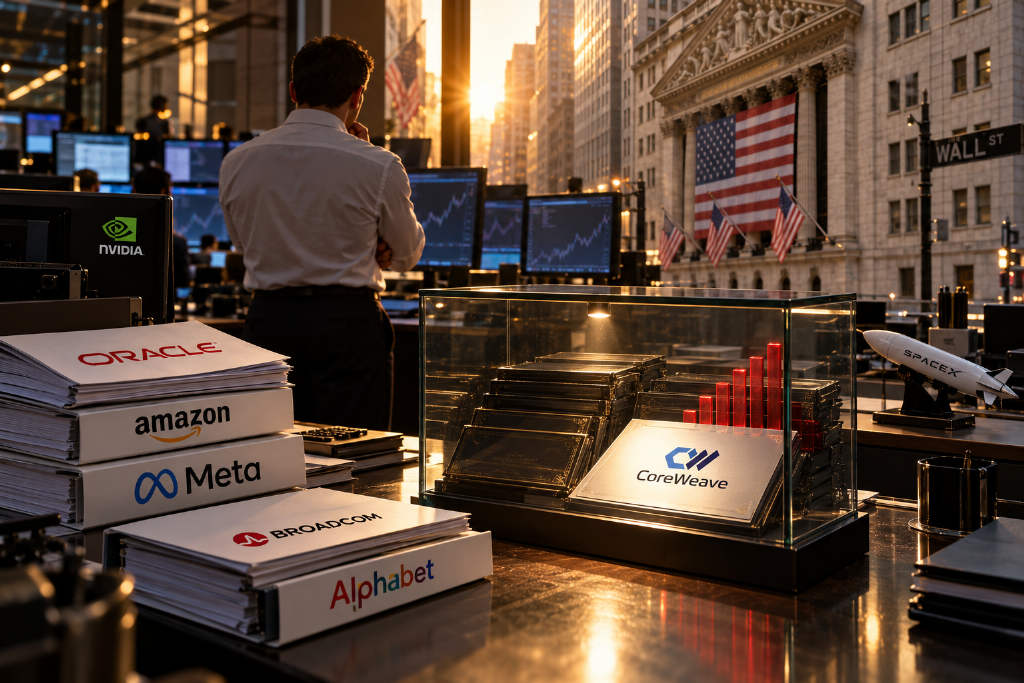
Credit default swaps tied to AI-linked companies have returned to the center of Wall Street trading as debt issuance tied to the sector accelerates. Morgan Stanley said average weekly CDS trading in September linked to Oracle, SpaceX, Alphabet, Amazon, Meta, Broadcom and Nvidia rose above $9 billion, up more than 4.5 times from less than $2 billion in July.

Goldman Sachs data from its fixed income, currencies and commodities division showed AI single-name CDS volumes climbed 400% year over year, while the number of liquid names expanded from four to 10 to 12. Some market participants have compared the pace of that expansion with the credit derivatives market in the run-up to the 2007-2008 financial crisis.
Debt issuance is driving demand for default protection
Behind the jump in CDS activity is a much larger wave of borrowing. Morgan Stanley estimated that AI-related companies have issued about $466 billion of bonds so far in 2026, compared with $101 billion in the same period of 2025, an increase of more than 3.6 times. As AI companies become one of the largest borrower groups in the bond market, demand for protection on those names has risen sharply.
In an early-October credit strategy report, Goldman credit strategist Avishek Biswas said weekly notional trading per AI-related CDS name had moved from $50 million to $100 million last year to several hundred million dollars a day now.
Societe Generale’s head of U.S. equity strategy, Manish Kabra, described CDS as a "key barometer" for hyperscaler financing conditions and broader AI trading sentiment. He listed it as one of the bank’s core trades in its fourth-quarter 2026 U.S. equity outlook and said investors should "watch CDS, not earnings per share."
Protection costs have climbed across major names
Pricing has also started to reflect the strain. Five-year Meta CDS rose to a record 108 basis points this month, while Nvidia reached 101 basis points. Protection costs for Alphabet and Amazon also hit record highs.
Oracle CDS widened from 144 basis points at the start of the year to 322 basis points. SpaceX moved from 110 basis points at the end of June to a record 226 basis points, roughly doubling over that span.
In her latest weekly note, Goldman cross-asset credit specialist Alisha Pasi said the bank had recently received a record number of inquiries from non-traditional accounts about CoreWeave debt and Oracle CDS. Demand was strong enough that Goldman set up a dedicated AI cross-capital-structure investor call that included teams across technology, media and telecom equities, convertibles, investment-grade cash and distressed/AI debt trading, which has become a standalone function.
Why investors are choosing CDS over equity puts
Kabra said hedging hyperscaler risk with equity put options is "extremely difficult" and "very expensive." That helps explain why more equity accounts are crossing into credit derivatives to seek protection.
Morgan Stanley made a similar point in its Oct. 1 report, "The State of AI Financing: Pause, Not Retreat," saying that buying AI-related CDS protection "remains our preferred way to express the AI theme in credit derivatives markets." The bank also said "non-economic hedging demand" is likely to keep rising as banks manage counterparty exposure.
Goldman IG trader Miles McCarthy previously said the buyer base is diverse. Some accounts are using leverage or unfunded credit views for directional trades. Others are arbitraging relative-value dislocations between CDS and bonds. Equity accounts are also using CDS to hedge public and private AI-related equity portfolios.
As Nvidia, AMD and Broadcom have started providing vendor financing and guarantees to buyers, the market has begun to treat them more like borrowers, and related CDS trading volumes have risen about tenfold.
Goldman credit sales strategy data showed the CDX IG index widened only 4.4 basis points last week to 62.5 basis points, while core AI names can move 30 basis points in a single day. That gap is one reason investors are shifting from index hedges to single-name CDS: the index no longer captures the actual exposures many investors hold.
CoreWeave has become the market’s main pressure point
Among AI-linked names, CoreWeave has drawn the most concentrated attention. The Financial Times reported that CoreWeave’s 5-year CDS is currently quoted around 1,090 basis points. Buying $10 million of protection requires an upfront payment of $1.82 million, followed by quarterly payments of $125,000, putting first-year cost at about 23% of notional.
Gavan Nolan, a credit analyst at S&P Global, said that "once a name trades above 1,000 basis points, pricing starts to shift toward expected recovery," meaning the market is pricing a default scenario rather than just a risk premium hedge.
Goldman had previously upgraded CoreWeave, but HSBC then set a $39 price target and warned that "the more you put in, the more value you destroy." On Oct. 14, CoreWeave CDS moved intraday from 1,000 basis points to 1,050 basis points and closed even higher at 1,117 basis points, implying a roughly 63% probability of default over five years.
At the same time, Elice, described in the source as South Korea’s largest IPO and a data-center operator, fell 32% within seconds of listing. The source said that drop added to doubts about returns on AI infrastructure investment.
Robert Dafforn of Polus Capital told the Financial Times that the circular nature of the AI financing chain means that "whichever link is weakest will be the first to drag on the whole system."
From hedge instrument to broader risk signal
The current CDS boom has raised the question of whether it points to deeper systemic risk. Structurally, demand appears self-reinforcing. Goldman expects hyperscalers to issue another $420 billion of direct debt in 2027, plus about $300 billion of project financing. Each new bond sale creates fresh hedging demand, and each new special purpose vehicle, lease guarantee or vendor-financing arrangement adds new counterparty exposure.
Pasi also said in her report that CDS tied to financial and insurance names were in demand this week because "the market is concerned about these institutions’ concentration risk in an AI trade reversal." That suggests the transmission channel has already extended from AI borrowers to the balance sheets of financial institutions holding their bonds.
Societe Generale data showed 5-year CDS on hyperscalers have risen more than twofold since the start of 2025, while forward price-to-earnings multiples have compressed at the same time, narrowing the divergence between the two.
The last time real-money accounts returned to the single-name CDS market at scale after more than 15 years of quiet was 2007. The source notes that, at the time, they also had reasons to do so.