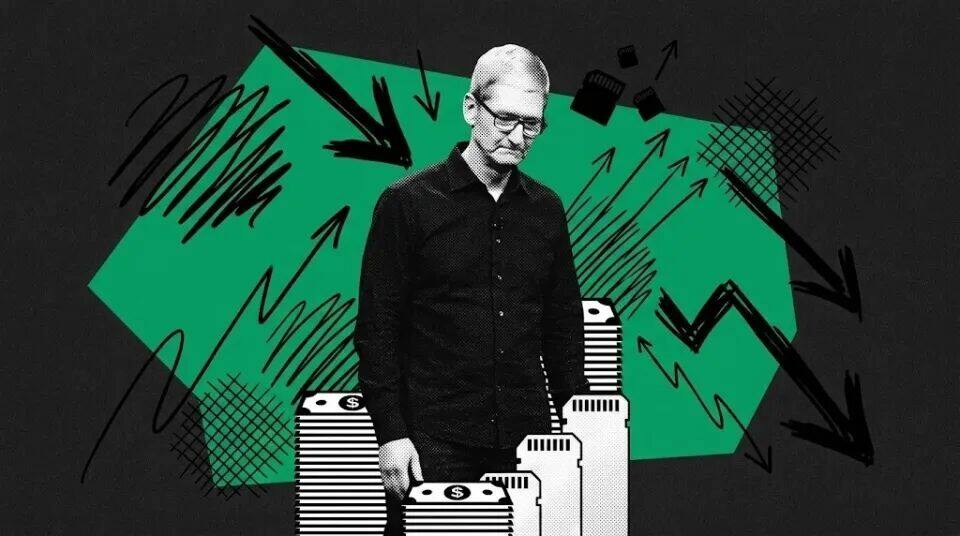
iPhone Profit Allocation: Apple Takes a Quarter, Memory Makers Get a Thirtieth
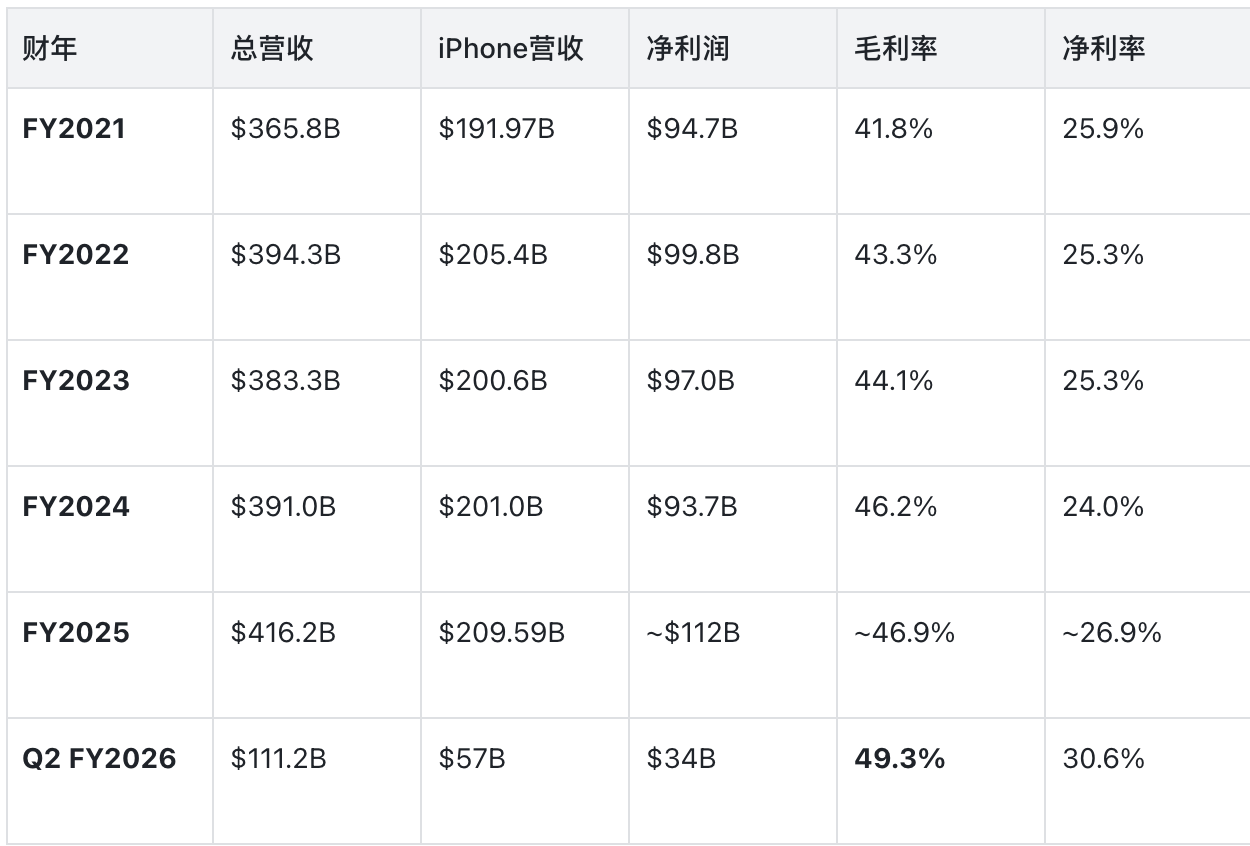
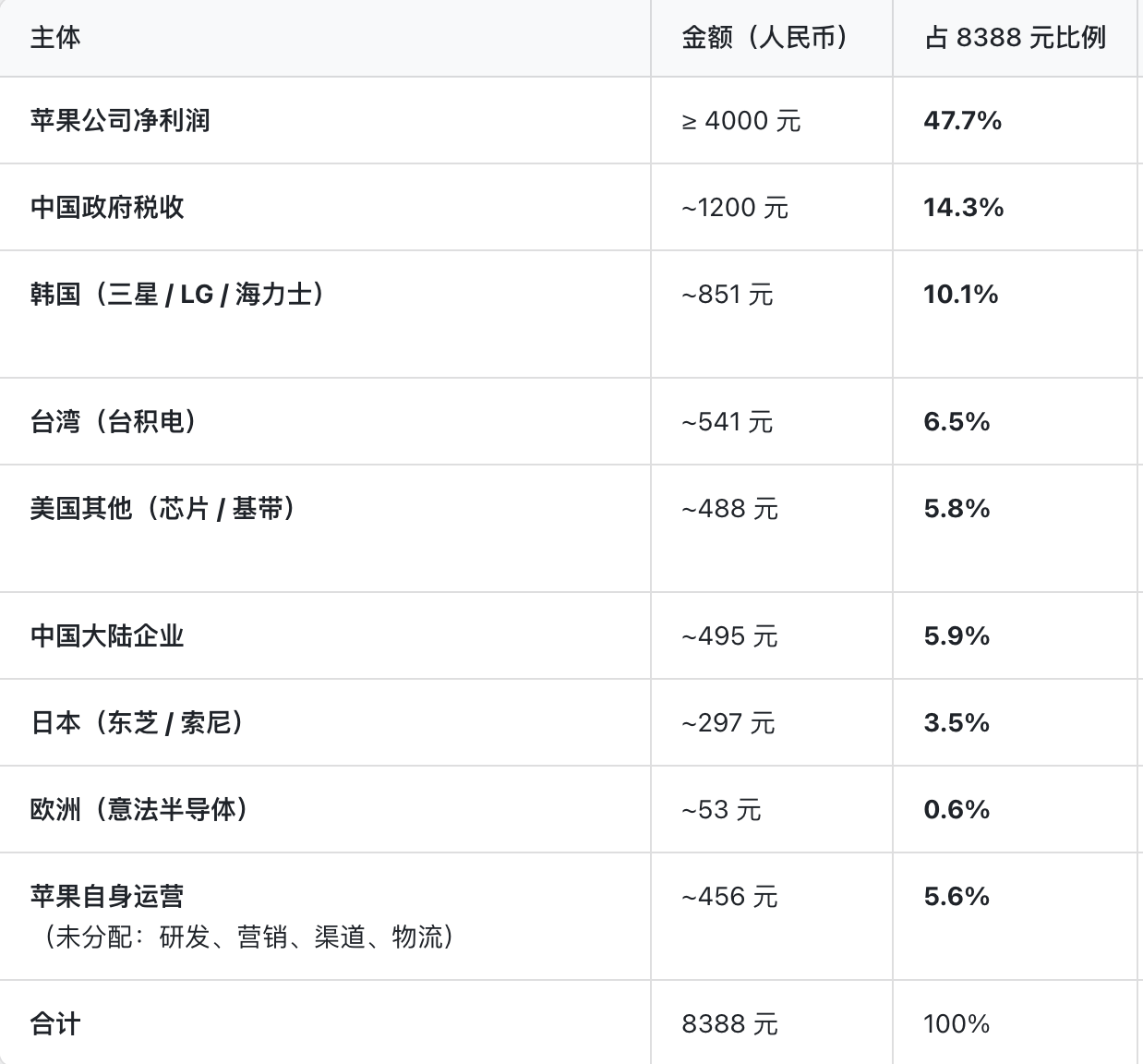
Foreign tech blogger @BluthCapital, writing in the persona of Micron's CEO, jokingly described Apple's long-standing practice: buying chips from Micron for $5 each, putting them in a metal box, and selling the final product for $99. When Micron tried to raise the price to $7, Apple mocked them. But now, as memory costs have surged to $50, Apple has hiked its product price by $250. This anecdote vividly illustrates the asymmetry in iPhone profit distribution. Estimates suggest that Apple takes about a quarter of the profit per iPhone (net profit margin of 33%-36%, or approximately $320-$340 net profit per device), while memory giants capture only about one-thirtieth. TSMC, due to its monopoly position, takes 4%-5%. According to Counterpoint, Apple has long captured nearly 50% of global handset operating profits, and IDC data for 2025 shows that with only 18% market share, Apple captures about 75% of total industry profits.
Evolution of Memory Costs: From 'Afterthought' to 'Critical Component'
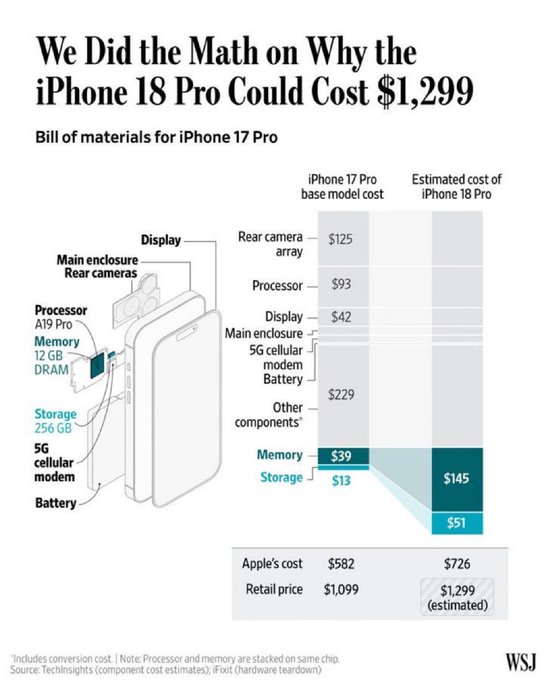
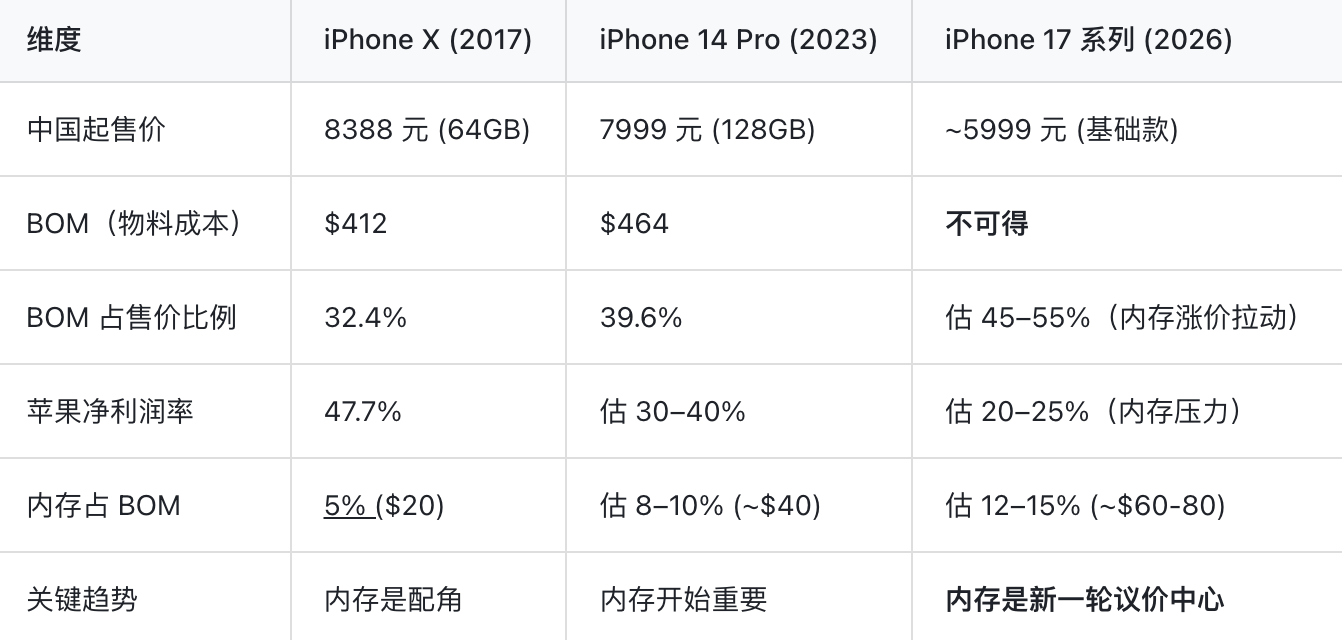
Memory cost in iPhones has gone through three historical phases. During the iPhone X era in 2017, memory cost was merely 135–195 RMB (1.6%–2.3% of the total retail price of 8,388 RMB), essentially an afterthought, while Apple's net profit margin approached 50%. By the iPhone 14 Pro launch in 2023, memory cost had increased slightly but Apple's net margin remained around 40%. Entering 2025-2026 with the iPhone 17 series, memory cost as a proportion of BOM has surged to 12%-15%, or $60-$80 per device. TrendForce data shows DRAM contract prices jumped 93%-98% quarter-on-quarter in Q1 2026, and Citi expects DRAM average selling prices to rise 88% for the full year. Memory has become a critical component influencing Apple's pricing strategy.
AI-Driven Memory Bull Run: The Root of Supply-Demand Imbalance
The fundamental driver of this memory bull run is the surging demand from the AI sector. Industry estimates indicate that each AI server requires 8 times the DRAM and 3 times the NAND compared to a conventional server. In response, the three memory giants—Samsung, SK Hynix, and Micron—have shifted advanced manufacturing capacity toward high-profit HBM and premium DDR5 products, while actively cutting back on consumer-grade DDR4 lines. This has led to a shortage of general-purpose DRAM. Micron's Q3 earnings report revealed a stunning gross margin of 84.6% and revenue of $41.46 billion, up 346% year-over-year. SK Hynix has announced plans to list in the US, aiming to raise ~$29 billion to further capitalize on memory demand. One Nvidia Vera Rubin AI server uses the equivalent memory of approximately 14,500 MacBook Neo devices, illustrating the extreme imbalance between demand and supply.
Apple's Response and the CXMT Opportunity
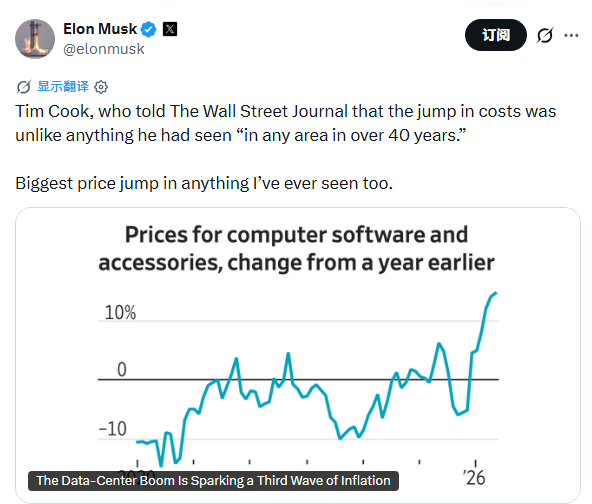
Facing memory price hikes, Apple CEO Tim Cook told the Wall Street Journal on June 17 that 'memory manufacturers are passing along huge pricing pressure.' Less than a week later, he revised his language, calling it a 'once-in-a-century flood' and subsequently announced price increases across the entire product line, including Mac, iPad, HomePod, Apple TV, and Vision Pro. The announcement triggered a 6% drop in Apple's stock price, erasing $263 billion in market value. Elon Musk echoed Cook's sentiment, calling it 'the sharpest price jump I've ever seen.' To break the monopoly of Samsung, SK Hynix, and Micron, Apple is actively lobbying the Trump administration for approval to purchase memory chips from Chinese manufacturer ChangXin Memory Technologies (CXMT). CXMT is expected to go public next month, and the market is watching whether it can replicate the wealth-creation miracles of SK Hynix and Micron.
Power Rebalancing: A Two-Way Street for Hardware and Memory Makers
This profit tug-of-war is essentially a 'the store bullies the customer, or the customer bullies the store' dilemma. For the past decade, Apple leveraged its brand and ecosystem to suppress memory maker margins. Now, AI demand has handed pricing power back to memory companies. The memory market pie continues to expand, and CXMT's entry could disrupt the oligopoly of Micron, Samsung, and SK Hynix. For professionals in crypto and tech, understanding this shift in supply chain power is crucial for anticipating future hardware cost trends and supply chain risks.