

BitMEX co-founder Arthur Hayes explained on the Kyle Chasse crypto podcast why he recently sold several of his largest crypto positions, including HYPE, NEAR, Worldcoin and Zcash. The episode was hosted by Kyle Chasse, CEO of Master Ventures, and was published under the original title “Arthur Hayes: Bitcoin's Final Dump Before The Pump.” Hayes said the decision was not driven by the individual crypto assets themselves, but by a broader macro chain involving oil prices, the Iran war, Donald Trump’s midterm election strategy, the AI trade and the way liquidity has been absorbed by AI-related investment.

Hayes referred to a roughly 5,000-word article he had just published called “Reality Check,” saying the podcast version compressed the same thesis into a shorter discussion. At the center of that thesis is what he described as a reflexive interaction between oil prices and the political narrative Trump needs going into the November 2026 midterm elections. Hayes argued that Trump needs Republicans to defeat Democrats and hold Congress, while the unresolved Iran conflict is creating a constraint that cannot be ignored. In his framing, Trump and Iran’s Islamic Revolutionary Guard Corps need some type of arrangement to end the conflict, because both sides are being pressured by the price of oil.
For Trump, high oil prices translate into domestic political pain, because voters dislike expensive gasoline and energy-driven inflation. For Iran, Hayes said the pressure comes from China and other developing countries that need oil and goods to keep moving through the Strait of Hormuz. The higher oil prices rise, the more willing all sides become to negotiate; when prices fall, the incentive to reach a deal weakens again. Hayes said this back-and-forth dynamic has continued for about three months, or for as long as the war has been active.
He then connected the political problem to physical inventory. According to Hayes, the war period has been drawing down commercial and national reserves of oil and other hydrocarbons. Before the war, inventories were ample, supporting the belief that oil and gas supply was in surplus and helping keep prices relatively low. But those surpluses are now being consumed at an increasing pace. Hayes said energy analysts may differ on the exact number of billions of barrels and the expected date, but the broad conclusion is the same: once inventories fall below a certain level, the only way for the market to rebalance is through a rapid increase in oil prices.
Hayes described the worst case as a scenario in which Trump and Iran’s Revolutionary Guard cannot reach an agreement and, by October, the Strait of Hormuz remains effectively blocked, with only 25% to 30% of normal volume passing through. He said a more likely path would be an agreement within one or two months that restores shipping to some degree. Even under that outcome, countries would still need to rebuild national reserves and would likely stockpile more than before after experiencing dependence on decisions made by Trump and Iranian generals. In his view, that would add demand for oil, natural gas, helium and other commodities needed to operate a modern economy, leaving prices for oil, gas and other commodities higher in three or four months than they are today.

The next step in Hayes’s argument is the election. He cited Polymarket odds showing Democrats with an 82% chance of retaking control of the House of Representatives. Hayes argued that Trump is losing the cost-of-living debate: voters see inflation as bad and worsening, Republicans control the White House, and the war is being associated with the current administration. He said Trump cannot easily change the inflation narrative because policy works with long lags and supply chains are still processing events that happened three or four months earlier. Gasoline prices are visible to voters, and Hayes said no political messaging can make people believe inflation is absent when they see it every other day at the pump.
That is why Hayes sees AI data centers as the issue Trump could reverse on. He said Democrats are finding an effective campaign message around banning new data centers, taxing AI giants and regulating AI. The fear is not limited to lower-income workers, because wealthier workers also fear job displacement by AI. Hayes argued that if an opposition party can use that fear, it has two strong messages: inflation caused by Republican-backed war, and an AI buildout effectively supported by Republican politicians.
In Hayes’s view, Trump’s only real opportunity to change the political map is to adopt the anti-AI message himself. He could say the government will review data centers more aggressively, tax AI companies and establish an AI national dividend. Hayes described that as a Trump-style rhetorical move: it may or may not lead to policy after November, but it could allow Republicans to present themselves as the party protecting Americans from AI. Hayes said the public could forget that Republicans helped finance and encourage the AI boom in the first place.
Hayes tied Trump’s willingness to attack AI directly back to oil prices. The longer the war lasts without a solution, the more commodity pressure accumulates, and the more likely Trump is, in Hayes’s reasoning, to target AI as an electoral tactic. Hayes said tax and regulation are especially damaging to the AI narrative. He pointed to South Korea, where a politician’s suggestion of a national AI tax coincided with Cosby hitting its daily limit down. If that kind of rhetoric is publicly promoted by the ruling party and especially by Trump, Hayes said the AI bubble would top during the months leading into the election and would drag crypto down with it. He said that was the reason he sold the entire portfolio in the second half of the previous week.

Asked where his liquid assets are now and whether energy could hold up if the AI bubble bursts, Hayes answered that civilization still needs oil regardless of preferences. He clarified that he is not saying AI will stop growing. Instead, he believes the market’s willingness to pay high forward multiples for that growth will decline. He described the logic as straightforward: the companies may still earn attractive profits, but if investors previously expected even better profits, share prices can fall when expectations are reset.
Hayes also discussed a chart showing the second derivative of capital expenditure growth. He said AI capital expenditure has already reached $800 billion in 2026 and that the second derivative of AI capex is expected to decelerate from 2027. In his view, investors cannot keep paying 100 times sales for SpaceX or any AI company when both earnings and capital expenditure are decelerating. Even if revenues continue to grow, the key question is how fast growth is changing and how the market perceives that rate of change. Hayes said the math of large numbers makes it physically impossible for capex growth in the near future to keep matching the pace seen from 2023 to 2026.
He linked this to a broader political backlash. Around the world, he said, opposition parties are tapping into anger about data center inflation and the replacement of jobs by AI. He named Elon Musk, Sam Altman and Mark Zuckerberg while describing a public question over why a small group of people should capture enormous profits from models trained on human knowledge, including public and private data used legally and illegally. Hayes framed it as a recurring conflict between capital and labor. When an agreement between those forces is eventually reached, he said investors still holding the affected assets are often crushed.
Hayes then turned to Bitcoin. He asked why Bitcoin has not risen much more since November 2022. He said he has often argued that everything is about liquidity and that if future liquidity increases, Bitcoin should rise. But he admitted that, in this cycle, that model has not worked cleanly. From the commercialization of ChatGPT on November 30, 2022, Bitcoin has risen, but Nvidia and other AI stocks have risen much more. Bitcoin topped last October at $125,000, while Hayes’s model showed that trillions of dollars in liquidity had been created. He asked why Bitcoin did not reach $500,000 or $1 million and why it underperformed AI.

His revised answer is that AI consumed the available debt and excess liquidity. Using M2 as a rough example, Hayes said U.S. M2 has increased by at least $1.5 trillion since ChatGPT. He then said he asked Perplexity AI how much debt had been issued to AI and AI-related companies, receiving an estimate of about $1.5 trillion, with $1.3 trillion concentrated in 2025 and 2026. In his framing, AI excitement began in late 2022, but the debt machine behind the AI buildout became especially heavy later in the cycle.
Hayes said Bitcoin could rebound from its lows because liquidity was indeed being created and AI was not yet consuming it heavily before 2025. From 2022 to mid-2025, the decline in reverse repo balances and other factors helped. But AI company capex and lending began scaling in 2025 and especially in 2026, the same period in which Bitcoin started struggling after its October high and then fell 50% to 60%. If liquidity continues to flow into AI and the AI bubble then corrects or bursts, Hayes argued, investors will not suddenly have extra cash to pour into Bitcoin. They will sell AI, Bitcoin and everything else. When a bubble breaks, he said, correlations across assets go to 1 until the dust settles and specific assets begin to outperform again.
That is why Hayes does not currently see a very favorable environment for Bitcoin or other cryptocurrencies. He said that after a correction Bitcoin should perform better, but the market must first go through the selloff. He also emphasized that he sold NEAR, HYPE, Worldcoin and Zcash in profit. His decision was to put those gains in his pocket and move to the sidelines because, within his model, the risks he could identify at the current moment made him uncomfortable.
The discussion then moved to planned IPOs. Chasse noted that the S&P 500 has been rising while many individual stocks have been falling, with the index carried by a small group of technology names. He also mentioned upcoming listings for OpenAI, Anthropic and SpaceX, saying they could bring more than $4 trillion in new market capitalization into equities. Hayes said these listings will be difficult to perform well because the market is not merely expecting normal trading; it expects an IPO to jump 50% or post an extreme gain as proof that investors still believe in AI and in the chosen star company.
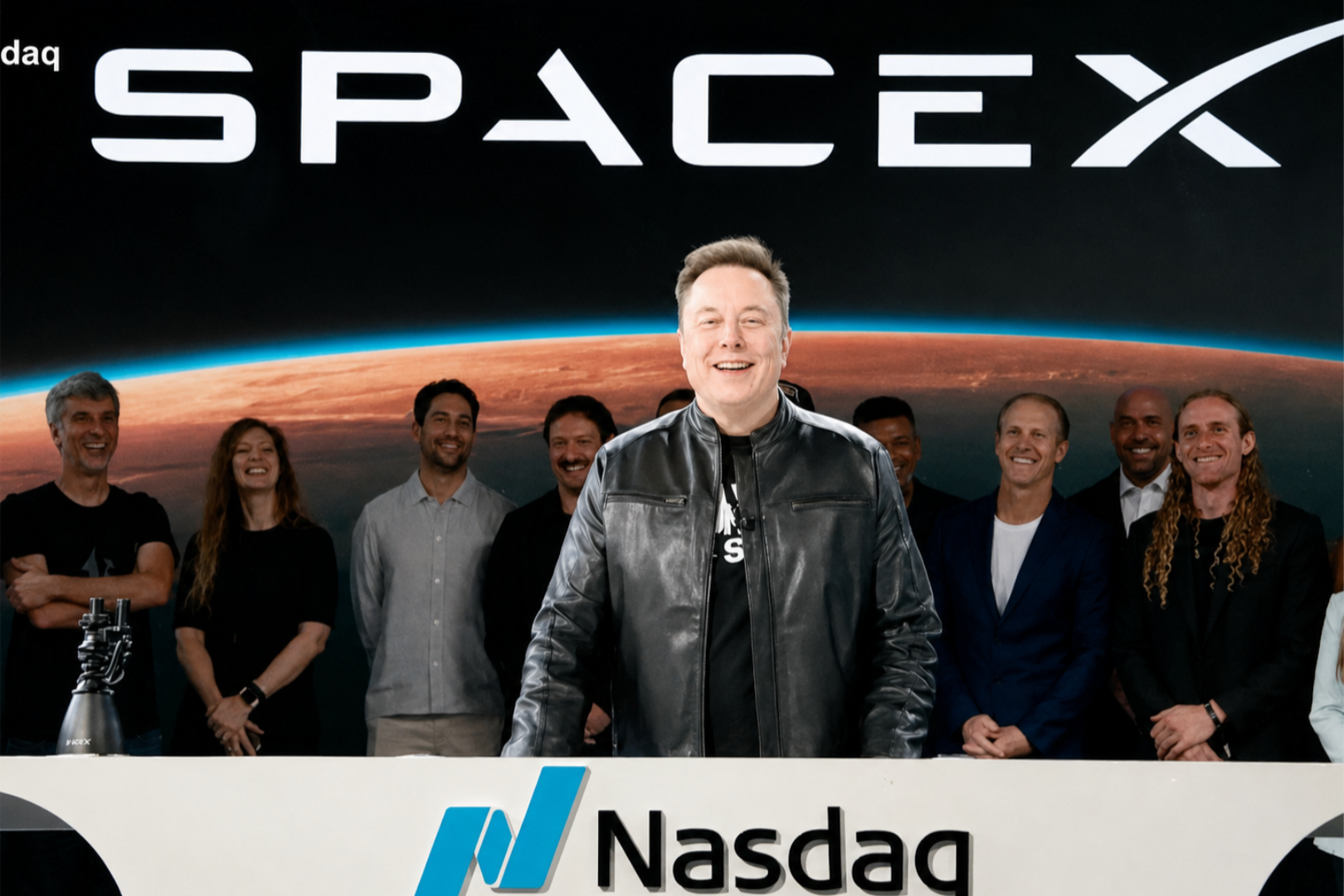
Hayes focused on SpaceX, saying it would come to market at around a $1.8 trillion valuation and immediately become the seventh-largest company in the world. For SpaceX to rise another 50%, he said, it would become larger than Amazon. He said that reading the S-1 shows SpaceX trading close to 100 times sales, a level he called absurd for a company that, in his view, has not yet proven the key claims behind the valuation.
He used language familiar to crypto traders to describe the structure: low float and high fully diluted valuation. Hayes said the float is 4% to 5% and will rise to nearly 25% by September, while insiders will be able to sell into the market from July to October. He acknowledged that satellite internet and similar businesses are attractive, but said those are not the reason investors are buying SpaceX in this AI and data center narrative. If SpaceX rises only 10%, Hayes said investors will treat that as insufficient because they were expecting 50%, 60% or 70%.
According to Hayes, pricing the IPO at $1.8 trillion creates a situation in which exceeding expectations is almost impossible. If SpaceX were a $100 billion company, it could double or triple and reinforce the AI thesis. But at the proposed scale, he said it would be extremely difficult to outperform companies such as Nvidia or Amazon, which have real revenues, operations and proven business cases. Hayes argued that a disappointing SpaceX listing would pressure Anthropic and OpenAI to lower their IPO pricing or reduce deal size, creating a damaging precedent that the AI bubble had been inflated too much and that expectations were being cut. That could cool investor enthusiasm, pull liquidity out of other assets and trigger a chain reaction in prices.
Chasse then asked about evidence for a Trump anti-AI pivot, noting that many AI leaders had helped Trump politically, had private dinners and discussions with him, and were major donors or supporters while Trump had publicly praised AI. Hayes said he used Perplexity AI to ask whether Republicans had a path to victory if Polymarket was showing a loss. He argued that Trump’s motive to hold the House is political self-preservation: if Democrats take the House, he and his family could face two years of congressional subpoenas, leaving him little room to create what he views as a second-term legacy.
Hayes said Trump has no fixed ideology and cares about winning. He cited the pandemic period in 2020, when Trump oversaw the largest fiscal transfer to the U.S. public since the New Deal through broad checks that went to rich and poor alike, with no strict income filtering and substantial fraud. Hayes said AI creates negative sentiment among both Republican and Democratic voters. He asked AI to examine competitive districts within the margin of error and search for local legislation related to data center bans or limits on data center construction. Hayes said the result showed that if Trump moved anti-AI, there were enough seats where local residents had already taken action against data centers to help Republicans keep the House.
Hayes stressed that the strategy could remain rhetorical. Trump could tell Jensen Huang and other AI leaders that he would attack them publicly for four months and then abandon the issue after November. Hayes compared that to Trump’s tariff behavior, saying hedge fund friends lost billions while Trump tried to rewrite U.S. trade infrastructure, before he pulled back at a critical moment. Hayes said if political strategists see enough votes in an anti-AI position, there is little reason Trump would avoid it, since the immediate victims would be wealthy stock-market investors and no law would necessarily pass.
The conversation also covered the Federal Reserve and Warsh. Hayes said he did not recall Warsh’s most recent remarks in detail, but described the narrative markets want to believe: the Fed can look through wartime commodity inflation and assume an AI productivity miracle will bring non-inflationary growth, allowing rate cuts. Hayes disagreed with the setup. He said oil prices are higher and will not come down soon, while the two-year Treasury yield is about 60 basis points above the effective federal funds rate. In his view, the market is telling the Fed it needs to raise rates.
Hayes also said Trump may privately soften his insistence on rate cuts if he wants to address affordability, because cutting rates with inflation at 3.5% to 4% would hurt him in the midterms. Hayes’s base case is that Warsh keeps policy unchanged, with the key distinction being whether the hold is hawkish or dovish. A hawkish hold that signals building inflation pressure and future action would lead markets to price in eventual rate hikes. Hayes said rising interest rates and higher funding costs are especially dangerous for bubbles because they push money away from the casino.

Asked whether any short-term crypto catalyst could provide relief between now and the midterms, Hayes said he does not see many signs of money printing, and even when money is printed it is flowing directly into AI construction. He said a MicroStrategy-related push could reignite some bullish sentiment, but he does not see a major positive catalyst that would pull crypto out of its malaise or make it outperform AI. If the economy returns to a perfect mix of high growth and low inflation, Hayes asked whether investors would buy Nvidia or Bitcoin, and answered that they would choose Nvidia or Samsung because AI-related assets have already delivered far stronger returns.
On re-entry, Hayes said he would consider returning to the market in the autumn if oil prices remain moderate and Trump does not turn against the AI tycoons. But he added a strict condition: the epic IPOs of SpaceX, Anthropic and OpenAI must open successfully and produce extraordinary gains that match the largest IPO issuance in human history. If reality does not match those expectations, he said the market has a problem.
To identify the next crypto bull market, Hayes said investors need to see more money printing and need that new money not to flow entirely into AI. He does not know when that will happen and does not believe it is happening now. If the AI bubble truly bursts and financial institutions fail, a bailout would follow at some point. That, in his view, is when crypto can outperform: AI would no longer have the same credit story, investors would need something else to trade, and he hopes that something else will be cryptocurrency. Hayes said he remains convinced the answer is always money printing, with the timeline being the unresolved question.
In the quick-fire section, Chasse asked whether Bitcoin would end the year above or below $100,000. Hayes’s broader comments remained cautious. He said the market had just gone through an altcoin season involving only four assets, with people making money in HYPE and a few other coins. He said another such phase could happen, but he did not know. Chasse also asked whether Hayes would buy back HYPE before year-end and how he would allocate $1 million among Bitcoin, HYPE, short-term Treasuries and gold if investing today; the provided source ends after those questions and does not include full answers.