
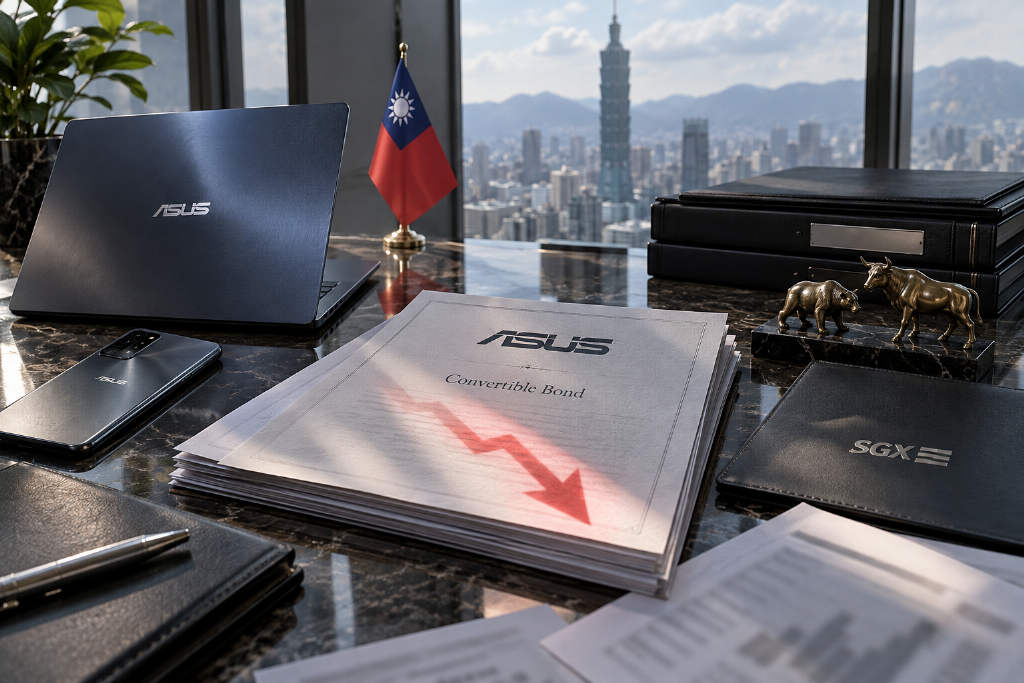
Asus announced late on Sept. 10 that it had completed pricing for its second overseas unsecured exchangeable convertible bond, with total proceeds of $1.5 billion, or about NT$48 billion. The conversion price was set at NT$1,384.6, representing a 40% conversion premium.
On Sept. 11, the stock came under pressure. With the broader market performing weakly and hedging-related selling emerging after the offering, Asus shares opened lower and at one point dropped by more than 8% to NT$912.
$1.5 billion ECB deal set at a 40% premium
According to Asus’ material information filing, the five-year offshore convertible bond offering totals $1.5 billion, with a face value of $200,000 per bond. The scheduled issue date is Sept. 17, year 115 on the ROC calendar, and the bonds will be listed on the Singapore Exchange.
The notes carry a 0% coupon. At maturity, Asus will redeem the bonds at par plus a yield based on a 1.7% annual rate, calculated semiannually. The conversion price was calculated at 140% of the Sept. 10 closing price of NT$989, resulting in a final conversion price of NT$1,384.6.
The structure also includes put and call features. Investors can exercise an early sell-back option at the end of the second and fourth years, with 1.7% annual interest compensation added. Asus, for its part, may exercise an early redemption right after the end of the third year if the stock price reaches 130% of the conversion price, including interest-compensation adjustments, on 20 out of 30 consecutive business days.
Asus said the proceeds will mainly be used to meet foreign-currency funding needs for materials procurement. If the entire ECB issue is converted into common shares, the dilution to existing shareholders would be about 4.40%.
Hedging flows weighed on the stock
Even with the conversion premium set at 40%, Asus shares fell sharply on Sept. 11 as the Taiwan stock market dropped 755 points. The stock opened with a gap lower and at one stage sank by more than 8% to NT$912.
The report said offshore convertible bond deals are often bought by overseas hedge funds and institutional investors. Those investors commonly use delta-neutral hedging strategies to capture volatility and spread arbitrage. While gaining exposure to the embedded call option, they may also borrow and short Asus common shares in the spot market to hedge the position and lock in returns.
With hedging-related selling appearing at the same time and the broader market remaining weak, Asus shares were under pressure in early trading on Sept. 11, and trading volume expanded sharply during the session.
Funds aimed at foreign-currency procurement and expansion
Asus has recently seen strong demand in AI servers and high-end commercial PCs. Upstream components, including high-end GPUs and advanced chips, are often priced and settled in U.S. dollars. By issuing U.S. dollar-denominated ECBs with a 0% coupon, the company is adding to its foreign-currency funding pool and supporting supply-chain procurement and global business expansion.