
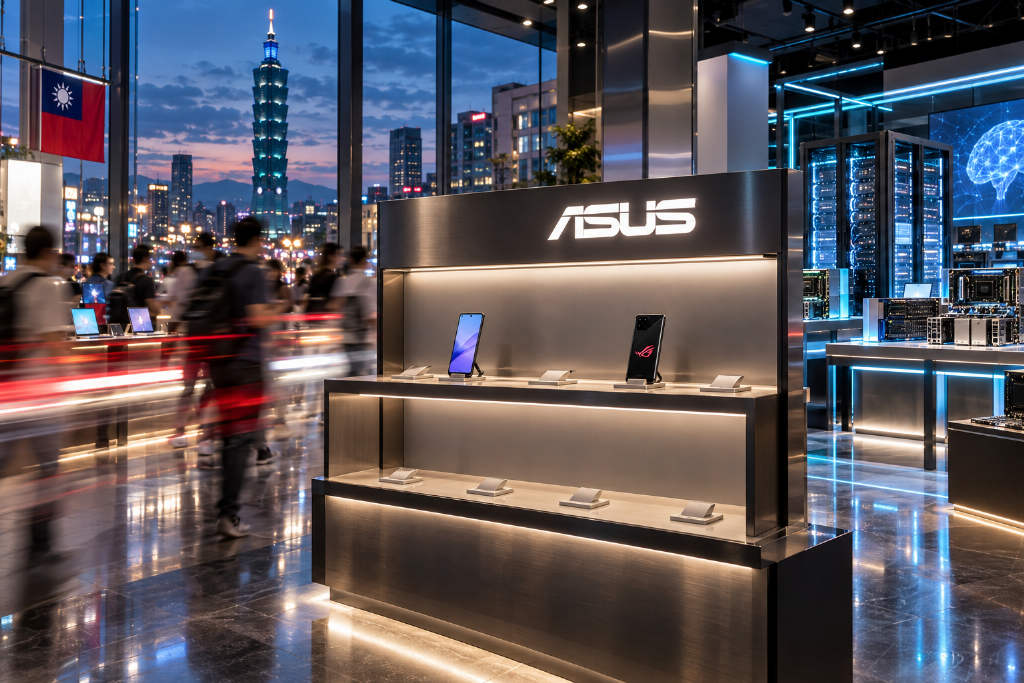
ASUS smartphones are now largely unavailable in the market. Channel partners said the final batch of inventory at major retail outlets has sold out, and chain retailers said they do not plan to bring in more stock. For buyers still looking for a device, only scattered remaining units and the second-hand market are left.
Final Zenfone inventory has sold out
The closing inventory included the Zenfone 11 Ultra and Zenfone 12 Ultra. By mid-October, both models were nearly sold out, with some variants down to single-digit stock. Inventory for the ROG Phone line had already run dry in the first half of the year. When distributors were asked again on Oct. 27, the answer was that everything had sold out.
Earlier this year, ASUS said it would gradually step away from the smartphone market. It also said there would be no successor models for either the ROG Phone or Zenfone lines. In practical terms, once the last batch was gone, the product line had reached its end.
More than 20 years in phones comes to a close
ASUS has been making phones for more than two decades, starting in 2003. Its sales never broke into the top tier, but several models still stand out among enthusiasts: the PadPhone, which turned into a larger-screen device when docked into a tablet shell; the Zenfone 6, whose camera module could flip forward for selfies; the Zenfone 10, which went against the large-screen trend by emphasizing one-handed use; and the ROG Phone series, built for mobile gaming with a strong focus on thermal design.
ASUS says support for existing users will continue
For people who already own an ASUS phone, Chairman Jonney Shih said on Jan. 16, before the company’s year-end celebration event, that ASUS would continue to take care of existing smartphone users, but would "not add new models." He said related resources would be "appropriately reallocated" into AI, which the company sees as carrying greater strategic value.
For shoppers hoping to pick up the last remaining inventory at a discount, prices had already fallen sharply. The Zenfone 11 Ultra was cut by another NT$2,000 in September, bringing the channel price to NT$16,990 and the cumulative decline to 43%. The Zenfone 12 Ultra, unveiled in February 2025 and described in the report as ASUS’ last flagship phone, was selling at NT$23,990 in mid-October.
Still, retailer Jiesheng Communications warned that buying an older flagship at a low price comes with three hidden risks: a shorter software update cycle, limited original parts inventory, and uncertainty around repairs and warranty service. Buyers were advised to confirm those details with sellers before making a decision.
HTC is also pushing smartphones to the sidelines
HTC Senior Vice President Huang Chao-ying said in September, during the launch event for the VIVE Eagle, that it has become difficult to find a new breakthrough in smartphones at this stage of the market. He said the smartphone business would "temporarily take a back seat," though HTC could reassess a return to phones if a new technological breakthrough appears.
The current picture is also clear. HTC’s last new phone was the HTC U24 pro, launched in June 2024, and the company has not released a new model for more than two years. The U24 pro is now nearing the end of its sales cycle, and chain retailers said only double-digit inventory remains, with stock likely to be gone before year-end. By contrast, the VIVE Eagle AI glasses, launched in 2025, have generated more revenue this year than HTC’s smartphone business.
Taiwan’s two best-known phone brands are shifting resources to AI hardware
On the ASUS side, Shih said the company is going all in on AI. That effort covers not only PCs but also a range of physical AI devices. Some of those products are commercially sensitive and will be disclosed at a later time, according to the report.
Taken together, the report said, Taiwan’s two most representative smartphone brands are both moving resources away from phones and into AI hardware.



