
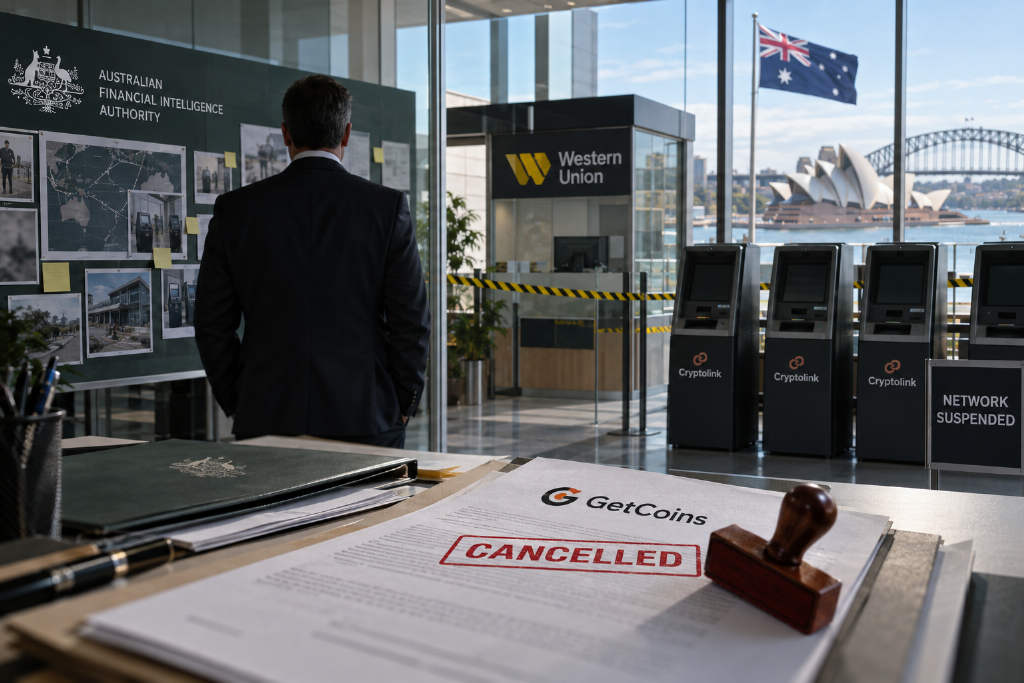
Australia’s financial intelligence agency, the Australian Transaction Reports and Analysis Centre (AUSTRAC), said on Monday that it has canceled, suspended, or refused to renew the registrations of 45 crypto and remittance businesses over the past year. The action covers both virtual asset service providers (VASPs) and traditional remittance firms.
According to AUSTRAC, the removals involved businesses that had stopped operating without deregistering, become insolvent or otherwise unable to continue, failed to report material changes, provided registration information that did not match their actual operations, or showed money laundering and terrorism financing risks.
AUSTRAC details the reasons behind the removals
The regulator said the businesses affected generally fell into several categories:
- They were no longer operating but had not voluntarily deregistered.
- They had entered bankruptcy or were no longer capable of providing services.
- They failed to notify the regulator of major changes involving ownership, business model, or management.
- Their registration information was inaccurate or inconsistent with actual operations.
- Their business model or compliance record suggested money laundering or terrorism financing risks.
AUSTRAC Chief Executive Brendan Thomas said businesses whose registrations were canceled no longer have the right to operate. He also said some individuals connected to the deregistered firms had been referred to domestic and overseas law enforcement or regulatory bodies for further investigation.
GetCoins cited in crypto investment scam case
AUSTRAC specifically named BA Digital Ventures, which operated as GetCoins, as a representative case. The company’s virtual asset registration was revoked in June 2026 following a large number of customer complaints.
The regulator said its investigation found that the GetCoins trading platform had been used by organized cryptocurrency investment scam groups as a channel to attract victims and collect funds. AUSTRAC said it worked with Australia’s National Anti-Scam Centre to revoke the registration, with the move helping disrupt the flow of funds tied to the scam activity.
AUSTRAC did not publish the full list of all 45 businesses, nor did it break down how many were crypto firms versus remittance providers. Still, its public VASP registration action page lists several recently penalized firms, including GetCoins (BA Digital Ventures), Cryptolink, Self Custody, Jam Xchange, and Coinsec Australia.
Western Union investigated, Cryptolink ATM network suspended
Beyond the registration cleanup, AUSTRAC said it is widening its enforcement activity. The agency has opened an investigation into Western Union and suspended Cryptolink’s crypto ATM network.
The source article described Western Union as one of the world’s largest cross-border remittance platforms, processing more than $100 billion annually. AUSTRAC’s move indicates that the regulator is not limiting its attention to crypto-native businesses and is also examining traditional financial players involved in cross-border fund flows under anti-money laundering (AML) and counter-terrorism financing (CFT) standards.
Cryptolink’s suspension also points to closer scrutiny of physical access points in the crypto market. Crypto ATMs let users buy cryptocurrency directly with cash, and the article said they have long been viewed as a weak point in money laundering and scam-related fund movement.
Tighter oversight across Australia’s payment sector
The annual enforcement push sends several clear messages. One is that registration and reporting obligations are not optional for firms operating in Australia. Another is that cooperation between AUSTRAC and the National Anti-Scam Centre shows how crypto scam enforcement is being handled across agencies. The Western Union case also shows that traditional remittance operators and crypto firms are being examined under the same compliance lens.
The source article also cited a recent comment from Kraken’s Australia chief executive, who said the country is at an “inflection point” for crypto demand. In that context, the article said clearer regulation may support long-term development for compliant businesses.
Reference point for Taiwan
The source article said Taiwan’s Financial Supervisory Commission has also been tightening registration and compliance requirements for virtual asset businesses. It suggested several possible lessons from AUSTRAC’s approach, including regular reviews of registration lists, cross-agency coordination with police and anti-scam bodies, and public disclosure of revoked registrations and the reasons behind them.
It also said crypto fraud is a major public issue in Taiwan, with annual losses reaching tens of millions of New Taiwan dollars. The article argued that proactively removing non-compliant operators and strengthening oversight of cross-border payments may be more effective than dealing with the damage later.