
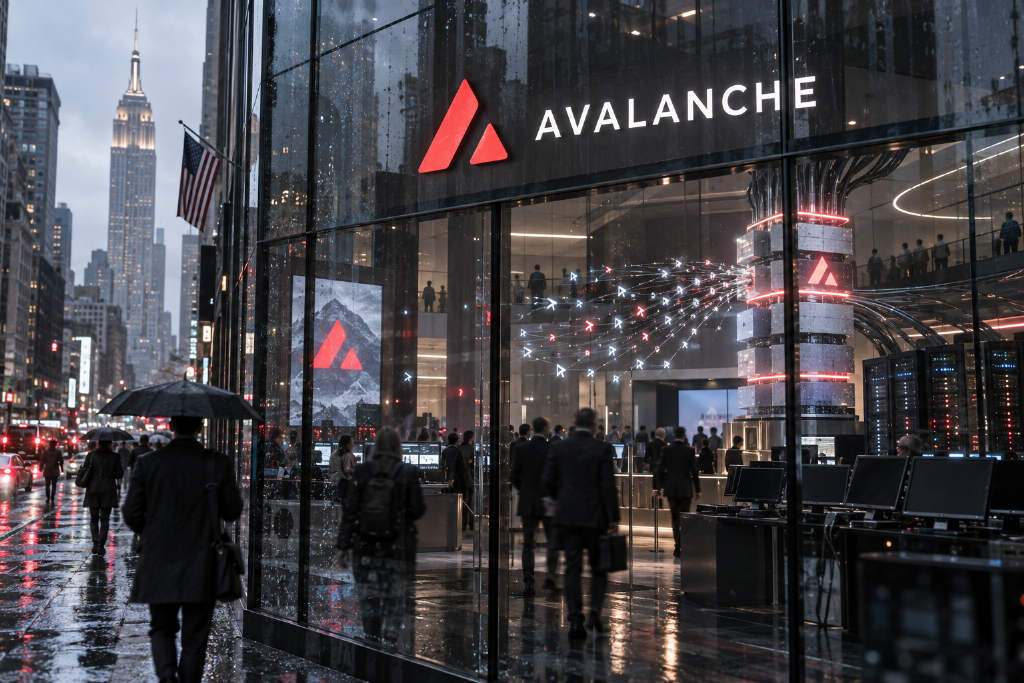
Avalanche Treasury CEO Bart Smith said large-scale adoption of AI agents in financial markets could put serious pressure on Layer 1 blockchain capacity, arguing that blockspace is no longer effectively unlimited. He made the remarks at Avalanche Summit in New York and in an interview with The Block.
Smith said that even if AI agent activity in finance only reaches what he described as a conservative expectation, the resulting automated trading flow would still land on blockchains, and existing capacity would struggle to keep up.
Scarcer blockspace could make L1 differences matter more
According to Smith, users today do not need to focus too much on the technical differences between Layer 1 networks because blockspace remains relatively abundant. He said that condition may not last.
"Solana, Avalanche, Ethereum, other L1s, in theory have a lot of subtle differences," Smith said. "Those differences will matter in the future."
In his view, once blockspace becomes scarce, differences in throughput, latency, fee models and sharding design will directly shape how institutions and AI agents choose chains. The current market condition, where nearly any chain can be used, could give way to a system centered on capacity allocation.
Smith expects traditional markets to move to 24/5 by mid-2027
Smith also said he sees a high probability that traditional financial markets will shift to 24-hour trading, five days a week, by mid-2027.
"If traditional markets haven't become 24/5 by mid-2027, I would be very surprised," he said. "The existing financial infrastructure cannot handle around-the-clock trading. You have to build entirely new infrastructure, and you won't build it the old way. It will be built on blockchain."
The report said crypto assets already trade 24/7, while traditional markets have remained tied to fixed trading hours because of manual operations and clearing and settlement cycles. Smith's argument is that once AI agents can run trading decisions, risk controls, clearing and reconciliation continuously, 24/5, and potentially 24/7, would no longer be unique to crypto markets.
Smith's background and Avalanche positioning
Smith previously served as CEO of Susquehanna Crypto and spent nearly 14 years at the trading firm. The report said he became CEO of the newly formed Avalanche Treasury Company in June 2026. It added that the company is listed on NASDAQ, marking a step toward institutional-grade capital management within the Avalanche ecosystem.
Smith said Avalanche is the best choice for commercial use cases with higher privacy and security requirements. The report linked that view to Avalanche's push into RWA, or real-world asset, tokenization, saying multiple subnets already support bank-grade privacy and compliance requirements.
AI agents could intensify competition for blockspace
Smith's comments point to a broader shift: if AI agents become mainstream participants in financial markets, blockspace could move from being treated as a public resource to being treated as a competitive commodity.
The report highlighted several areas to watch:
- Competition over capacity among Layer 1 networks could intensify, including Ethereum's rollup strategy, Solana's monolithic scaling approach and Avalanche's subnet architecture.
- Blockspace pricing could become more complex, with mechanisms such as priority fees, reserved capacity and institution-specific blocks.
- Chain selection by AI agents could emerge as a new battleground, with lower latency, steadier capacity and stronger automation support becoming key attractions.
The report said Smith is not the first person to argue that blockspace is finite, but described him as one of the first institutionally backed figures to frame large-scale AI agent trading as the central variable. If that view proves correct, 2027 and 2028 could become a major stress test for blockchain infrastructure.