
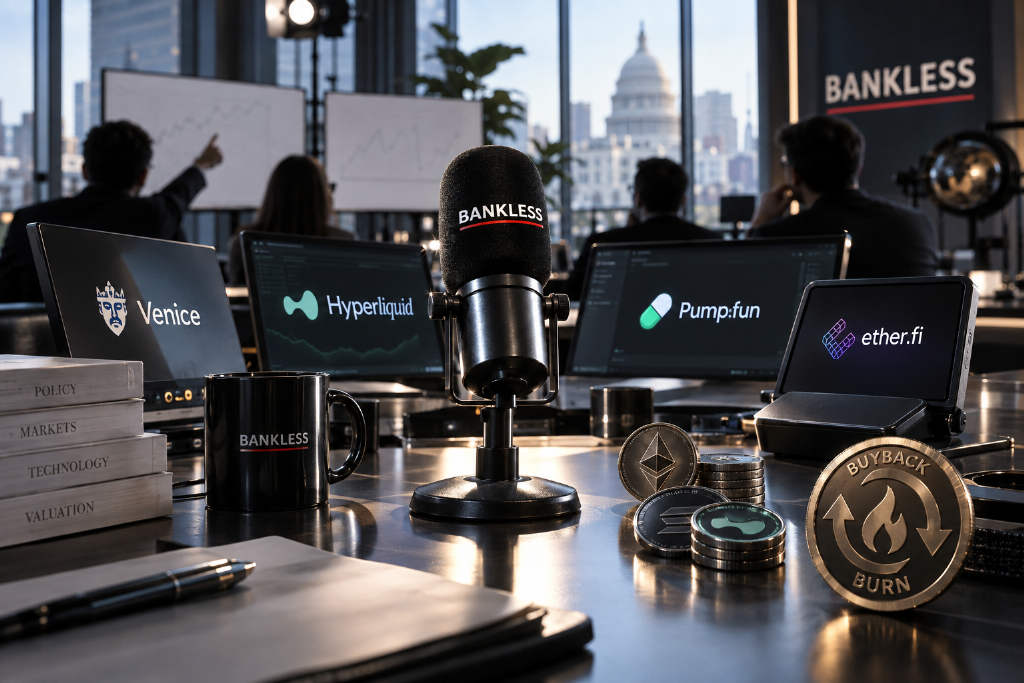
Bankless used its latest podcast to frame a sharper question for crypto investors: the next round of repricing may hinge less on infrastructure stories and more on whether a project can turn real usage into recurring revenue, then pass part of that value back to token holders in a credible way.
The episode featured Austin Barack, founder and managing partner of Relayer Capital, who discussed token valuation across Venice, Hyperliquid, Pump.fun, and ether.fi. His focus was not simply on who generates the most revenue or who buys back the most tokens. He broke token investing into a more basic set of questions: whether the product has real demand, whether revenue can keep growing, whether business value reaches the token in a durable way, and whether the market is still using an outdated category to price a business that has already changed.
From pure growth chasing to the overlap between growth and value
Barack said crypto investing methods do not stay fixed across cycles. A strategy that worked in 2017 may not work in 2021, and sectors that drew capital in 2021 or 2024 may lose their appeal in the next cycle. One idea he thinks travels better across cycles is to look for the overlap between growth and value: projects growing fast enough that market pricing still does not fully reflect that growth.
He was careful to distinguish that from traditional value investing. In his telling, people do not come to crypto to find a mature company growing 10% a year at a 4x earnings multiple. What makes the asset class attractive is that violent capital cycles can create a mix that is much rarer in traditional markets: a business may grow severalfold while its valuation stays compressed because the broader market remains weak.
Relayer Capital, which Barack said was founded about two and a half years ago, invests across both early-stage deals and liquid markets. At launch, attention was split roughly evenly between the two. Today, he said, around 95% of the firm’s focus has shifted to liquid tokens, with Crypto x AI and 24/7 trading plus asset tokenization as the two main themes.
The reason, he said, is not only that crypto could be entering another upcycle. A long bear market has already done some of the filtering. Once most tokens lost their narrative premium, a smaller set of projects with real product-market fit, fast-growing revenue, and still-reasonable valuations began to stand out.
Tokens are getting a new valuation language, but it is not equity
For much of crypto’s history, project valuation leaned on long-dated assumptions around total addressable market, network effects, and token utility. Even when a protocol generated revenue, that revenue often had no clear link to token performance.
Barack said some applications are now creating a more legible bridge through programmatic buybacks or burns, converting business revenue into token demand or supply reduction. That gives investors a way to borrow part of the equity toolkit and look at buybacks relative to token market cap as an approximation of an earnings yield.
He also stressed the limits of that analogy. Equity usually represents a legal claim on residual profits and assets. Tokens often do not. A team can change the buyback ratio, and new business lines can sit under an equity entity rather than the token. In practice, buyback multiples are only useful when value-accrual rules are reasonably transparent and the underlying revenue is durable.
Venice: a growth story in AI, with burns layered on top
Venice was one of Barack’s main case studies. He described it as a privacy-focused, censorship-resistant AI application that lets users access different frontier and open-source models from one platform. Its current revenue comes mainly from paid subscriptions and purchases of extra compute credits.
Venice has built two burn channels for VVV. The first is tied to first-time subscription purchases, where the platform burns a corresponding amount of VVV based on the tier selected. The second applies to extra credits, with about 5% of the purchase amount used to burn the token.
By Barack’s estimate, Venice had an annualized revenue run rate of about $107 million as of August 2026, implying roughly $8.3 million in annualized token burns. He said revenue could rise to $336 million by 2027, while burns could reach $70 million. Using a 50x buyback multiple, that model points to a token valuation of roughly $3.5 billion. Combined with his projected circulating supply, it yields a VVV target price of about $43.9, versus roughly $16 at the time of the show.
Still, the episode repeatedly framed this as a scenario model rather than a firm forecast.
Of the projected $70 million in burns, around $29 million would come from Minds, a product that has not formally launched yet and would account for more than 40% of the total. As discussed in the show, Minds is supposed to let advanced users and developers combine models, prompts, and tools into structured AI applications for end users, then earn revenue share based on usage. Barack compared the form factor to an AI app store.
He argued that Minds is not entirely separate from Venice’s current business because it still sits on top of existing models, users, and use cases. Host David Hoffman pushed back, saying credit purchases are an extension of the current service, while Minds represents a new line of business that the market has not validated yet. The two risks are not the same.
Barack accepted that criticism and described his model as slightly above a base case. If 0 were extreme bearishness, 5 a base case, and 10 a fully bullish outcome, he said this forecast would sit around 6.
The model also assumes that Venice could eventually include renewals in the burn framework and raise the burn rate on credit revenue from 5% to 10% in 2027. The show said neither measure has been firmly committed to. That is why the $43.9 figure is better understood as a scenario valuation built on multiple business and mechanism assumptions, not a guaranteed price target.
Why would a fast-growing startup buy back tokens so early?
The Venice discussion also exposed a broader tension for application tokens. A high-growth startup normally wants to put cash into product expansion, hiring, and customer acquisition. In traditional markets, companies at that stage rarely commit to large buybacks early on. Venice has chosen to use part of its revenue to buy back and burn VVV from the early phase of business development, which means less cash available for reinvestment.
Barack said the answer lies in crypto’s dual structure of equity and tokens. A token can help a project gather attention quickly, bootstrap a network, and create new product features. But without a hard legal framework, the market does not automatically trust that all value created by the company will eventually flow to the token.
Under that setup, programmatic burns are not just a distribution method. They are also a way to build trust. The team has to show through action that business growth reaches VVV rather than staying trapped at the equity layer.
He described Venice’s current approach as incremental: early burns had some discretion, then first-time subscription burns were added, and later 5% of credit revenue was folded into the mechanism. In his view, that gives the token a path to value accrual while preserving most of the company’s capital for growth.
The episode also noted that Venice previously raised $65 million, which may ease the tension between buybacks and reinvestment. Barack’s interpretation was that external financing gave the company expansion capital and made it easier to send more operating cash flow toward the token. He also said investors in that financing hold token warrants, which may reduce misalignment between equity holders and token holders.
Even so, that balance remains fragile. If growth slows, inference costs rise, or competition intensifies, the company may need to keep more cash. If the burn rate stays too low for too long, the token may not share enough of the upside. On that basis, evaluating VVV means watching not only burn totals but also revenue growth, gross margin, operating expenses, and whether the company keeps honoring its value-accrual commitments.
Pump.fun and Hyperliquid: same revenue discussion, very different multiples
Compared with Venice, Pump.fun and Hyperliquid are more directly tied to crypto trading cycles. Barack said that, using market data around the time of the episode, Pump.fun was valued at roughly 5x buybacks, while Hyperliquid and Lighter traded closer to 30x to 40x. To him, that spread reflects a market bias toward different types of revenue.
Pump.fun’s core business comes from meme-coin launches and trading. Many investors doubt that such activity can produce durable revenue, especially compared with a perpetual futures venue. The concern is not baseless. The show noted that crypto has seen products whose revenue spiked in one cycle and then fell by more than 90% afterward.
Barack’s counterpoint was that Pump.fun has shown more resilience over the past two-plus years than the market initially expected. Any individual meme coin may flare up and fade quickly, but user demand for high-volatility, high-variance speculative products may persist over a much longer period.
He compared Pump.fun with casinos, lotteries, prediction markets, and ultra-short-dated options. The point was not to say meme-coin trading is identical to those products. It was to explain the demand mechanism. Even when participants face a negative expected return overall, some users keep showing up because the appeal of high volatility and small-probability, high-payoff outcomes does not disappear.
From that view, he said Pump.fun’s buyback multiple could rerate from around 5x to 10x. If business volume stayed flat, multiple expansion alone could imply roughly 100% upside. If onchain activity and meme-coin trading recovered together, revenue could rise as well.
Yet Pump.fun also carries the same equity-token risk. The project previously directed all revenue to buybacks, then shifted to a framework in which 50% of revenue over the next 12 months goes to buybacks and the rest is used for business development. What happens after those 12 months is still subject to another decision.
That means the authenticity of Pump.fun’s revenue can be observed onchain, but the share of that revenue that will keep flowing to the token is not permanently guaranteed. In valuing PUMP, investors have to discount for that institutional uncertainty rather than treating all platform profit as if it belonged to token holders.
Hyperliquid, by contrast, commands a richer multiple. One reason is that its crypto perpetuals business already generates meaningful revenue. Another is that the HIP-3 market is expanding into contracts tied to stocks, commodities, indices, and private-company-related exposures.
Barack said Hyperliquid shows the potential of 24/7 blockchain-based trading, instant settlement, and global price discovery. In his telling, some assets that have not yet been listed could eventually form price signals onchain first, with traditional financial institutions later using those signals as references for issuance pricing.
That thesis still needs to be proven. According to the discussion, Hyperliquid’s recently added real-world asset market has contributed substantial trading volume, but because it remains in expansion mode, it has not yet produced a matching rise in revenue. The high-profit business today still comes mainly from crypto trading.
That gives Hyperliquid stronger cyclical reflexivity than a typical application token. When crypto capital flows back in, HYPE may benefit not only from a higher token multiple but also from rising platform volume, fees, and buyback size. If market activity drops, the same mechanism can work in reverse.
ether.fi may have changed more than the market recognizes
For Barack, ether.fi represents a different kind of mispricing. The business mix has shifted, but the market still prices the token under an older label.
ether.fi entered the market as a liquid restaking project. The show said its fully diluted valuation reached about $8 billion at one point during the height of the restaking trade in 2024. As expectations around that segment faded, ether.fi’s valuation fell too, and it continued to be viewed as an asset broadly comparable to staking protocols such as Lido.
Barack argued that this framing no longer reflects the company’s revenue mix. Based on the numbers he cited in the episode, more than 65% of the business now comes from Neo Bank products, including card transaction revenue and lending income generated when users borrow against account assets. Yield and staking now account for roughly 35%.
As the platform adds tokenized stocks and more onchain assets, ether.fi is moving from a digital neo-bank model toward an onchain full-service brokerage. Users can hold and trade different assets, borrow against them, and spend through a credit card.
He said the model benefits from not having to build every piece of financial infrastructure from scratch. For lending, ether.fi can tap existing DeFi protocols such as Aave and earn through revenue sharing. The broader the stablecoin, lending, and tokenized-asset stack on Ethereum becomes, the more services ether.fi can offer to users.
Barack cited data showing that ether.fi’s card transaction volume has grown from about $300,000 a day a year ago to $3 million to $4 million a day, a more than 10x increase. He added that only about 4% of current revenue comes from lending interest, versus roughly 60% to 70% at the traditional digital bank Nubank. To him, that suggests there is still room for the revenue mix to expand.
Using a potential next-12-month buyback figure of around $30 million and a 30x multiple, Barack said ETHFI could be worth more than $1, or about double where it traded when the episode aired. The show also made clear that this is an optimistic scenario. The $30 million figure is higher than the $21 million implied by another model he referenced, and the outcome depends on his assumption that ether.fi’s future growth could accelerate.
The more important point in this case is not the exact target price. It is whether the market’s category is lagging the business. If most of ether.fi’s revenue now comes from payments, lending, and brokerage, then a liquid-restaking valuation framework may no longer describe the business correctly. If the newer lines fail to sustain growth, the reclassification thesis may not hold.
Fundamentals can lower correlation, not erase the crypto cycle
Barack closed by saying that real revenue does not allow application tokens to fully escape Bitcoin and the broader crypto cycle. He described the relationship as partly coupled and partly decoupled.
On one side, Venice, Pump.fun, Hyperliquid, and ether.fi can build a more independent valuation base through user growth, revenue, and buybacks. Even if Bitcoin trades sideways, tokens can still rerate if the underlying business keeps expanding.
On the other side, they are still crypto assets. If capital rotates out of equities, AI, or other markets and back into tokens, projects with visible fundamentals may be among the first allocations for professional investors. Pump.fun and Hyperliquid could also see added revenue from stronger trading activity, creating a positive loop between token price and business performance.
Venice is less directly linked to crypto trading conditions. Its main outside variable is AI usage. The show argued that if multi-model access, privacy-focused AI, and generative applications keep growing, Venice could draw demand from a different source than a pure crypto app. But if user growth or paid conversion misses expectations, a broad crypto rally alone would not automatically deliver the valuation implied by the model.
Barack placed the whole discussion in a longer industry cycle. Based on data he cited, execution-layer infrastructure accounted for more than 95% of industry revenue during much of crypto’s history. Now, application revenue has risen to about two-thirds of the total. He expects that share to keep shifting toward applications and eventually move above 90%.
The show did not present that as a settled fact. Instead, it framed the next set of questions that need proof: whether revenue really continues to migrate from chains and execution layers to user-facing apps, whether application cash flow can be transmitted to tokens in a stable way, and whether buyback mechanisms remain intact through growth, downturns, and regulatory change.
If those conditions do hold, the main objects of crypto valuation may continue to move away from infrastructure that sells block space and toward applications that use blockchains to sell financial and digital services. In that case, the search shifts as well. The market would be looking less for the next high-performance chain and more for which products truly connect crypto to outside demand, and which tokens can keep sharing in that growth.