
Bernstein said in the third installment of its memory LTA research series that the market is misreading the downside protection embedded in the latest round of long-term agreements. According to the report, structural AI demand, a new back-end-weighted deposit framework, and supply discipline are combining to lengthen the memory cycle and reduce volatility.
TechFlowPost’s write-up of the note said Bernstein’s analysts are not aligned on every part of the memory trade, but they broadly agree on one point: the current batch of contracts is materially different from the LTAs that failed in prior cycles.
A redesigned deposit structure is central to the thesis
The bearish case, as summarized in the report, is that investors are overstating how much support LTAs can really provide. Publicly disclosed deposits total about $33 billion, a small figure against the trillions of dollars in revenue that would need protection. On that view, preserving peak earnings power would require customers to post hundreds of billions of dollars in deposits, which is not realistic.
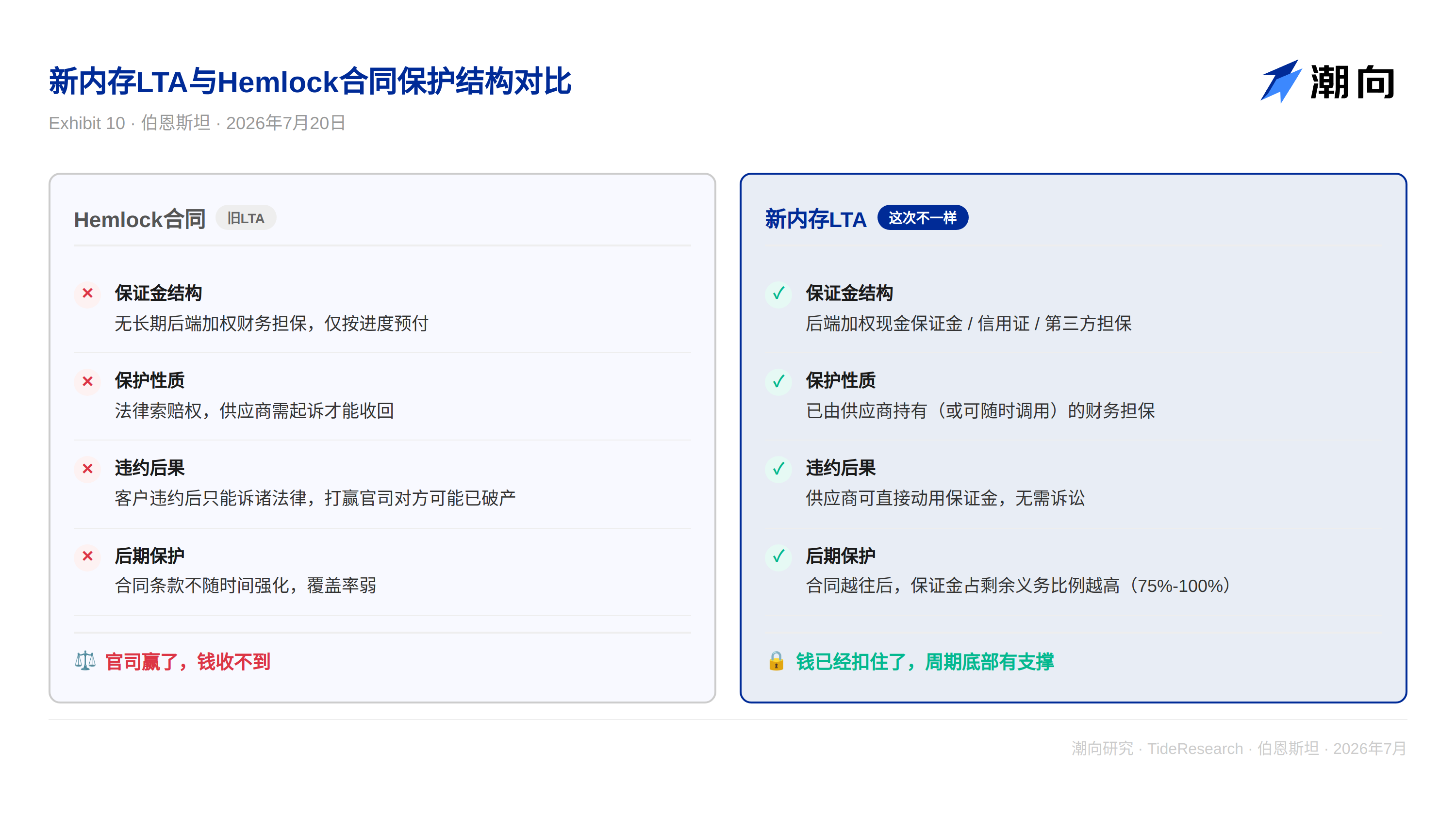
Bernstein’s response is that the problem with earlier LTA failures, including Hemlock and Microchip, was not the idea of long-term contracting itself. The problem was weak financial enforceability. When customers defaulted, suppliers were often left pursuing legal claims, and by the time those claims moved forward, the counterparty could already be bankrupt.
The new memory LTAs, Bernstein argues, work differently. Customers post cash deposits up front, but those deposits are largely not offset in the early phase of the contract. Refunds come later. As the agreement progresses, the deposit covers a larger share of the remaining purchase obligation and can eventually reach 100%, pushing up the cost of default over time.
That timing matters. If market prices do not fall sharply until two years later, customers trying to exit at that point face a much higher barrier. Bernstein’s conclusion is that the real value of the new LTAs sits in the back half of the contract, which is also the phase when the industry typically needs the most support.
This cycle’s customers look stronger than past counterparts
The report draws a sharp distinction between today’s buyers and the customer base in earlier failed agreements. Hemlock’s customers were largely solar module makers, companies with thin margins, subsidy exposure, and weak financial resilience. SolarWorld AG eventually went bankrupt, and even a legal win did not translate into meaningful recovery for Hemlock.
Microchip’s PSP customers were more fragmented, including industrial companies, OEMs, and distributors. When demand weakened, those buyers had little incentive to keep taking product under contract.
This time, Bernstein says, the core LTA signers are hyperscale cloud operators and AI infrastructure providers. These companies have stronger balance sheets and more diversified businesses, and AI infrastructure spending is treated as strategic. In that setting, the cost of losing memory supply and delaying AI compute deployment can be higher than the cost of honoring the contract, even when market prices move below the agreed price.
NAND remains the biggest point of disagreement
Bernstein’s Asia research team is more cautious on NAND. The argument starts with demand mix: AI spending has so far benefited DRAM and HBM more directly, while NAND’s exposure is less obvious. The team also sees greater competitive risk from Chinese suppliers in NAND than in DRAM because NAND capacity expansion does not require EUV tools, lowering the technical barrier. Micron, the report noted, has also said the NAND shortage could end earlier than the DRAM shortage.
Bernstein’s U.S. team sees the picture differently. Its view is that AI is moving beyond early training and basic inference toward more complex inference, longer context windows, and agentic workloads. As those systems retain and call prior context, they need to store more KV cache. That data was historically housed mainly in HBM and DRAM, but the report says it is now starting to spill over into NAND flash.
As an example, the report points to NVIDIA’s Vera Rubin platform, where NAND capacity per GPU has increased from 4TB to 20TB to 21TB, a roughly fivefold jump. Bernstein’s U.S. analysts treat that as evidence that a new demand layer for NAND is taking shape.
The report also says NAND tends to lag DRAM by about one cycle. At the same point last year, DRAM gross margin had already reached 60%, while NAND was still losing money. NAND prices did not begin rising until last August and are still in recovery mode now.
On the supply side, Bernstein says capital spending remains focused on DRAM, with NAND expansion plans pushed beyond 2028. If that holds, NAND supply could stay tighter, and stay tight for longer, than the market expects.
Bernstein’s preferred names: SanDisk, Samsung, SK hynix, and Micron
Bernstein lists SanDisk, Samsung Electronics, SK hynix, and Micron as Outperform-rated names. KIOXIA is the only stock in the coverage set rated Underperform.
SanDisk stands out as the most aggressive user of LTAs. The company has signed five LTA agreements, enough to cover about one-third of its FY27 capacity needs. The report notes that SanDisk’s CEO did not come out of the traditional memory industry and has experience in hard drives, Cisco, and software, which Bernstein views as a sign of strategic flexibility. For valuation, the firm uses 11x FY28 earnings per share or 14x through-cycle average EPS and says the market has not fully priced in the structural NAND opportunity.
Samsung Electronics and SK hynix are Bernstein’s core DRAM holdings. The firm values both at 6.2x forward earnings per share. Its support for the pair rests on supply discipline and what it describes as a natural insulation from shifts in the competitive landscape.
Micron also fits the DRAM thesis. Bernstein applies a 7.7x forward earnings multiple, modestly above the Korean names. The report says Micron has also been active in LTAs, with 16 contracts signed, though its earnings leverage is seen as lower than that of Samsung Electronics and SK hynix.
KIOXIA is Bernstein’s sole Underperform call. The reasons given are the least aggressive LTA positioning, the highest valuation, and the weakest NAND competitive setup. In the Q&A section cited by TechFlowPost, Mark Newman said the key difference between SanDisk and KIOXIA is that they sit at opposite ends of the industry in LTA adoption.
TechFlowPost’s reading of the note highlights three fault lines
The article says Bernstein’s U.S. and Asia analysts are looking at the same market through different time horizons. Mark Newman focuses on the demand increase implied by the fivefold rise in NAND capacity per GPU on Vera Rubin. Mark Li is more focused on a medium-term supply risk, namely the ability of Chinese NAND producers to expand without EUV. Both sides, the article says, have factual support; the split comes from where each team places the time emphasis.
It also points to a limitation in the back-end-weighted deposit design. If the downturn arrives on the usual schedule, roughly two years out, the deposit coverage is higher and the protection is stronger. If the cycle turns earlier, that protection weakens. In that sense, the benefit of LTAs is delayed rather than front-loaded.
HBM pricing is another area the article flags. Traditional DRAM has already gone through four rounds of price increases, and the piece says margins on conventional DRAM are now higher than on HBM, prompting suppliers to push HBM pricing upward. Under Bernstein’s assumptions, HBM prices in 2027 would be 2x to 2.5x 2026 levels, while traditional DRAM could rise 5x. If that framework proves right, HBM may become relatively cheaper than expected, and supplier earnings sensitivity could be larger than the market is pricing in.
Bernstein’s broad industry call can be reduced to three linked forces: structural AI demand, new LTAs with back-end protection, and supply discipline. Together, the firm says, they could extend the memory cycle and narrow the amplitude of swings.
The TechFlowPost article adds that the eventual outcome of the NAND debate will have a direct bearing on whether SanDisk’s $3,000 price target is justified.
Report attribution and disclaimer
TechFlowPost said the article is a整理 and interpretation of a third-party sell-side report published by Bernstein on July 20, 2026. The ratings, price targets, earnings forecasts, and related judgments cited in the piece are the views of Bernstein’s analysts and represent only their institution’s position, not TechFlowPost’s, and do not constitute investment advice.
The article also carries a market-risk warning, saying it should not be used as a basis for buying or selling any security and that investors should make decisions based on their own independent judgment.